. 2013 Feb 6;2013(1):3.
doi: 10.1186/1687-9856-2013-3.

Monogenic hyperinsulinemic hypoglycemia: current insights into the pathogenesis and management

Affiliations

Monogenic hyperinsulinemic hypoglycemia: current insights into the pathogenesis and management

Katherine Lord et al. Int J Pediatr Endocrinol. .

Abstract

Hyperinsulinism (HI) is the leading cause of persistent hypoglycemia in children, which if unrecognized may lead to development delays and permanent neurologic damage. Prompt recognition and appropriate treatment of HI are essential to avoid these sequelae. Major advances have been made over the past two decades in understanding the molecular basis of hyperinsulinism and mutations in nine genes are currently known to cause HI. Inactivating KATP channel mutations cause the most common and severe type of HI, which occurs in both a focal and a diffuse form. Activating mutations of glutamate dehydrogenase (GDH) lead to hyperinsulinism/hyperammonemia syndrome, while activating mutations of glucokinase (GK), the "glucose sensor" of the beta cell, causes hyperinsulinism with a variable clinical phenotype. More recently identified genetic causes include mutations in the genes encoding short-chain 3-hydroxyacyl-CoA (SCHAD), uncoupling protein 2 (UCP2), hepatocyte nuclear factor 4-alpha (HNF-4α), hepatocyte nuclear factor 1-alpha (HNF-1α), and monocarboyxlate transporter 1 (MCT-1), which results in a very rare form of HI triggered by exercise. For a timely diagnosis, a critical sample and a glucagon stimulation test should be done when plasma glucose is < 50 mg/dL. A failure to respond to a trial of diazoxide, a KATP channel agonist, suggests a KATP defect, which frequently requires pancreatectomy. Surgery is palliative for children with diffuse KATPHI, but children with focal KATPHI are cured with a limited pancreatectomy. Therefore, distinguishing between diffuse and focal disease and localizing the focal lesion in the pancreas are crucial aspects of HI management. Since 2003, 18 F-DOPA PET scans have been used to differentiate diffuse and focal disease and localize focal lesions with higher sensitivity and specificity than more invasive interventional radiology techniques. Hyperinsulinism remains a challenging disorder, but recent advances in the understanding of its genetic basis and breakthroughs in management should lead to improved outcomes for these children.


Figures
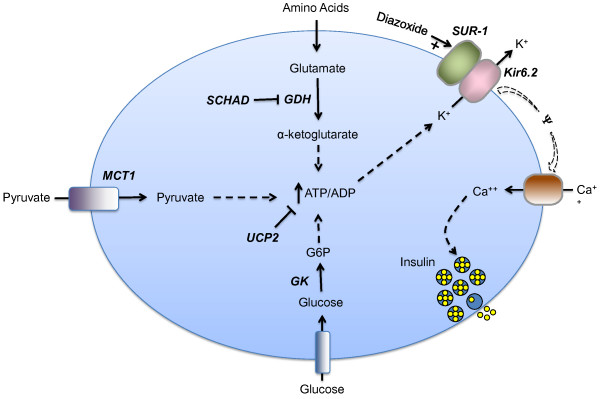
Figure 1
Figure 1
Genetic defects in the beta cell leading to hyperinsulinism. In the pancreatic beta cell, ATP production from fuel metabolism leads to inhibition and closure of ATP-sensitive potassium channels, which triggers membrane depolarization and opening of voltage-dependent calcium channels. The resulting increase in cytosolic calcium triggers insulin secretion. Defects in this pathway can result in hyperinsulinism. The known protein defects are depicted in bold italics. Five are inactivating mutations: SUR-1 (sulfonylurea receptor), Kir6.2 (potassium channel), SCHAD (short-chain 3-OH acyl-CoA dehydrogenase), UCP2 (uncoupling protein 2), HNF-4α (hepatic nuclear transcription factor 4α), and HNF-1α (hepatic nuclear transcription factor 1α). The last 2 are transcription factors and are not depicted in the figure. Three are activating mutations: GK (glucokinase), GDH (glutamate dehydrogenase), MCT-1 (monocarboxylate transporter 1). Positive effects are shown by a plus arrow; negative effects by a minus arrow. Dashed arrows denote multiple steps in a pathway. G6P = glucose-6-phosphate, ATP = adenosine triphosphate, ADP = adenosine diphosphate.
Figure 2
Figure 2
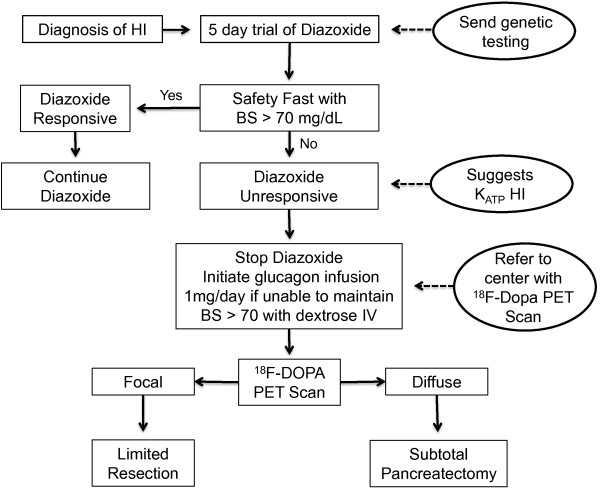
Algorithm for the treatment of hyperinsulinism. Assessing the response to diazoxide is a critical step in the management of HI. Patients who fail to respond to diazoxide will most likely have KATP channel defect and require referral to a specialized center with 18 F DOPA PET scan capability. A safety fast should be 8 to 18 h long depending on the age of the patient. Note that octreotide is not recommended as pre-operative treatment in neonates with HI due to high rate of treatment failure and risk of necrotizing enterocolitis. KATP = ATP-sensitive potassium channel, 18 F DOPA PET = 18-fluoro L-3,4-dihydroxyphenylalanine positron emission tomography.
Figure 3
Figure 3
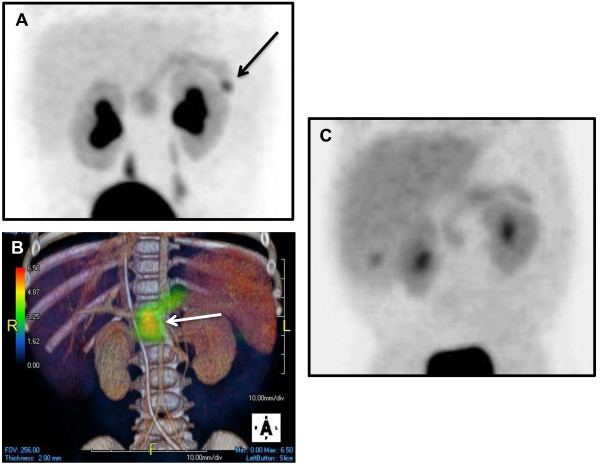
A. Frontal view of a 3D maximum intensity projection (MIP) 18-fluoro L-3,4-dihydroxyphenylalanine positron emission tomography (18 F-DOPA PET) image demonstrating a focal lesion in the tail of the pancreas (arrow). B. A frontal view 3D MIP 18 F-DOPA PET image fused with a contrast-enhanced CT shows a focal lesion in the pancreatic head (white arrow). C. Frontal view of a 3D MIP showing non-uniform pattern of uptake with increased activity throughout the pancreas consistent with diffuse disease. Note the normal liver, kidney and bladder uptake.

References

    1. Mazor-Aronovitch K, Gillis D, Lobel D, Hirsch HJ, Pinhas-Hamiel O, Modan-Moses D, Glaser B, Landau H. Long-term neurodevelopmental outcome in conservatively treated congenital hyperinsulinism. Eur J Endocrinol. 2007;157(4):491–497. doi: 10.1530/EJE-07-0445. - DOI - PubMed
    1. Stanley CA, De Leon DD. Monogenic Hyperinsulinemic Hypoglycemia Disorders. 1. Basel: Karger; 2012.
    1. Monogenic Disorders of Insulin Secretion. Congenital Hyperinsulinism and Neonatal Diabetes March 15–16, 2012 Faculty Synopses. Pediatr Diabetes. 2012;13(4):344–368.
    1. Thomas P, Ye Y, Lightner E. Mutation of the pancreatic islet inward rectifier Kir6.2 also leads to familial persistent hyperinsulinemic hypoglycemia of infancy. Hum Mol Genet. 1996;5(11):1809–1812. doi: 10.1093/hmg/5.11.1809. - DOI - PubMed
    1. Thomas PM, Cote GJ, Wohllk N, Haddad B, Mathew PM, Rabl W, Aguilar-Bryan L, Gagel RF, Bryan J. Mutations in the sulfonylurea receptor gene in familial persistent hyperinsulinemic hypoglycemia of infancy. Science. 1995;268(5209):426–429. doi: 10.1126/science.7716548. - DOI - PubMed