


A theory of biological relativity: no privileged level of causation
- PMID: 23386960
- PMCID: PMC3262309
- DOI: 10.1098/rsfs.2011.0067
A theory of biological relativity: no privileged level of causation
Abstract
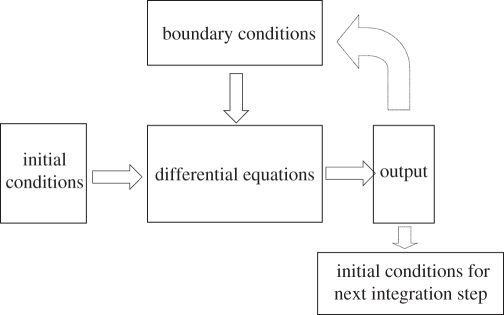
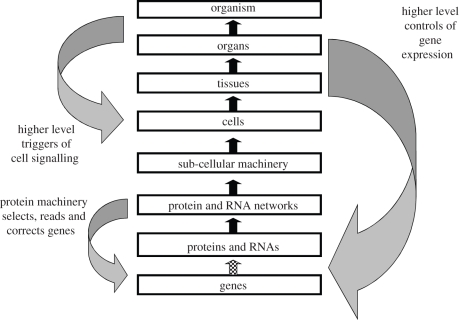
Must higher level biological processes always be derivable from lower level data and mechanisms, as assumed by the idea that an organism is completely defined by its genome? Or are higher level properties necessarily also causes of lower level behaviour, involving actions and interactions both ways? This article uses modelling of the heart, and its experimental basis, to show that downward causation is necessary and that this form of causation can be represented as the influences of initial and boundary conditions on the solutions of the differential equations used to represent the lower level processes. These insights are then generalized. A priori, there is no privileged level of causation. The relations between this form of 'biological relativity' and forms of relativity in physics are discussed. Biological relativity can be seen as an extension of the relativity principle by avoiding the assumption that there is a privileged scale at which biological functions are determined.
Keywords: biological relativity; cardiac cell model; downward causation; scale relativity.
Figures
References
-
- Noble D. 2006. The music of life. Oxford, UK: Oxford University Press
-
- Huxley A. F. 1957. Muscle structure and theories of contraction. Prog. Biophys. Mol. Biol. 7, 255–318 - PubMed
-
- Huxley H. 2004. Fifty years of muscle and the sliding filament hypothesis. Eur. J. Biochem. 271, 1403–1415 10.1111/j.1432-1033.2004.04044.x (doi:10.1111/j.1432-1033.2004.04044.x) - DOI - PubMed
-
- International Human Genome Mapping Consortium 2001. A physical map of the human genome. Nature 409, 934–941 10.1038/35057157 (doi:10.1038/35057157) - DOI - PubMed
-
- Venter C., et al. 2001. The sequence of the human genome. Science 291, 1304–1351 10.1126/science.1058040 (doi:10.1126/science.1058040) - DOI - PubMed
LinkOut - more resources
Full Text Sources
Other Literature Sources