


V-TIME: a treadmill training program augmented by virtual reality to decrease fall risk in older adults: study design of a randomized controlled trial
- PMID: 23388087
- PMCID: PMC3602099
- DOI: 10.1186/1471-2377-13-15
V-TIME: a treadmill training program augmented by virtual reality to decrease fall risk in older adults: study design of a randomized controlled trial
Abstract
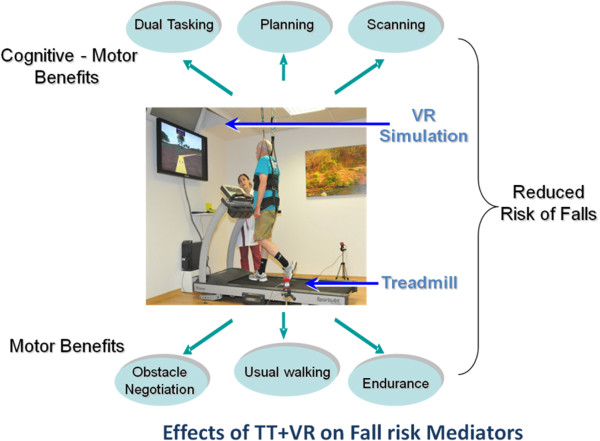
Background: Recent work has demonstrated that fall risk can be attributed to cognitive as well as motor deficits. Indeed, everyday walking in complex environments utilizes executive function, dual tasking, planning and scanning, all while walking forward. Pilot studies suggest that a multi-modal intervention that combines treadmill training to target motor function and a virtual reality obstacle course to address the cognitive components of fall risk may be used to successfully address the motor-cognitive interactions that are fundamental for fall risk reduction. The proposed randomized controlled trial will evaluate the effects of treadmill training augmented with virtual reality on fall risk.
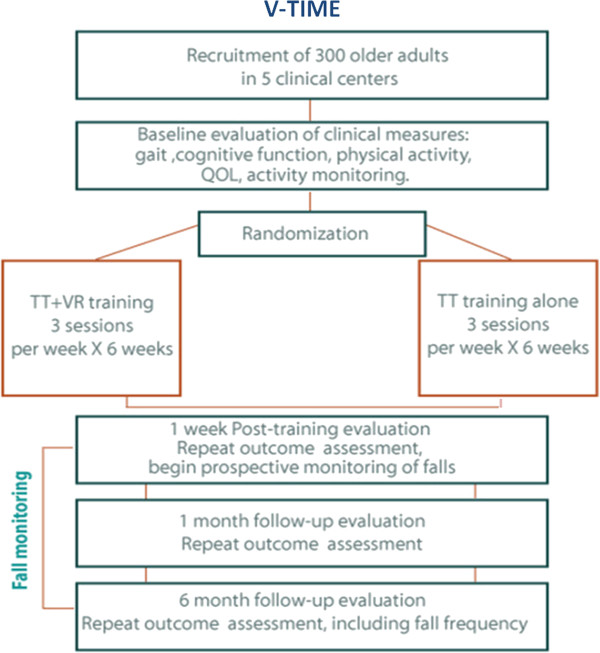
Methods/design: Three hundred older adults with a history of falls will be recruited to participate in this study. This will include older adults (n=100), patients with mild cognitive impairment (n=100), and patients with Parkinson's disease (n=100). These three sub-groups will be recruited in order to evaluate the effects of the intervention in people with a range of motor and cognitive deficits. Subjects will be randomly assigned to the intervention group (treadmill training with virtual reality) or to the active-control group (treadmill training without virtual reality). Each person will participate in a training program set in an outpatient setting 3 times per week for 6 weeks. Assessments will take place before, after, and 1 month and 6 months after the completion of the training. A falls calendar will be kept by each participant for 6 months after completing the training to assess fall incidence (i.e., the number of falls, multiple falls and falls rate). In addition, we will measure gait under usual and dual task conditions, balance, community mobility, health related quality of life, user satisfaction and cognitive function.
Discussion: This randomized controlled trial will demonstrate the extent to which an intervention that combines treadmill training augmented by virtual reality reduces fall risk, improves mobility and enhances cognitive function in a diverse group of older adults. In addition, the comparison to an active control group that undergoes treadmill training without virtual reality will provide evidence as to the added value of addressing motor cognitive interactions as an integrated unit.
Trial registration: (NIH)-NCT01732653.
Figures
Comment in
-
Addition of a virtual reality component to treadmill training to reduce fall risk in older adults, including individuals with Parkinson's disease.Mov Disord. 2016 Nov;31(11):1632. doi: 10.1002/mds.26843. Epub 2016 Oct 19. Mov Disord. 2016. PMID: 27759893 No abstract available.
References
Publication types
MeSH terms
Associated data
LinkOut - more resources
Full Text Sources
Other Literature Sources
Medical
