


Review
. 2013 Mar;207 Suppl 1(Suppl 1):S19-25.
doi: 10.1093/infdis/jis928.
Breaking down the barriers to hepatitis C virus (HCV) treatment among individuals with HCV/HIV coinfection: action required at the system, provider, and patient levels
Affiliations
- PMID: 23390301
- PMCID: PMC3565594
- DOI: 10.1093/infdis/jis928
Item in Clipboard
Review
Breaking down the barriers to hepatitis C virus (HCV) treatment among individuals with HCV/HIV coinfection: action required at the system, provider, and patient levels
J Infect Dis.
2013 Mar.
Abstract
The majority of hepatitis C virus (HCV) and human immunodeficiency virus (HIV) coinfection occurs among persons who inject drugs. Rapid improvements in responses to HCV therapy have been observed, but liver-related morbidity rates remain high, given notoriously low uptake of HCV treatment. Advances in HCV therapy will have a limited impact on the burden of HCV-related disease at the population-level unless barriers to HCV education, screening, evaluation, and treatment are addressed and treatment uptake increases. This review will outline barriers to HCV care in HCV/HIV coinfection, with a particular emphasis on persons who inject drugs, proposing strategies to enhance HCV treatment uptake and outcomes.
Figures
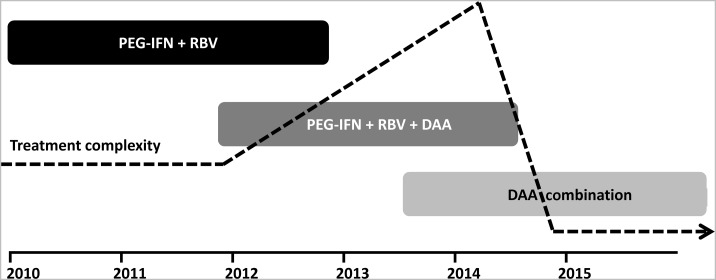
Phases of therapeutic development for the treatment of hepatitis C virus infection and the associated complexity of clinical management. Adapted from Dore [35] with permission. Abbreviations: DAA, direct-acting antiviral; PEG-IFN, pegylated interferon; RBV, ribavirin.
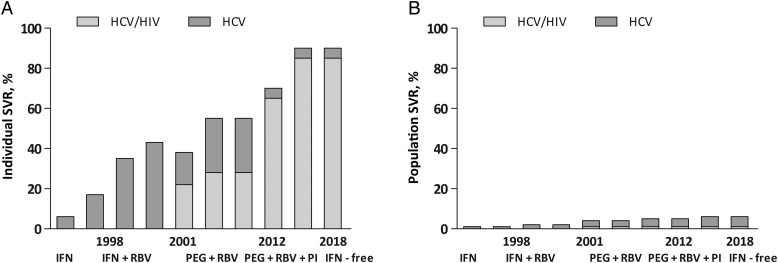
Disparity between potential hepatitis C virus (HCV) treatment efficacy and projected HCV treatment effectiveness. A, High HCV treatment efficacy if projected over 5-10 years; the sustained virological response (SVR) will increase from 55% with pegylated-interferon (PEG-IFN) and ribavirin (RBV) to approximately 70% in the era of PEG-IFN (65% in HCV/human immunodeficiency virus [HIV] coinfection), RBV, and a protease inhibitor (genotype 1 only, with HCV genotype 2/3 patients still having an SVR of approximately 80% with PEG-IFN/RBV). It is anticipated that by 2018, IFN-free agents will be available, with SVR equal to 90% in HCV infection (85% in HCV/HIV coinfection). B, The global impact of new treatment is negligible without expanded access; in 2005, estimates in Europe and the United States suggested that approximately 3% of patients had received treatment, with treatment uptake increasing by only 0.5% per year (adapted from Thomas et al [2], with permission). Abbreviations: HCV, hepatitis C virus; HIV, human immunodeficiency virus; IFN, interferon; PEG, pegylated IFN; RBV, ribavirin; SVR, sustained virological response.
References
-
- Kim A. An epidemiologic update on hepatitis C infection in persons living with or at risk of HIV infection. J Infect Dis. 2012 doi:10.1093/infdis/jis927. - DOI - PMC - PubMed
-
- Grebely J, Tyndall MW. Management of HCV and HIV infections among people who inject drugs. Curr Opin HIV AIDS. 2011;6:501–7. - PubMed
-
- Hellard M, Sacks-Davis R, Gold J. Hepatitis C treatment for injection drug users: a review of the available evidence. Clin Infect Dis. 2009;49:561–73. - PubMed
Publication types
MeSH terms
Substances
Grants and funding
LinkOut - more resources
Full Text Sources
Other Literature Sources
Medical
