Review
. 2013 Feb 7:11:31.
doi: 10.1186/1741-7015-11-31.

The sweet and sour of serological glycoprotein tumor biomarker quantification

Affiliations
Review

The sweet and sour of serological glycoprotein tumor biomarker quantification

Uros Kuzmanov et al. BMC Med. .

Abstract

Aberrant and dysregulated protein glycosylation is a well-established event in the process of oncogenesis and cancer progression. Years of study on the glycobiology of cancer have been focused on the development of clinically viable diagnostic applications of this knowledge. However, for a number of reasons, there has been only sparse and varied success. The causes of this range from technical to biological issues that arise when studying protein glycosylation and attempting to apply it to practical applications. This review focuses on the pitfalls, advances, and future directions to be taken in the development of clinically applicable quantitative assays using glycan moieties from serum-based proteins as analytes. Topics covered include the development and progress of applications of lectins, mass spectrometry, and other technologies towards this purpose. Slowly but surely, novel applications of established and development of new technologies will eventually provide us with the tools to reach the ultimate goal of quantification of the full scope of heterogeneity associated with the glycosylation of biomarker candidate glycoproteins in a clinically applicable fashion.


Figures
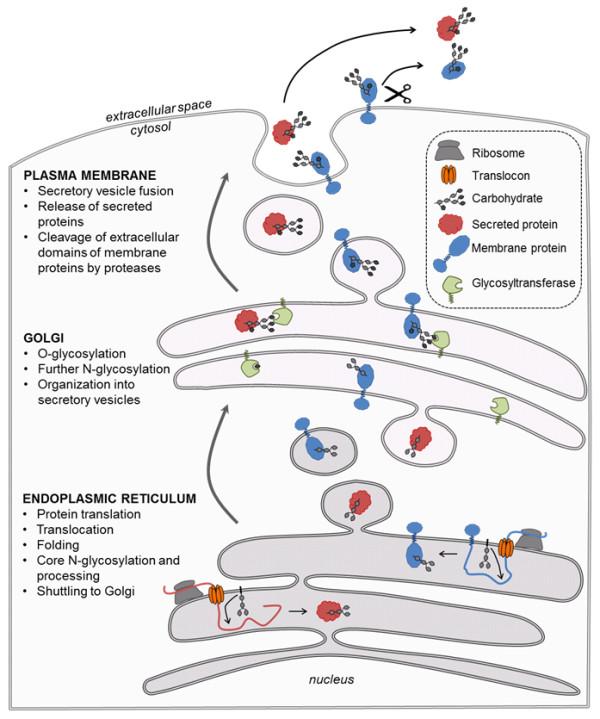
Figure 1
Figure 1
Life span of glycoproteins from translation to circulation. The translation of signal peptide-containing membrane and secreted protein occurs on the surface of the endoplasmic reticulum (ER), with the growing peptide chain being shuttled through the translocon complex into the lumen of the ER. In the ER lumen, core N-glycosylation of accessible N-X-S/T sites is performed by the oligosaccharide transferase component of the translocon complex while the nascent protein is being translated and folded. Following the completion of translation, folding, and core glycan processing, the protein is shuttled to the Golgi apparatus, where further N-glycosylation and O-glycosylation are performed by different glycosyltransferases. In the Golgi, glycoproteins are packaged into secretory vesicles bound for fusion with the plasma membrane, where the secreted proteins are released into the extracellular space and membrane proteins are presented on the surface of the cell, making them accessible for cleavage and release by proteolytic enzymes. Once in the extracellular space, these glycoproteins can then enter the circulation.
Figure 2
Figure 2
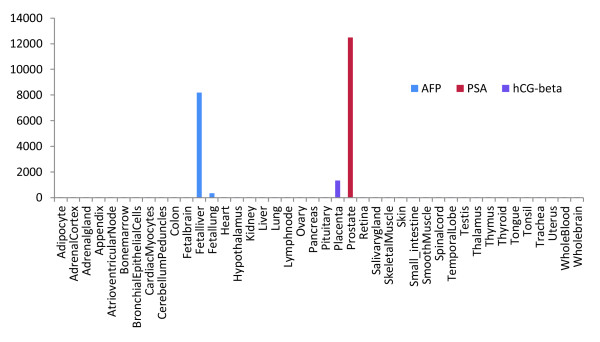
Gene expression of alpha-fetoprotein (AFP), beta-human chorionic gonadotropin (beta HCG), and prostate-specific antigen (PSA) by tissue. Figure adapted and modified from the BioGPS Application [151], using the HG_U133A/GNF1H Gene Atlas [152].
Figure 3
Figure 3
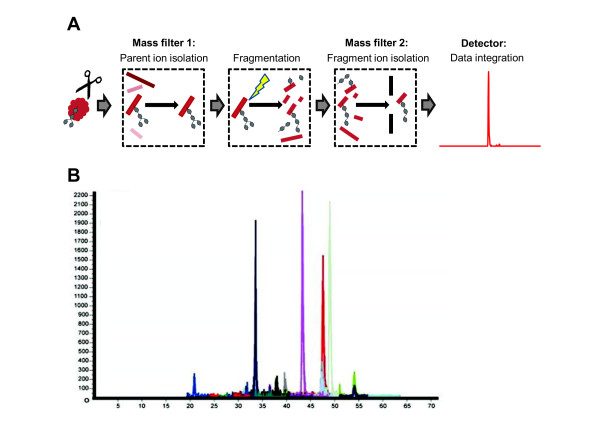
Glycopeptide MRM/SRM. (A) General schematic representation of multiple reaction monitoring (MRM). Peptides and glycopeptides from a protease (normally trypsin)-cleaved glycoprotein are subjected to triple quadrupole mass spectrometry (MS). Only selected parent ion ions were selected for fragmentation, and the resulting fragment ion intensities were used for (glyco)peptide quantification. (B) Representative chromatogram of simultaneous MRMs of 25 pyridyl amineated sialoglycopeptides found on 16 glycoproteins in mouse serum. Adapted and modified from Kurogochi et al. [109].

References

    1. Cunningham S, Gerlach JQ, Kane M, Joshi L. Glyco-biosensors: Recent advances and applications for the detection of free and bound carbohydrates. Analyst. 2010;135:2471–2480. doi: 10.1039/c0an00276c. - DOI - PubMed
    1. Dalpathado DS, Desaire H. Glycopeptide analysis by mass spectrometry. Analyst. 2008;133:731–738. doi: 10.1039/b713816d. - DOI - PubMed
    1. Reinders J, Sickmann A. Modificomics: posttranslational modifications beyond protein phosphorylation and glycosylation. Biomol Eng. 2007;24:169–177. doi: 10.1016/j.bioeng.2007.03.002. - DOI - PubMed
    1. Walsh CT, Garneau-Tsodikova S, Gatto GJ Jr. Protein posttranslational modifications: the chemistry of proteome diversifications. Angew Chem Int Ed Engl. 2005;44:7342–7372. doi: 10.1002/anie.200501023. - DOI - PubMed
    1. Crocker PR, Feizi T. Carbohydrate recognition systems: functional triads in cell-cell interactions. Curr Opin Struct Biol. 1996;6:679–691. doi: 10.1016/S0959-440X(96)80036-4. - DOI - PubMed