


Magnitude of pedestrian head injuries & fatalities in Bangalore, south India: a retrospective study from an apex neurotrauma center
- PMID: 23391802
- PMCID: PMC3612309
Magnitude of pedestrian head injuries & fatalities in Bangalore, south India: a retrospective study from an apex neurotrauma center
Abstract
Background & objectives: Pedestrians contribute to 30-40 per cent of all road traffic injuries in India. However, there is a paucity of literature on pedestrian head injury as compared to two wheeler trauma. The purpose of the present study was to study the pattern of pedestrian injuries and their outcome with a special focus on head injuries.
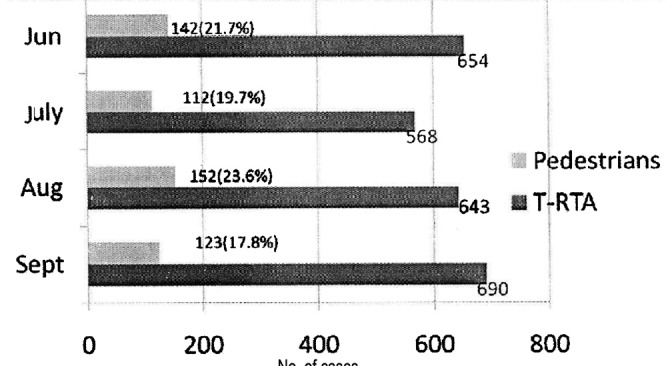
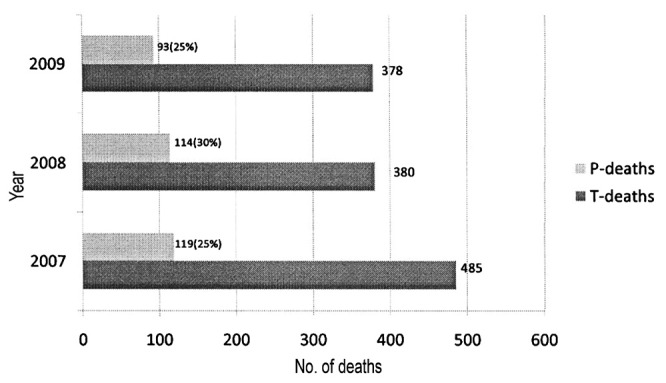
Methods: The study was conducted in two parts in the Trauma Center at National Institute of Mental Health & Neuro Sciences, Bangalore. A retrospective study was conducted at the casualty services of the hospital in which 529 consecutive pedestrians who sustained injury in a road traffic accident were studied from June to September 2009. In the second part, records from the hospital mortuary were retrospectively analyzed from 2007 to 2009. An analysis of 326 patients who died as a pedestrian in road accidents during this period was performed.
Results: Patients in both paediatric and elderly age groups constituted 47.6 per cent (252/529) of all casualty admissions. Majority of the pedestrian injuries (41.7%, 221/529) occurred between 1600 - 2100 h; 87.1 per cent of all patients received some primary care before admission. The most common offending vehicle was a two wheeler (49.1%, 260/529). At the time of admission, 55.2 per cent (292/529) patients had sustained a moderate or severe head injury (GCS 3-13), and 40.5 per cent (214/529) had an abnormal CT scan. In addition, 90.4 per cent (478/529) patients had also sustained associated injuries. Major thoracoabdominal trauma was seen in 4 per cent and spine injury in 2.3 per cent of the patients. The mortality rate was 6.6 per cent. In the postmortem group, pedestrian deaths constituted 26.2 per cent of all the postmortems conducted. Two wheelers were the offending vehicle in the majority of the fatal crashes (39.9%).
Interpretation & conclusions: Pedestrian injuries form a major part of the workload of a neurotrauma emergency. Majority of them sustained moderate to severe head injury. More attention, infrastructure and strict implementation of rules may help reduce this burden.
Figures
References
-
- Gururaj G. Road traffic injury prevention in India. Bangalore: National Institute of Mental Health and Neuro Sciences; 2006.
-
- Peden M, Scurfield R, Sleet D, Mohan D, Hyder AA, Jarawan E, et al. World report on road traffic injury prevention. Geneva: WHO; 2004.
-
- Accidental deaths and suicides in India. New Delhi: Ministry of Home Affairs, Government of India; 2007. National Crime Records Bureau.
-
- New Delhi: Ministry of Urban Development; 2008. Study of Traffic and Transportation Policies and strategies in Urban areas in India, Final report.
-
- Tokdemir M, Kafadar H, Turkoglu A, Deveci SE, Colak C. Comparison of the severity of traumatic brain injuries in pedestrians and occupants of motor vehicles admitted to Firat health center: a five-year series in an Eastern Turkish city. Med Sci Monit. 2009;15:PI1–4. - PubMed
MeSH terms
LinkOut - more resources
Full Text Sources
Medical
Miscellaneous