Pediatric intracerebral hemorrhage: acute symptomatic seizures and epilepsy
- PMID: 23392319
- PMCID: PMC3640376
- DOI: 10.1001/jamaneurol.2013.1033
Pediatric intracerebral hemorrhage: acute symptomatic seizures and epilepsy
Abstract
Importance: Seizures are believed to be common presenting symptoms in neonates and children with spontaneous intracerebral hemorrhage (ICH). However, few data are available on the epidemiology of acute symptomatic seizures or the risk for later epilepsy.
Objective: To define the incidence of and explore risk factors for seizures and epilepsy in children with spontaneous ICH. Our a priori hypotheses were that younger age at presentation, cortical involvement of ICH, acute symptomatic seizures after presentation, ICH due to vascular malformation, and elevated intracranial pressure requiring urgent intervention would predict remote symptomatic seizures and epilepsy.
Design: Prospective cohort study conducted between March 1, 2007, and January 1, 2012.
Setting: Three tertiary care pediatric hospitals.
Participants: Seventy-three pediatric subjects with spontaneous ICH including 20 perinatal (≥37 weeks' gestation to 28 days) and 53 childhood subjects (>28 days to <18 years at presentation).
Main outcome measures: Acute symptomatic seizures (clinically evident and electrographic-only seizures within 7 days), remote symptomatic seizures, and epilepsy.
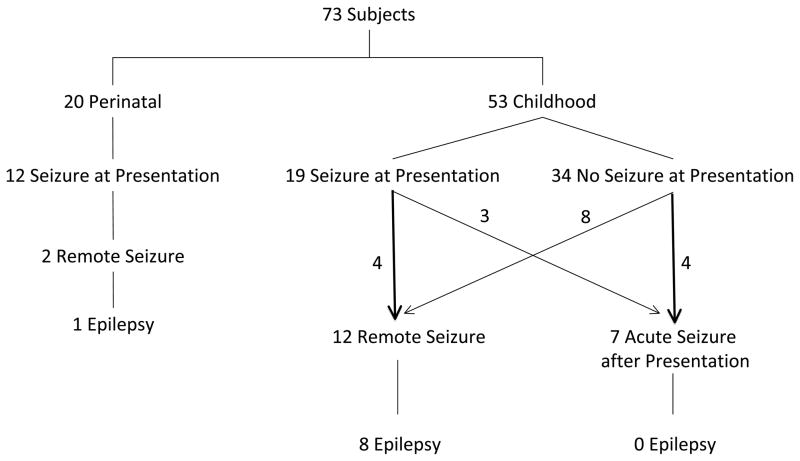
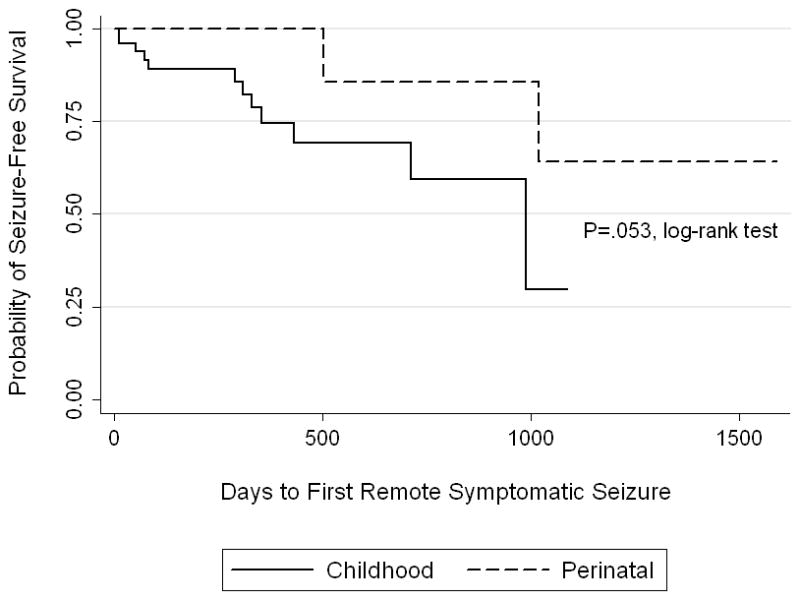
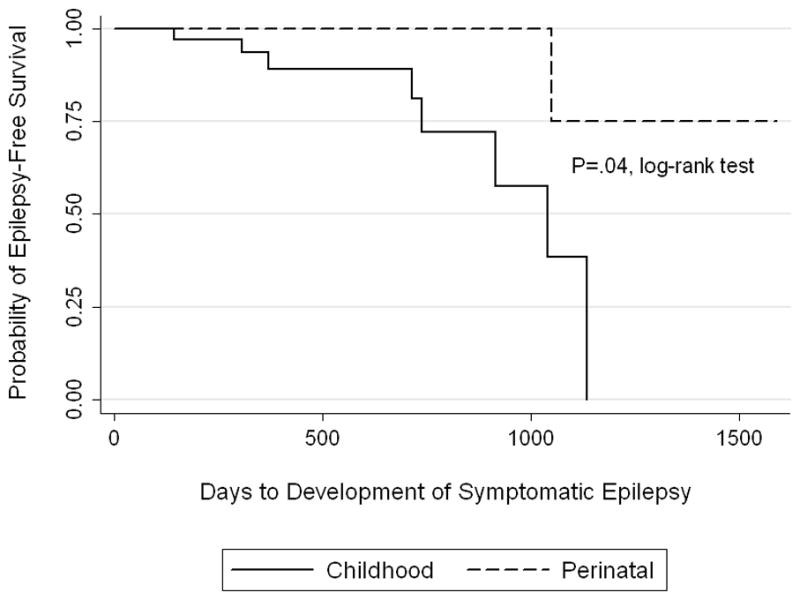
Results: Acute symptomatic seizures occurred in 35 subjects (48%). Acute symptomatic seizures as a presenting symptom of ICH occurred in 12 perinatal (60%) and 19 childhood (36%) subjects (P = .07). Acute symptomatic seizures after presentation occurred in 7 children. Electrographic-only seizures were present in 9 of 32 subjects (28%) with continuous electroencephalogram monitoring. One-year and 2-year remote symptomatic seizure-free survival rates were 82% (95% CI, 68-90) and 67% (95% CI, 46-82), respectively. One-year and 2-year epilepsy-free survival rates were 96% (95% CI, 83-99) and 87% (95% CI, 65-95), respectively. Elevated intracranial pressure requiring acute intervention was a risk factor for seizures after presentation (P = .01; Fisher exact test), remote symptomatic seizures, and epilepsy (P = .03, and P = .04, respectively; log-rank test).
Conclusions and relevance: Presenting seizures are common in perinatal and childhood ICH. Continuous electroencephalography may detect electrographic seizures in some subjects. Single remote symptomatic seizures occur in many, and development of epilepsy is estimated to occur in 13% of patients at 2 years. Elevated intracranial pressure requiring acute intervention is a risk factor for acute seizures after presentation, remote symptomatic seizures, and epilepsy.
Figures
Comment in
-
Pediatric intracerebral hemorrhage, acute seizures, and epilepsy.JAMA Neurol. 2013 Apr;70(4):437. doi: 10.1001/jamaneurol.2013.1801. JAMA Neurol. 2013. PMID: 23392342 No abstract available.
References
-
- Lo WD, Lee J, Rusin J, Perkins E, Roach ES. Intracranial hemorrhage in children: an evolving spectrum. Arch Neurol. 2008;65(12):1629–1633. - PubMed
-
- Al-Jarallah A, Al-Rifai MT, Riela AR, Roach ES. Nontraumatic brain hemorrhage in children: etiology and presentation. J Child Neurol. 2000;15(5):284–289. - PubMed
-
- Blom I, De Schryver EL, Kappelle LJ, Rinkel GJ, Jennekens-Schinkel A, Peters AC. Prognosis of haemorrhagic stroke in childhood: a long-term follow-up study. Dev Med Child Neurol. 2003;45(4):233–239. - PubMed
Publication types
MeSH terms
Substances
Grants and funding
- K23 NS062110/NS/NINDS NIH HHS/United States
- K23-NS062110/NS/NINDS NIH HHS/United States
- R01 NS072338/NS/NINDS NIH HHS/United States
- K23-NS076550/NS/NINDS NIH HHS/United States
- K23 NS076550/NS/NINDS NIH HHS/United States
- R01-NS072338/NS/NINDS NIH HHS/United States
- T32 NS007413/NS/NINDS NIH HHS/United States
- K12-NS049453/NS/NINDS NIH HHS/United States
- R01 NS050488/NS/NINDS NIH HHS/United States
- R01-NS050488/NS/NINDS NIH HHS/United States
- K12 NS049453/NS/NINDS NIH HHS/United States
- T32-NS007413/NS/NINDS NIH HHS/United States
LinkOut - more resources
Full Text Sources
Other Literature Sources
Medical