. 2013 Apr;6(2):193-200.
doi: 10.1161/CIRCGENETICS.112.964684. Epub 2013 Feb 7.

Prevalence and potential genetic determinants of sensorineural deafness in KCNQ1 homozygosity and compound heterozygosity

Affiliations

Prevalence and potential genetic determinants of sensorineural deafness in KCNQ1 homozygosity and compound heterozygosity

John R Giudicessi et al. Circ Cardiovasc Genet. 2013 Apr.

Abstract

BACKGROUND- Homozygous or compound heterozygous mutations in KCNQ1 cause Jervell and Lange-Nielsen syndrome, a rare, autosomal-recessive form of long-QT syndrome characterized by deafness, marked QT prolongation, and a high risk of sudden death. However, it is not understood why some individuals with mutations on both KCNQ1 alleles present without deafness. In this study, we sought to determine the prevalence and genetic determinants of this phenomenon in a large referral population of patients with long-QT syndrome. METHODS AND RESULTS- A retrospective analysis of all patients with long-QT syndrome evaluated from July 1998 to April 2012 was used to identify those with ≥1 KCNQ1 mutation. Of the 249 KCNQ1-positive patients identified, 15 (6.0%) harbored a rare putative pathogenic mutation on both KCNQ1 alleles. Surprisingly, 11 of these patients (73%) presented without the sensorineural deafness associated with Jervell and Lange-Nielsen syndrome. The degree of QT-interval prolongation and the number of breakthrough cardiac events were similar between patients with and without deafness. Interestingly, truncating mutations were more prevalent in patients with Jervell and Lange-Nielsen syndrome (79%) than in nondeaf patients (36%; P<0.001) derived from this study and those in the literature. CONCLUSIONS- In this study, we provide evidence that the recessive inheritance of a severe long-QT syndrome type 1 phenotype in the absence of an auditory phenotype may represent a more common pattern of long-QT syndrome inheritance than previously anticipated and that these cases should be treated as a higher-risk long-QT syndrome subset similar to their Jervell and Lange-Nielsen syndrome counterparts. Furthermore, mutation type may serve as a genetic determinant of deafness, but not cardiac expressivity, in individuals harboring ≥1 KCNQ1 mutation on each allele.


Conflict of interest statement

Conflict of Interest Disclosures: MJA is a consultant for Transgenomic. Intellectual property derived from MJA’s research program resulted in license agreements in 2004 between Mayo Clinic Health Solutions (formerly Mayo Medical Ventures) and PGxHealth (formerly Genaissance Pharmaceuticals and now Transgenomic).

Figures

Figure 1
Figure 1
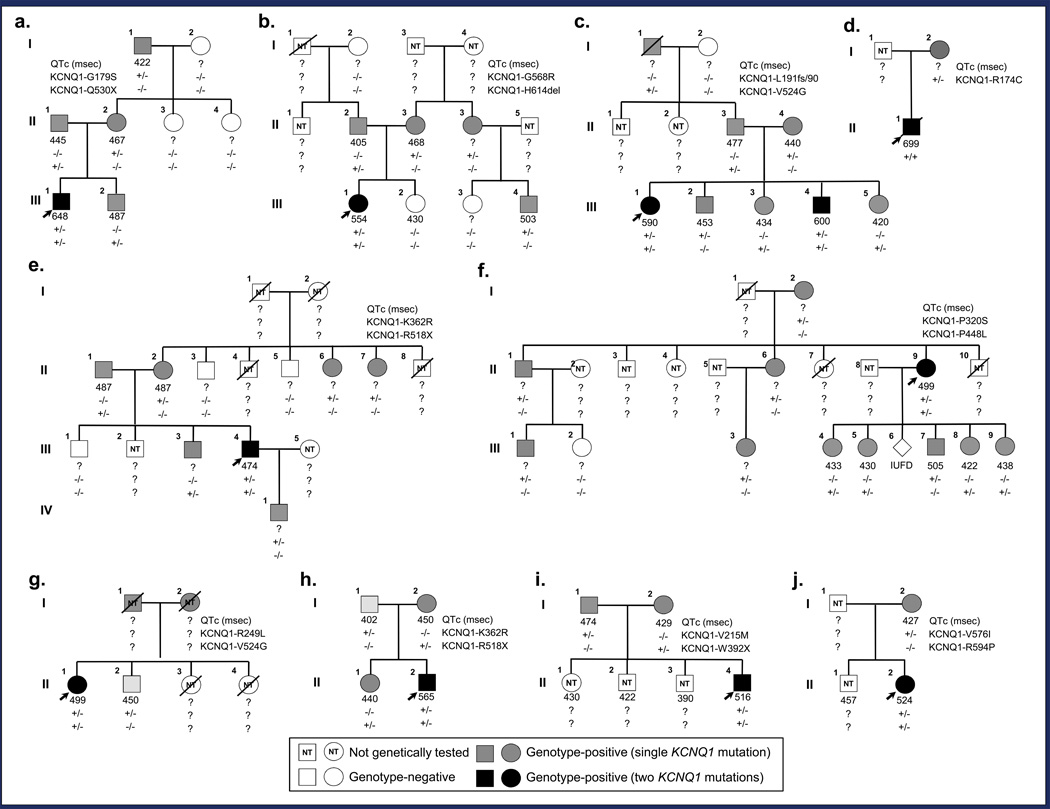
Pedigree structure and genotypic information for families of KCNQ1 homozygotes/compound heterozygotes with intact hearing. Genotype-positive individuals indicated by gray (single KCNQ1 mutation) or black (two KCNQ1 mutations) squares (male) and circles (female). Genotype-negative individuals indicated by open symbols; index cases by black arrows; and deceased individuals by slashes. Lastly, squares or circles containing “NT” (not tested) indicate individuals who have yet to undergo or have refused genetic testing. QTc intervals and genotypes are displayed beneath each symbol. a. Family AR LQT1a. This three-generation pedigree is notable for the index case with severe QT prolongation that suffered from breakthrough syncopal episodes prior to undergoing a LCSD (III.1). b. Family AR LQT1b. This three-generation pedigree is notable for the index case with severe QT prolongation and a history of breakthrough cardiac events (III.1). c. Family AR LQT1c. This three-generation pedigree is notable for the index case with severe QT prolongation and a history of breakthrough cardiac events including an out-of-hospital cardiac arrest (III.1) and her brother who also has severe QT prolongation and has suffered multiple breakthrough cardiac events including an ICD storm (III.4). d. Family AR LQT1d. This two-generation pedigree is notable only for the index case that displays extreme QT prolongation and suffered multiple breakthrough cardiac events prior to succumbing to his malignant LQTS phenotype at the age of 3 (II.1). e. Family AR LQT1e. This four-generation pedigree is notable for the index case with QT prolongation that suffered numerous exertional syncopal episodes during childhood (III.4). f. Family AR LQT1f. This three-generation pedigree is notable for the index case who features a prolonged QT interval but has remained asymptomatic for the last 25 years (III.9) and the sudden unexplained deaths of her siblings at the age of 13 and 3, respectively (III.7 and III.10). g. Family AR LQT1g. A two-generation pedigree notable for the index case with QT prolongation (III.1) and the swimming-triggered sudden unexplained death of the index case’s 13-year old sister (III.3). h. Family AR LQT1h. A two-generation pedigree notable for the index case who has severe QT prolongation and suffered several breakthrough ICD shocks prior to undergoing a LCSD (III.2). i. Family AR LQT1i. This two-generation pedigree is notable for the index case who has QT prolongation and suffered several breakthrough cardiac events including an out-of-hospital cardiac arrest (III.5). j. Family AR LQT1j. This two-generation pedigree is notable for the symptomatic index case that has QT prolongation (III.2).
Figure 2
Figure 2
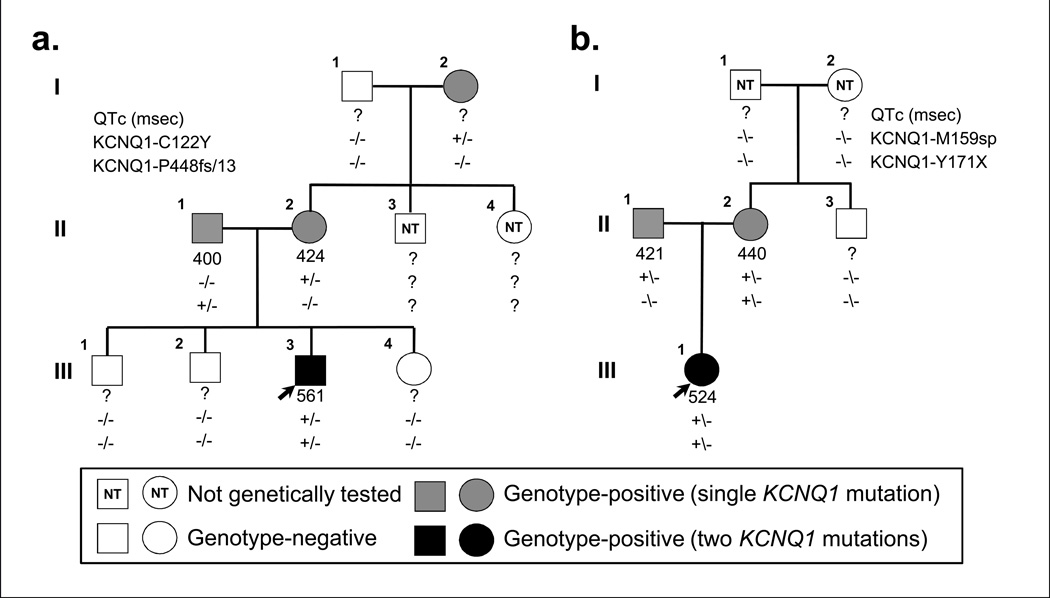
Pedigree structure and genotypic information for families of KCNQ1 homozygotes/compound heterozygotes with bilateral sensorineural hearing loss. a. Family JLNS1a.This three-generation pedigree is only significant for the index case with severe QT prolongation and suffered from numerous breakthrough syncopal events during childhood including several appropriate VF-terminating ICD shocks (III.3). b. Family JLNS1b. This two-generation pedigree is only significant for the index case who features QT prolongation but is otherwise asymptomatic (III.1). Genotype-positive individuals indicated by gray (single KCNQ1 mutation) or black (two KCNQ1 mutations) squares (male) and circles (female). Genotype-negative individuals indicated by open symbols; index cases by black arrows; and deceased individuals by slashes. Lastly, squares or circles containing “NT” indicate individuals who have yet to undergo or have refused genetic testing. QTc intervals and genotypes are displayed beneath each symbol.
Figure 3
Figure 3
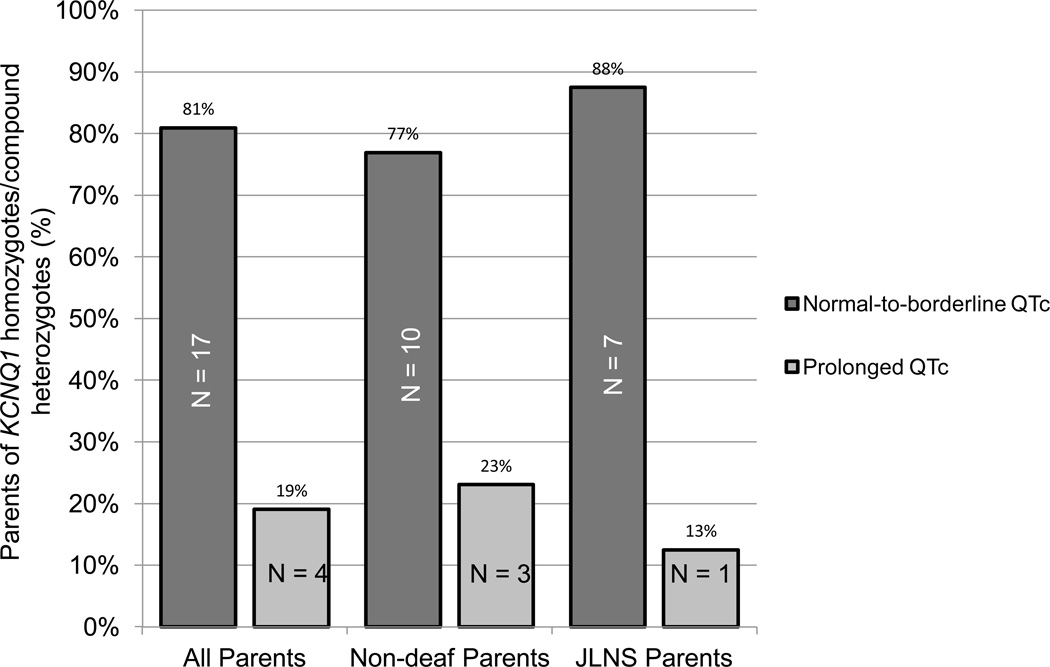
Electrocardiographic phenotype KCNQ1 compound heterozygote parents. Bar graph of the electrocardiographic phenotype of the parents of JLNS and non-deaf KCNQ1 compound heterozygotes. A normal-to-borderline QT interval was defined as a QTc < 470 in males and a QTc < 480 in females.
Figure 4
Figure 4
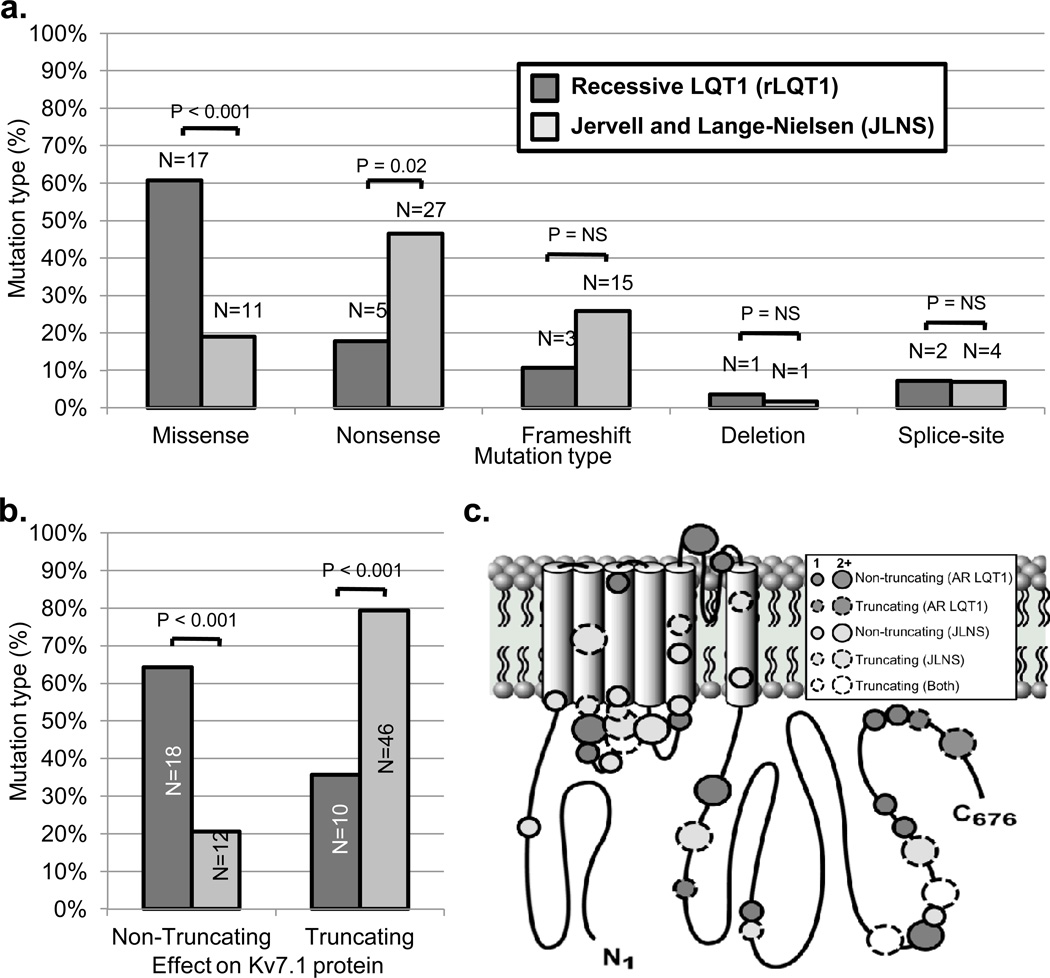
Potential genetic determinants of auditory phenotype in patients harboring mutations on both KCNQ1 alleles identified in the current study and previously in the literature. a. Comparison of mutation types identified in “recessive” type 1 long QT syndrome with intact hearing and Jervell and Lange-Nielsen syndrome cases. b. Percentage of truncating (e.g. nonsense, frameshift, etc.) and non-truncating (e.g. missense, in-frame deletion, etc.) mutations identified in “recessive” type 1 long QT syndrome with intact hearing and Jervell and Lange-Nielsen syndrome case, respectively. c. Location of putative “recessive” type 1 long QT syndrome with intact hearing- and Jervell and Lange-Nielsen syndrome-causative mutations in the Kv7.1 channel topology. Dark gray bars indicate “recessive” type 1 long QT syndrome cases, light gray bars indicate Jervell and Lange-Nielsen syndrome cases, and white circles indicate mutations seen in both “recessive” LQT1 and Jervell and Lange-Nielsen syndrome.

Comment in

References

    1. Moss AJ. Long QT Syndrome. JAMA. 2003;289:2041–2044. - PubMed
    1. Sanguinetti MC, Curran ME, Zou A, Shen J, Spector PS, Atkinson DL, et al. Coassembly of K(V)LQT1 and minK (IsK) proteins to form cardiac I(Ks) potassium channel. Nature. 1996;384:80–83. - PubMed
    1. Wangemann P. Supporting sensory transduction: cochlear fluid homeostasis and the endocochlear potential. J Physiol. 2006;576:11–21. - PMC - PubMed
    1. Wang Q, Curran ME, Splawski I, Burn TC, Millholland JM, VanRaay TJ, et al. Positional cloning of a novel potassium channel gene: KVLQT1 mutations cause cardiac arrhythmias. Nat Genet. 1996;12:17–23. - PubMed
    1. Tester DJ, Will ML, Haglund CM, Ackerman MJ. Compendium of cardiac channel mutations in 541 consecutive unrelated patients referred for long QT syndrome genetic testing. Heart Rhythm. 2005;2:507–517. - PubMed

Publication types

Substances