


Manganese neurotoxicity and the role of reactive oxygen species
- PMID: 23395780
- PMCID: PMC3713115
- DOI: 10.1016/j.freeradbiomed.2013.01.032
Manganese neurotoxicity and the role of reactive oxygen species
Abstract
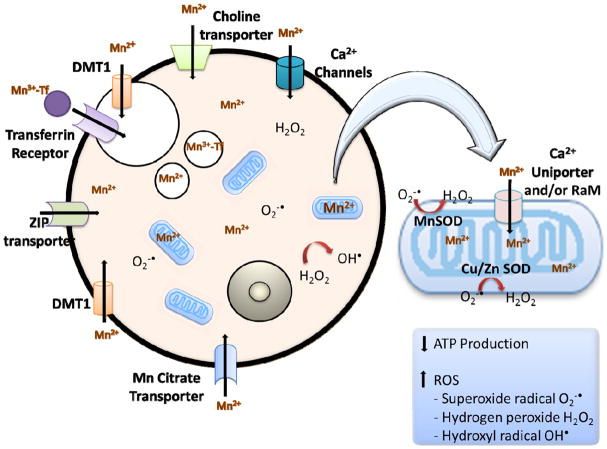
Manganese (Mn) is an essential dietary nutrient, but an excess or accumulation can be toxic. Disease states, such as manganism, are associated with overexposure or accumulation of Mn and are due to the production of reactive oxygen species, free radicals, and toxic metabolites; alteration of mitochondrial function and ATP production; and depletion of cellular antioxidant defense mechanisms. This review focuses on all of the preceding mechanisms and the scientific studies that support them as well as providing an overview of the absorption, distribution, and excretion of Mn and the stability and transport of Mn compounds in the body.
Keywords: DA autoxidation; Free radicals; Manganese; Manganism; Mitochondrial dysfunction; Reactive oxygen species.
Copyright © 2013 Elsevier Inc. All rights reserved.
References
-
- May BP, Dennis PP. Evolution and regulation of the gene encoding superoxide dismutase from the archaebacterium Halobacterium cutirubrum. J Biol Chem. 1989;264:12253–12258. - PubMed
-
- Aschner M, Dorman DC. Health Canada, Air Quality and Health Division. Ottawa, ON, Canada: Aug 1, 2002. Review of Manganese Toxicokinetics.
-
- Ali SF, Duhart HM, Newport GD, Lipe GW, Slikker W., Jr Manganese-induced reactive oxygen species: comparison between Mn+2 and Mn+3. Neurodegeneration. 1995;4:329–334. - PubMed
-
- Aschner M, Gannon M. Manganese (Mn) transport across the rat blood-brain barrier: saturable and transferrin-dependent transport mechanisms. Brain Res Bull. 1994;33:345–349. - PubMed
Publication types
MeSH terms
Substances
Grants and funding
LinkOut - more resources
Full Text Sources
Other Literature Sources
