


Imaging descriptors improve the predictive power of survival models for glioblastoma patients
- PMID: 23396489
- PMCID: PMC3779027
- DOI: 10.1093/neuonc/nos335
Imaging descriptors improve the predictive power of survival models for glioblastoma patients
Abstract
Background: Because effective prediction of survival time can be highly beneficial for the treatment of glioblastoma patients, the relationship between survival time and multiple patient characteristics has been investigated. In this paper, we investigate whether the predictive power of a survival model based on clinical patient features improves when MRI features are also included in the model.
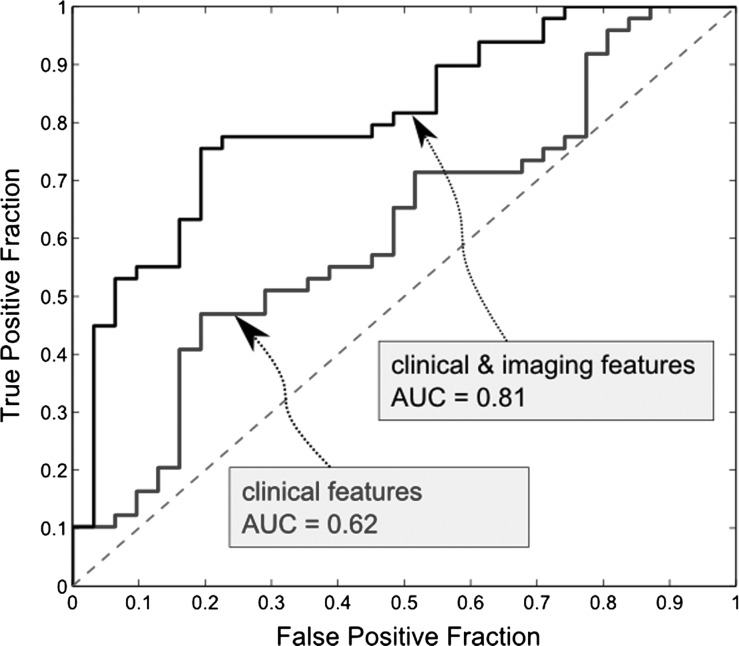
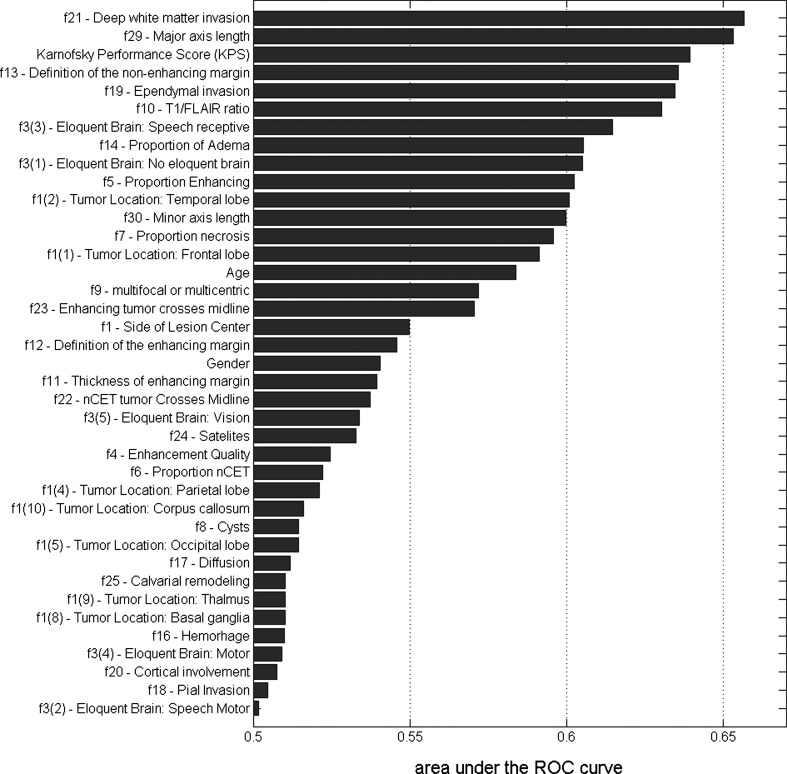
Methods: The subjects in this study were 82 glioblastoma patients for whom clinical features as well as MR imaging exams were made available by The Cancer Genome Atlas (TCGA) and The Cancer Imaging Archive (TCIA). Twenty-six imaging features in the available MR scans were assessed by radiologists from the TCGA Glioma Phenotype Research Group. We used multivariate Cox proportional hazards regression to construct 2 survival models: one that used 3 clinical features (age, gender, and KPS) as the covariates and 1 that used both the imaging features and the clinical features as the covariates. Then, we used 2 measures to compare the predictive performance of these 2 models: area under the receiver operating characteristic curve for the 1-year survival threshold and overall concordance index. To eliminate any positive performance estimation bias, we used leave-one-out cross-validation.
Results: The performance of the model based on both clinical and imaging features was higher than the performance of the model based on only the clinical features, in terms of both area under the receiver operating characteristic curve (P < .01) and the overall concordance index (P < .01).
Conclusions: Imaging features assessed using a controlled lexicon have additional predictive value compared with clinical features when predicting survival time in glioblastoma patients.
Keywords: MRI; VASARI; glioblastoma; proportional hazards; survival analysis.
Figures
References
-
- Central Brain Tumor Registry of the United States. CBTRUS statistical report: primary brain and central nervous system tumors diagnosed in the United States in 2004–2008. http://www.cbtrus.org/2012-NPCR-SEER/CBTRUS_Report_2004-2008_3-23-2012.pdf. (accessed December 18, 2012)
-
- Lacroix M, Abi-Said D, Fourney DR, et al. A multivariate analysis of 416 patients with glioblastoma multiforme: prognosis, extent of resection, and survival. J Neurosurg. 2001;95(2):190–198. - PubMed
-
- Stummer W, Reulen H-J, Meinel T, et al. Extent of resection and survival in glioblastoma multiforme: identification of and adjustment for bias. Neurosurgery. 2008;62(3):564–576. - PubMed
MeSH terms
LinkOut - more resources
Full Text Sources
Other Literature Sources
Medical
