Review
doi: 10.1128/EC.00364-12.
Epub 2013 Feb 8.
Adhesins in human fungal pathogens: glue with plenty of stick
Affiliations
- PMID: 23397570
- PMCID: PMC3623432
- DOI: 10.1128/EC.00364-12
Item in Clipboard
Review
Adhesins in human fungal pathogens: glue with plenty of stick
Eukaryot Cell.
2013 Apr.
Abstract
Understanding the pathogenesis of an infectious disease is critical for developing new methods to prevent infection and diagnose or cure disease. Adherence of microorganisms to host tissue is a prerequisite for tissue invasion and infection. Fungal cell wall adhesins involved in adherence to host tissue or abiotic medical devices are critical for colonization leading to invasion and damage of host tissue. Here, with a main focus on pathogenic Candida species, we summarize recent progress made in the field of adhesins in human fungal pathogens and underscore the importance of these proteins in establishment of fungal diseases.
Figures
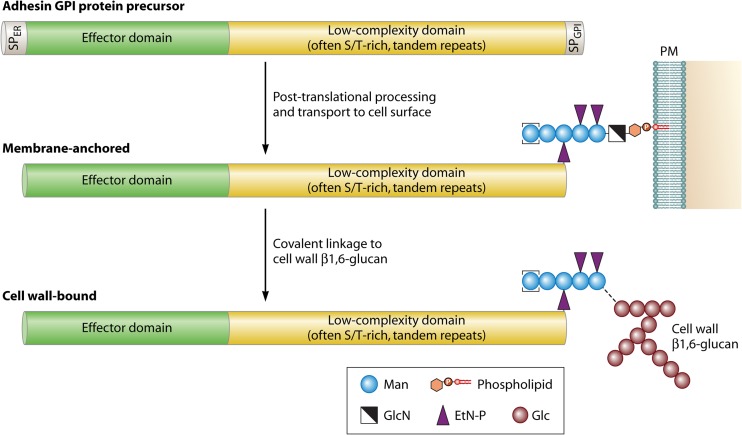
Generic structure and posttranslational processing steps leading to cell wall incorporation of fungal adhesins. Abundant protein N- and O-glycosylation, the latter especially taking place in the low-complexity domain, is not depicted for simplicity reasons. EtN-P, ethanolamine phosphate; Glc, glucose; GlcN, glucosamine; Man, mannose; PM, plasma membrane; PI, phosphatidylinositol.
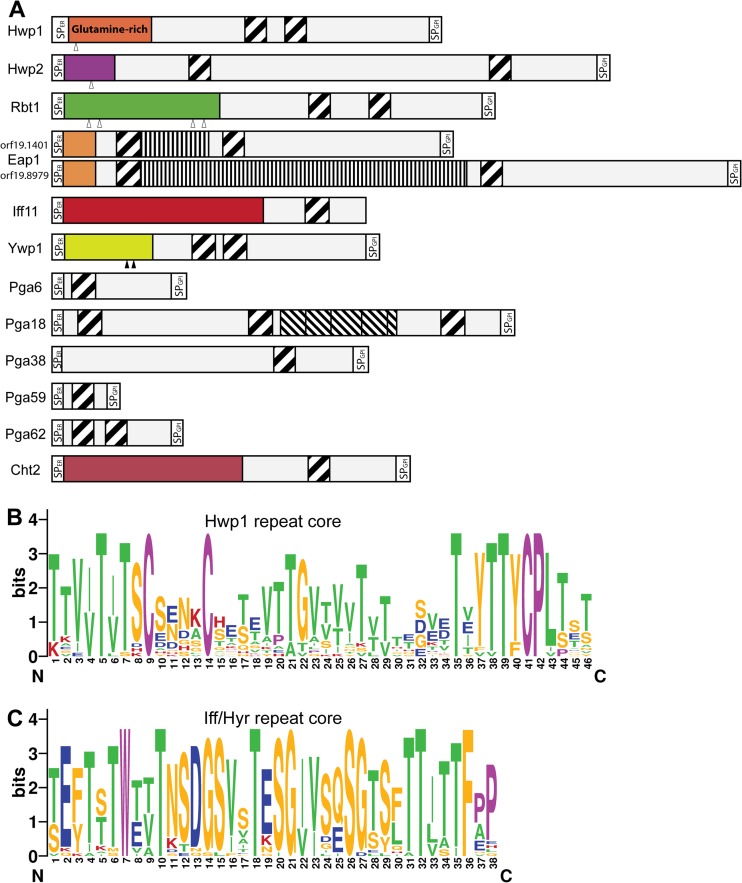
The C. albicans Hwp1 and Iff/Hyr families contain family-specific repeat sequences. (A) Diagram showing modular structures of the protein precursors of the Hwp1 family. Included are all 12 C. albicans SC5314 proteins (genome assembly 21) containing at least one copy of the pattern T[ILV][ST]XCX(4)CX(16,20)TX[VYF][TV]T[YF]CP[ILV] (PROSITE format), which are indicated as diagonally striped boxes. N-terminal high-complexity domains of the mature proteins, believed to comprise effector domains, are presented in different colors because of their lack of sequence similarity. The two EAP1 alleles in strain SC5314 differ in length at a region that predominantly encodes repeats of a “PATEST” pattern (indicated by vertically striped boxes). A region with imperfect 41-to-50-aa serine-rich repeats in Pga18 is shown as the boxes with the thinner diagonal stripes. Signal peptides (SP) for ER entry and GPI anchoring are indicated. Putative and experimentally validated proteolytic Kex2 cleavage sites are depicted by open and black triangles, respectively. (B and C) Sequence logos (created at http://weblogo.berkeley.edu/ ) of the Hwp1 group (B) and of the Iff/Hyr family repeats (75) (C). Amino acid color codes for both panels are as follows: purple, conserved tryptophan in the Iff group, cysteines, and prolines; green, amyloid forming (TLVIA); red, positively charged (KRH); blue, negatively charged (DE); orange, all other amino acids. Alignments used for building the logos have been communicated to Pfam (http://pfam.janelia.org/ ) for creation of Pfam hidden Markov models (HMM) entries. All Iff/Hyr repeats from reference match the pattern WX(2)TX (7)TX(2)G[IV](2).
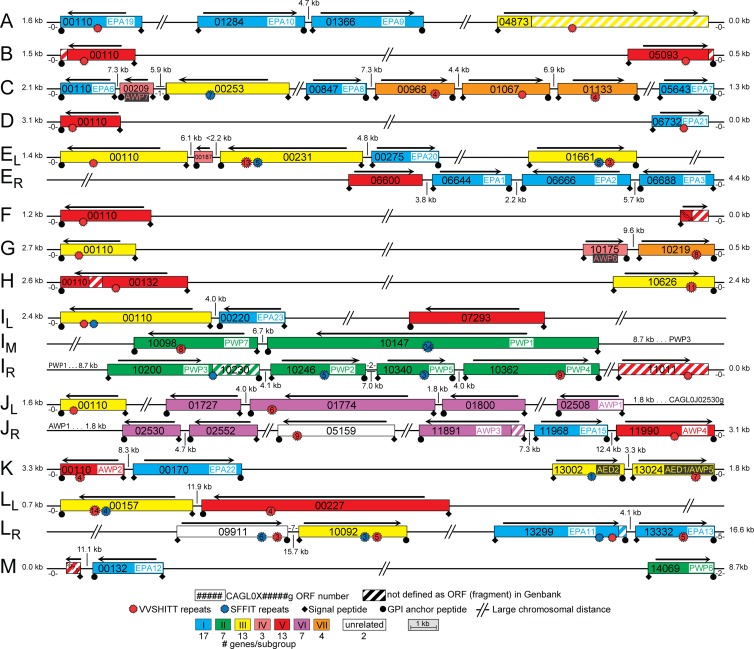
Genomic organization of putative adhesin-encoding genes in the sequenced C. glabrata strain CBS138, modified from reference . Chromosomes and open reading frames (ORFs) are numbered following Génolevures's systematic ORF numbering, which is also used in the Candida Genome Database. ORF sizes are to scale, but distances between ORFs are not. Many of the gene sequences, when translated, give rise to frameshifts, probably mostly due to sequencing and/or annotation errors or the presence of intronic sequences. Some unannotated ORF fragments (no ORF number), identified by BLASTX, are connected to incomplete ORFs. Colors indicate seven subfamilies, sharing homology in the N-terminal putative ligand-binding parts. Numbers of genes in each group are indicated. N-terminal domains of CAGL0L09911g and CAGL0J05170g (white) are unrelated to the other adhesins. For CAGL0E00187g (group IV, pink), only the GPI anchor peptide containing the C-terminal part was identified; its classification is therefore based on BLASTP analysis of this region. Numbers of nonadhesin ORFs separating adhesin-like ORFs and telomeres and distances of terminal adhesin-like genes to the end of the obtained telomeric DNA sequences are indicated. Numbers of the megasatellite signatures [VILF][VI][ST]H[IVS][TI][TGI] (“VVSHITT”) and SFFIT are specified only for ORFs whose protein sequences are complete in the databases. Arrows indicate directions of transcription.
References
-
- Perlroth J, Choi B, Spellberg B. 2007. Nosocomial fungal infections: epidemiology, diagnosis, and treatment. Med. Mycol. 45:321–346 - PubMed
-
- Borg-von Zepelin M, Kunz L, Ruchel R, Reichard U, Weig M, Gross U. 2007. Epidemiology and antifungal susceptibilities of Candida spp. to six antifungal agents: results from a surveillance study on fungaemia in Germany from July 2004 to August 2005. J. Antimicrob. Chemother. 60:424–428 - PubMed
-
- Busscher HJ, Rinastiti M, Siswomihardjo W, van der Mei HC. 2010. Biofilm formation on dental restorative and implant materials. J. Dent. Res. 89:657–665 - PubMed
-
- Ramage G, Martinez JP, Lopez-Ribot JL. 2006. Candida biofilms on implanted biomaterials: a clinically significant problem. FEMS Yeast Res. 6:979–986 - PubMed
Publication types
MeSH terms
Substances
LinkOut - more resources
Full Text Sources
Other Literature Sources