


Associations between attention deficit hyperactivity disorder symptom domains and DSM-IV lifetime substance dependence
- PMID: 23398223
- PMCID: PMC3704563
- DOI: 10.1111/j.1521-0391.2013.00325.x
Associations between attention deficit hyperactivity disorder symptom domains and DSM-IV lifetime substance dependence
Abstract
Background and objectives: Most studies of attention deficit hyperactivity disorder (ADHD) in the substance dependence literature have assessed ADHD as a single, categorical entity. This approach limits characterization across the spectrum of ADHD symptomatology and may mask differences across the two core domains of ADHD symptoms-hyperactive-impulsive (HI) and inattention (IN). Further, it is unclear whether relations of HI and IN symptoms to substance dependence extend across drug classes and to the general population.
Methods: This cross-sectional study investigated associations of lifetime ADHD HI and IN symptom levels to individual classes of lifetime substance dependence (alcohol, nicotine, depressants, opioids, stimulants, cannabis, hallucinogens, polysubstance) in a population-based sample of 34,653 American adults.
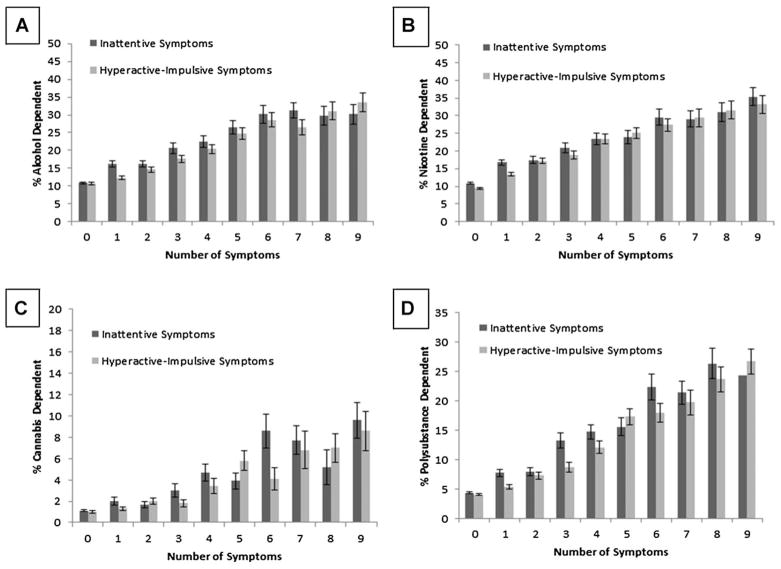
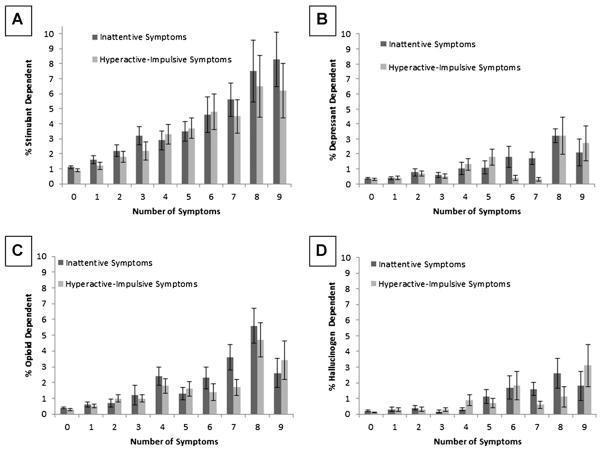
Results: HI and IN were associated with the majority of dependence diagnoses in a linear pattern, such that each additional symptom was associated with a proportional increase in odds of dependence. After adjusting for the overlap between symptom domains, both HI and IN uniquely associated with alcohol, nicotine, and polysubstance dependence, but only HI uniquely associated with dependence on illicit substances.
Conclusions and scientific significance: These findings suggest that individuals in the general population with elevated levels of ADHD (particularly HI) symptoms are at risk for various forms of substance dependence and could benefit from preventive interventions.
Copyright © American Academy of Addiction Psychiatry.
Conflict of interest statement
Declaration of Interest
The authors report no conflicts of interest. The authors alone are responsible for the content and writing of this paper.
Figures
References
-
- American Psychiatric Association. Diagnostic and Statistical Manual of Mental Disorders. 4. Washington, D.C: American Psychiatric Assocation; 1994.
-
- Biederman J, Wilens TE, Mick E, et al. Does attention-deficit hyperactivity disorder impact the developmental course of drug and alcohol abuse and dependence? Biol Psychiatry. 1998;44:269–273. - PubMed
-
- Molina BSG, Pelham WE. Childhood predictors of adolescent substance use in a longitudinal study of children with ADHD. J Abnorm Psychol. 2003;112:497–507. - PubMed
-
- Biederman J, Monuteaux MC, Mick E, et al. Young adult outcome of attention deficit hyperactivity disorder: A controlled 10-year follow-up study. Psychol Med. 2006;36:167–179. - PubMed
-
- Pomerleau OF, Downey KK, Stelson FW, et al. Cigarette smoking in adult patients diagnosed with attention deficit hyperactivity disorder. J Subst Abuse. 1995;7:373–378. - PubMed
MeSH terms
Grants and funding
LinkOut - more resources
Full Text Sources
Other Literature Sources
Medical
