. 2013 Jun;145(6):1654-9.
doi: 10.1016/j.jtcvs.2013.01.006. Epub 2013 Feb 8.

Adenosine A1 receptor activation attenuates lung ischemia-reperfusion injury

Affiliations

Adenosine A1 receptor activation attenuates lung ischemia-reperfusion injury

Lucas G Fernandez et al. J Thorac Cardiovasc Surg. 2013 Jun.

Abstract

Objectives: Ischemia-reperfusion injury contributes significantly to morbidity and mortality in lung transplant patients. Currently, no therapeutic agents are clinically available to prevent ischemia-reperfusion injury, and treatment strategies are limited to maintaining oxygenation and lung function. Adenosine can modulate inflammatory activity and injury by binding to various adenosine receptors; however, the role of the adenosine A1 receptor in ischemia-reperfusion injury and inflammation is not well understood. The present study tested the hypothesis that selective, exogenous activation of the A1 receptor would be anti-inflammatory and attenuate lung ischemia-reperfusion injury.

Methods: Wild-type and A1 receptor knockout mice underwent 1 hour of left lung ischemia and 2 hours of reperfusion using an in vivo hilar clamp model. An A1 receptor agonist, 2-chloro-N6-cyclopentyladenosine, was administered 5 minutes before ischemia. After reperfusion, lung function was evaluated by measuring airway resistance, pulmonary compliance, and pulmonary artery pressure. The wet/dry weight ratio was used to assess edema. The myeloperoxidase and cytokine levels in bronchoalveolar lavage fluid were measured to determine the presence of neutrophil infiltration and inflammation.

Results: In the wild-type mice, 2-chloro-N6-cyclopentyladenosine significantly improved lung function and attenuated edema, cytokine expression, and myeloperoxidase levels compared with the vehicle-treated mice after ischemia-reperfusion. The incidence of lung ischemia-reperfusion injury was similar in the A1 receptor knockout and wild-type mice; and 2-chloro-N6-cyclopentyladenosine had no effects in the A1 receptor knockout mice. In vitro treatment of neutrophils with 2-chloro-N6-cyclopentyladenosine significantly reduced chemotaxis.

Conclusions: Exogenous A1 receptor activation improves lung function and decreases inflammation, edema, and neutrophil chemotaxis after ischemia and reperfusion. These results suggest a potential therapeutic application for A1 receptor agonists for the prevention of lung ischemia-reperfusion injury after transplantation.


Conflict of interest statement

All authors declare that they have no conflict of interests.

Figures
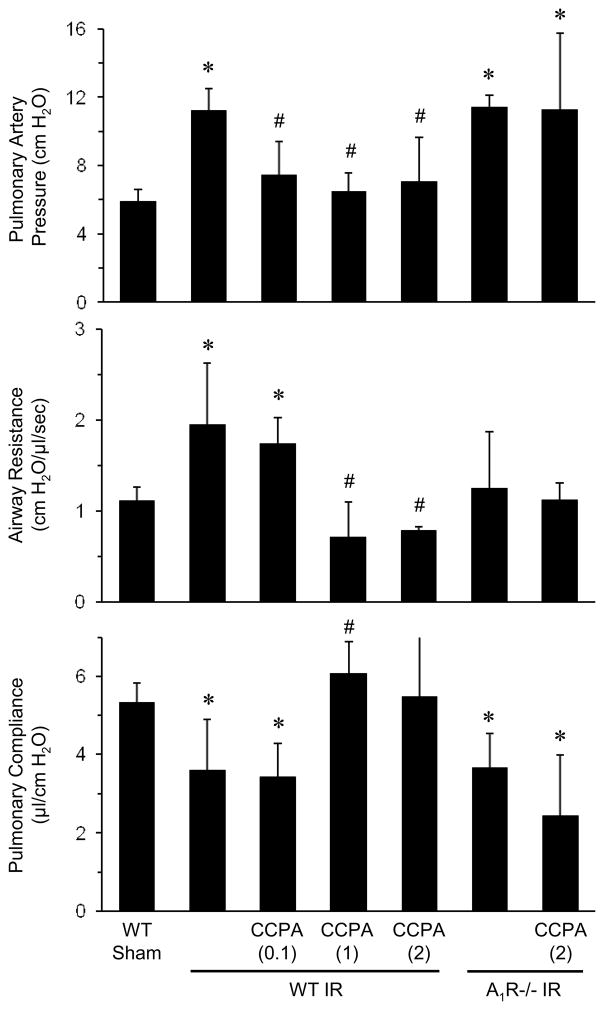
Figure 1
Figure 1. Lung function after IR is significantly improved by CCPA
WT and A1R−/− mice were treated with vehicle or CCPA (doses in mg/kg are shown in parentheses) prior to ischemia. In WT mice after IR, CCPA significantly decreased pulmonary artery pressure and airway resistance and increased pulmonary compliance. Lung function in A1R−/− mice after IR was not significantly different from WT mice after IR, and CCPA did not significantly affect lung function in A1R−/− mice. Lung function was similar between WT and A1R−/− mice after sham surgery (data not shown). *P < 0.03 vs. WT sham, #P < 0.03 vs. WT IR. Means ± SD are shown.
Figure 2
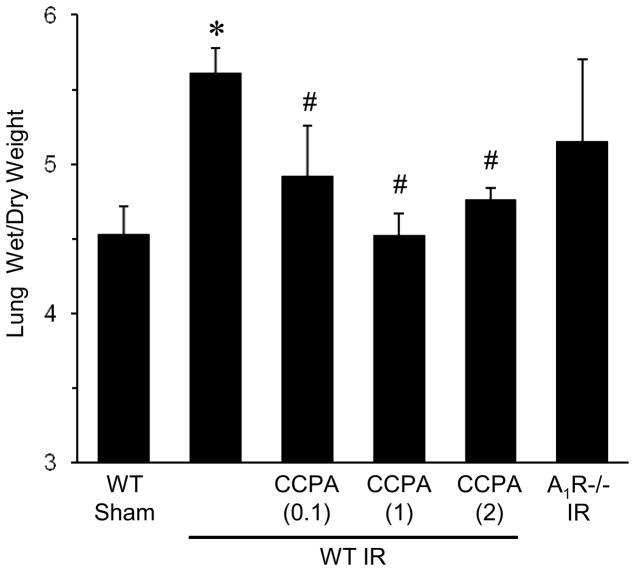
Figure 2. Pulmonary edema after IR is significantly reduced by CCPA
Lung wet/dry weight ratio was measured after IR or sham surgery in A1R−/− mice and in WT mice treated with vehicle or CCPA (doses in mg/kg are shown in parentheses) prior to ischemia. Lung wet/dry weight was significantly increased after IR in WT mice, which was significantly attenuated by CCPA treatment. Lung wet/dry weight after IR was also elevated in A1R−/− mice after IR similar to WT mice after IR. Lung wet/dry weight was similar between WT and A1R−/− mice after sham surgery (data not shown). *P < 0.05 vs. WT sham, #P < 0.05 vs. WT IR. Means ± SD are shown.
Figure 3
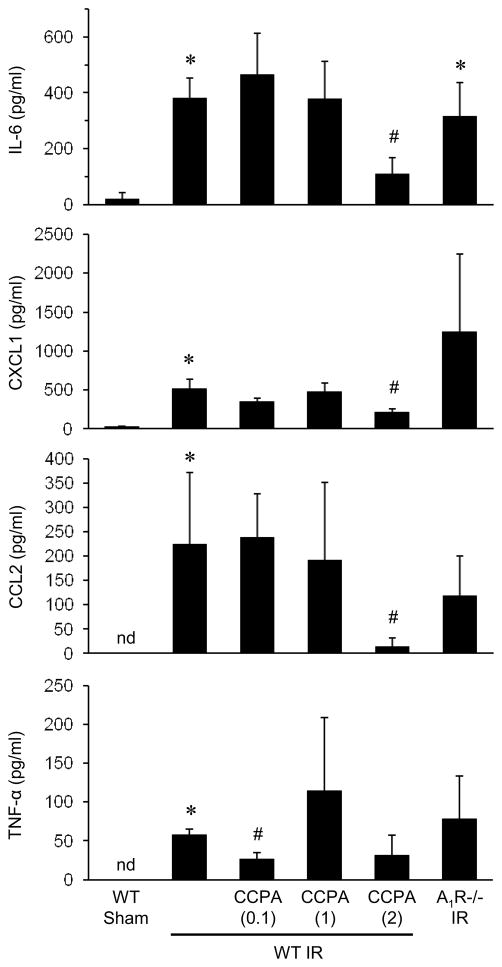
Figure 3. Expression of pro-inflammatory cytokines after IR is attenuated by CCPA
Cytokine levels in BAL fluid after IR or sham surgery were measured in A1R−/− mice and in WT mice treated with vehicle or CCPA (doses in mg/kg are shown in parentheses) prior to ischemia. Expression of IL-6, CXCL1, CCL2 and TNF-α were all significantly increased after IR in WT mice, and CCPA treatment significantly attenuated cytokine levels after IR. Cytokine levels after IR were elevated in A1R−/− mice after IR similar to WT mice after IR. *P < 0.05 vs. WT sham, #P < 0.05 vs. WT IR. nd = not detectable. Means ± SD are shown.
Figure 4
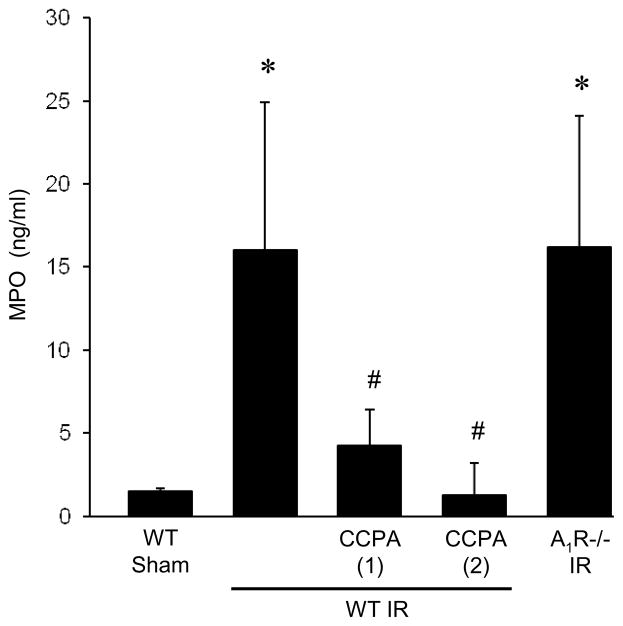
Figure 4. Myeloperoxidase (MPO) levels after IR are significantly reduced by CCPA
MPO levels in BAL fluid, as an estimate of neutrophil infiltration into alveolar airspaces, after IR or sham surgery were measured in A1R−/− mice and in WT mice treated with vehicle or CCPA (doses in mg/kg are shown in parentheses) prior to ischemia. Elevated MPO in WT mice after IR was significantly attenuated by CCPA. MPO levels were also elevated in A1R−/− mice after IR similar to WT mice after IR. *P < 0.05 vs. WT sham, #P < 0.05 vs. WT IR. Means ± SD are shown.
Figure 5
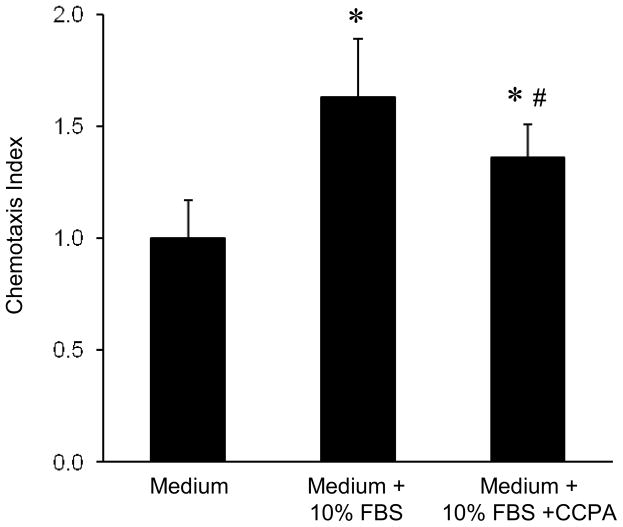
Figure 5. Neutrophil chemotaxis is significantly reduced by CCPA
Chemotaxis was measured in murine bone marrow-derived neutrophils as described in the methods. Chemotaxis was significantly increased in medium containing 10% FBS, which was significantly reduced by 10 ng/ml CCPA. *P < 0.001 vs. medium, #P = 0.03 vs. medium + 10% FBS. Means ± SD are shown.

References

    1. den Hengst WA, Gielis JF, Lin JY, Van Schil PE, De Windt LJ, Moens AL. Lung ischemia-reperfusion injury: a molecular and clinical view on a complex pathophysiological process. Am J Physiol Heart Circ Physiol. 2010;299:H1283–99. - PubMed
    1. Laubach VE, Kron IL. Pulmonary inflammation after lung transplantation. Surgery. 2009;146:1–4. - PMC - PubMed
    1. Fan M, Qin W, Mustafa SJ. Characterization of adenosine receptor(s) involved in adenosine-induced bronchoconstriction in an allergic mouse model. Am J Physiol Lung Cell Mol Physiol. 2003;284:L1012–9. - PubMed
    1. Salvatore CA, Jacobson MA, Taylor HE, Linden J, Johnson RG. Molecular cloning and characterization of the human A3 adenosine receptor. Proc Natl Acad Sci U S A. 1993;90:10365–9. - PMC - PubMed
    1. Gazoni LM, Walters DM, Unger EB, Linden J, Kron IL, Laubach VE. Activation of A1, A2A, or A3 adenosine receptors attenuates lung ischemia-reperfusion injury. J Thorac Cardiovasc Surg. 2010;140:440–6. - PMC - PubMed

Publication types

MeSH terms