


Randomized controlled trial comparing telephone and mail follow-up for recruitment of participants into a clinical trial of colorectal cancer screening
- PMID: 23399518
- PMCID: PMC3599938
- DOI: 10.1186/1745-6215-14-40
Randomized controlled trial comparing telephone and mail follow-up for recruitment of participants into a clinical trial of colorectal cancer screening
Abstract
Background: Investigators often face challenges when recruiting participants into randomized controlled trials (RCTs). Some data suggest that telephone reminders may lead to greater participant enrollment.
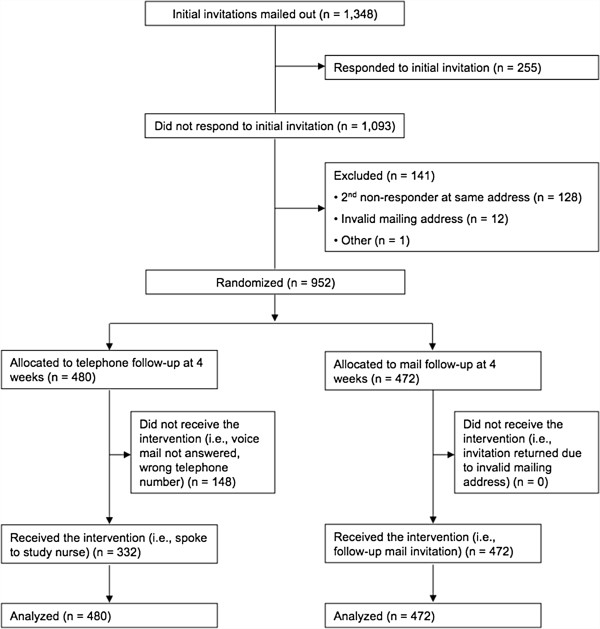
Methods: Patients aged 50 to 70 years from family practice rosters were initially mailed invitations to participate in an RCT of colorectal cancer screening. Patients who did not respond were randomly allocated to follow-up invitations by either telephone or mail four weeks after the initial invitation. The primary outcome was attendance for eligibility screening with the study nurse.
Results: After mailing invitations to 1,348 patients, 104 patients were initially enrolled in the RCT of colon cancer screening. Of 952 patients who did not respond to the initial mailed invitation, we randomly allocated 480 to follow-up invitation by telephone and 472 to follow-up invitation by mail. Attendance for eligibility screening with the study nurse was more frequent when non-responders were followed-up by telephone (84/480, 17.5%) than by mail (43/472, 9.1%) (relative risk (RR) 1.92, 95% confidence interval (CI) 1.36 to 2.71, P < 0.001). Enrollment into the RCT was also greater among patients followed-up by telephone (59/480, 12.3%) compared to those followed-up by mail (35/472, 7.4%) (RR 1.66, 95% CI 1.11 to 2.47, P=0.01).
Conclusions: Telephone-based follow-up results in greater enrollment compared to a mail-based method. Our findings should be of interest to investigators conducting RCTs, particularly trials of screening interventions involving asymptomatic participants for which volunteer participation may be challenging.
Trial registration: Clinicaltrials.gov NCT00865527.
References
-
- Swanson GM, Ward AJ. Recruiting minorities into clinical trials: toward a participant-friendly system. J Natl Cancer Inst. 1995;87(23):1747–1759. - PubMed
-
- Walson PD. Patient recruitment: US perspective. Pediatrics. 1999;104(3 Pt2):619–622. - PubMed
-
- Treweek S, Mitchell E, Pitkethly M, Cook J, Kjeldstrøm M, Taskila T, Johansen M, Sullivan F, Wilson S, Jackson C, Jones R. Strategies to improve recruitment to randomized controlled trials. Cochrane Database Syst Rev. 2010;1:MR000013. - PubMed
Publication types
MeSH terms
Associated data
LinkOut - more resources
Full Text Sources
Other Literature Sources
Medical
