. 2013 Feb 1;8(1):50-59.
doi: 10.1007/s11515-012-1198-y.

Alternative splicing switching in stem cell lineages

Affiliations

Alternative splicing switching in stem cell lineages

Iouri Chepelev et al. Front Biol (Beijing). .

Abstract

The application of stem cells to regenerative medicine depends on a thorough understanding of the molecular mechanisms underlying their pluripotency. Many studies have identified key transcription factor-regulated transcriptional networks and chromatin landscapes of embryonic and a number of adult stem cells. In addition, recent publications have revealed another interesting molecular feature of stem cells- a distinct alternative splicing pattern. Thus, it is possible that both the identity and activity of stem cells are maintained by stem cell-specific mRNA isoforms, while switching to different isoforms ensures proper differentiation. In this review, we will discuss the generality of mRNA isoform switching and its interaction with other molecular mechanisms to regulate stem cell pluripotency, as well as the reprogramming process in which differentiated cells are induced to become pluripotent stem cell-like cells (iPSCs).

Keywords: adult stem cells; alternative splicing; embryonic stem cells; epigenetic regulation; post-transcriptional regulation; stem cell maintenance and differentiation.


Figures
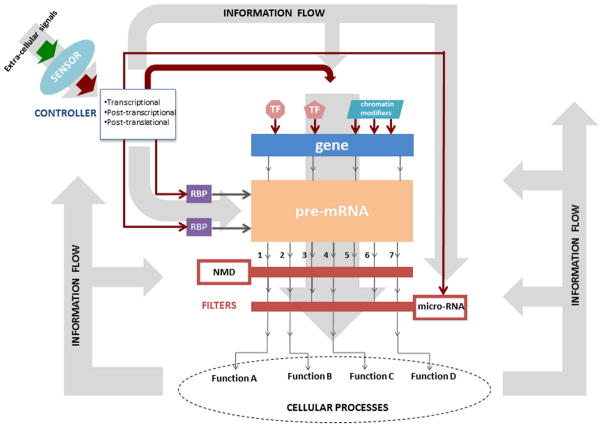
Figure 1
Figure 1
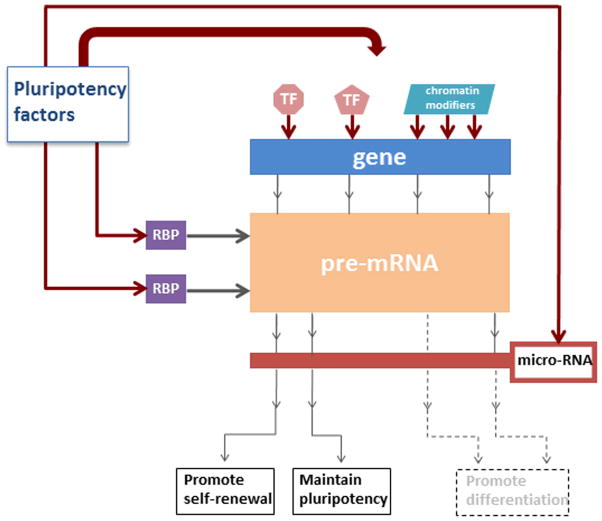
Figure 1A: A gene-centric view of the cellular information processing system (CIPS), see text for detailed explanation. Figure 1B: An example of applying the cellular information processing system (CIPS) framework to explain stem cell self-renewal and pluripotency. A multitude scenario can be used to explain how AS of pre-mRNAs can contribute to self-renewal and maintenance of multipotency/pluripotency of stem cells, as well as their cellular differentiation. Some possible scenarios are shown here: the general pluripotency factors can modulate the activity of RBPs which regulate pre-mRNA splicing. Additionally, the pluripotency factors can affect splicing indirectly by changing the chromatin template of the corresponding genes. The dotted line coming out from the “pre-mRNA” rectangle symbolizes a particular isoform, which is not produced by the splicing process. An isoform produced by the splicing process may still be filtered out by a micro-RNA filter as depicted by the dotted line coming out from the filter. The production of the protein that promotes cellular differentiation is thus inhibited. Instead, the protein that promotes self-renewal and maintains pluripotency is produced. See OCT4 and FOXP1 examples in the text. Abbreviations: TF - transcription factor; RBP -RNA binding protein; NMD - nonsense mediated decay.
Figure 1
Figure 1
Figure 1A: A gene-centric view of the cellular information processing system (CIPS), see text for detailed explanation. Figure 1B: An example of applying the cellular information processing system (CIPS) framework to explain stem cell self-renewal and pluripotency. A multitude scenario can be used to explain how AS of pre-mRNAs can contribute to self-renewal and maintenance of multipotency/pluripotency of stem cells, as well as their cellular differentiation. Some possible scenarios are shown here: the general pluripotency factors can modulate the activity of RBPs which regulate pre-mRNA splicing. Additionally, the pluripotency factors can affect splicing indirectly by changing the chromatin template of the corresponding genes. The dotted line coming out from the “pre-mRNA” rectangle symbolizes a particular isoform, which is not produced by the splicing process. An isoform produced by the splicing process may still be filtered out by a micro-RNA filter as depicted by the dotted line coming out from the filter. The production of the protein that promotes cellular differentiation is thus inhibited. Instead, the protein that promotes self-renewal and maintains pluripotency is produced. See OCT4 and FOXP1 examples in the text. Abbreviations: TF - transcription factor; RBP -RNA binding protein; NMD - nonsense mediated decay.

References

    1. Allemand E, Batsche E, Muchardt C. Splicing, transcription, and chromatin: a menage a trois. Curr Opin Genet Dev. 2008;18:145–51. - PubMed
    1. Allo M, Buggiano V, Fededa JP, Petrillo E, Schor I, de la Mata M, Agirre E, Plass M, Eyras E, Elela SA, et al. Control of alternative splicing through siRNA-mediated transcriptional gene silencing. Nat Struct Mol Biol. 2009;16:717–24. - PubMed
    1. Atlasi Y, Mowla SJ, Ziaee SA, Gokhale PJ, Andrews PW. OCT4 spliced variants are differentially expressed in human pluripotent and nonpluripotent cells. Stem Cells. 2008;26:3068–74. - PubMed
    1. Azuara V, Perry P, Sauer S, Spivakov M, Jorgensen HF, John RM, Gouti M, Casanova M, Warnes G, Merkenschlager M, et al. Chromatin signatures of pluripotent cell lines. Nat Cell Biol. 2006;8:532–8. - PubMed
    1. Barash Y, Calarco JA, Gao W, Pan Q, Wang X, Shai O, Blencowe BJ, Frey BJ. Deciphering the splicing code. Nature. 2010;465:53–9. - PubMed

LinkOut - more resources