


Racial differences in outcomes of triple-negative breast cancer
- PMID: 23400579
- PMCID: PMC4537526
- DOI: 10.1007/s10549-012-2397-6
Racial differences in outcomes of triple-negative breast cancer
Abstract
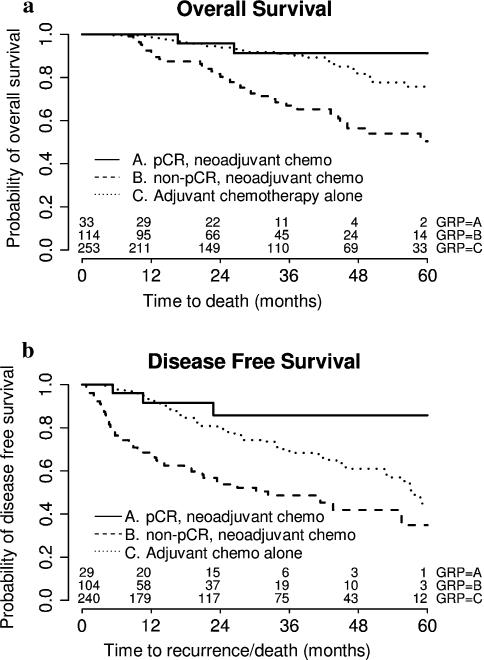
African American (AA) women have a higher incidence of triple-negative breast cancer (TNBC: negative for the expression of estrogen receptor, progesterone receptor, and HER2 gene amplification) than Caucasian (CA) women, explaining in part their higher breast cancer mortality. However, there have been inconsistent data in the literature regarding survival outcomes of TNBC in AA versus CA women. We performed a retrospective chart review on 493 patients with TNBC first seen at the Washington University Breast Oncology Clinic (WUBOC) between January 2006 and December 2010. Analysis was done on 490 women (30 % AA) for whom follow-up data was available. The median age at diagnosis was 53 (23-98) years and follow-up time was 27.2 months. There was no significant difference between AA and CA women in the age of diagnosis, median time from abnormal imaging to breast biopsy and from biopsy diagnosis to surgery, duration of follow-up, tumor stage, grade, and frequency of receiving neoadjuvant or adjuvant chemotherapy and pathologic complete response rate to neoadjuvant chemotherapy. There was no difference in disease free survival (DFS) and overall survival (OS) between AA and CA groups by either univariate or multivariate analysis that included age, race, and stage. The hazard ratio for AA women was 1.19 (CI 0.80-1.78, p = 0.39) and 0.91 (CI 0.62-1.35, p = 0.64) for OS and DFS, respectively. Among the 158 patients who developed recurrence or presented with stage IV disease (AA: n = 36, CA: n = 122), no racial differences in OS were observed. We conclude that race did not significantly affect the clinical presentation and outcome of TNBC in this single center study where patients received similar therapy and follow-up.
Figures

References
-
- Chlebowski RT, Chen Z, Anderson GL, Rohan T, Aragaki A, Lane D, Dolan NC, Paskett ED, McTiernan A, Hubbell FA, et al. Ethnicity and breast cancer: factors influencing differences in incidence and outcome. J Natl Cancer Inst. 2005;97(6):439–448. - PubMed
-
- Joslyn SA, West MM. Racial differences in breast carcinoma survival. Cancer. 2000;88(1):114–123. - PubMed
-
- Parker SL, Davis KJ, Wingo PA, Ries LA, Heath CW., Jr Cancer statistics by race and ethnicity. CA Cancer J Clin. 1998;48(1):31–48. - PubMed
-
- Siegel R, Naishadham D, Jemal A. Cancer statistics. CA Cancer J Clin. 2012;62(1):10–29. - PubMed
-
- Ayanian JZ, Kohler BA, Abe T, Epstein AM. The relation between health insurance coverage and clinical outcomes among women with breast cancer. NEJM. 1993;329(5):326–331. - PubMed
Publication types
MeSH terms
Substances
Grants and funding
LinkOut - more resources
Full Text Sources
Other Literature Sources
Medical
Research Materials
Miscellaneous
