


Lack of tissue renewal in human adult Achilles tendon is revealed by nuclear bomb (14)C
- PMID: 23401563
- PMCID: PMC3633810
- DOI: 10.1096/fj.12-225599
Lack of tissue renewal in human adult Achilles tendon is revealed by nuclear bomb (14)C
Abstract
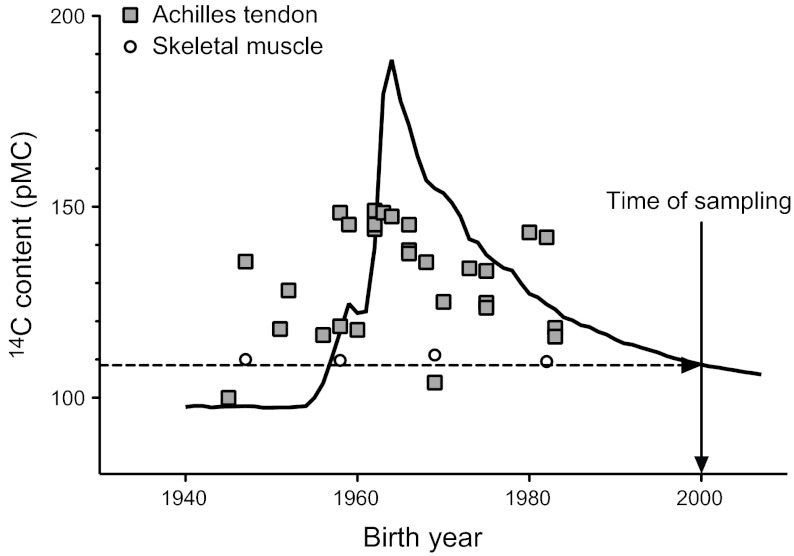
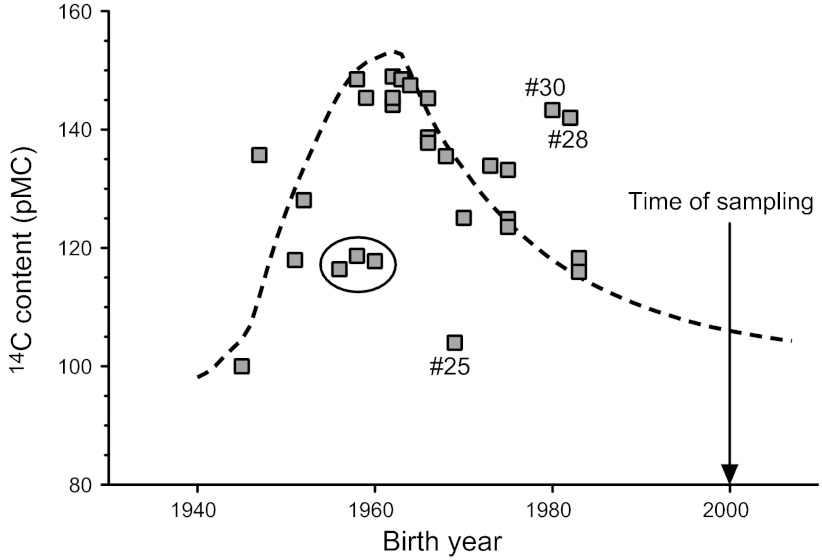
Tendons are often injured and heal poorly. Whether this is caused by a slow tissue turnover is unknown, since existing data provide diverging estimates of tendon protein half-life that range from 2 mo to 200 yr. With the purpose of determining life-long turnover of human tendon tissue, we used the (14)C bomb-pulse method. This method takes advantage of the dramatic increase in atmospheric levels of (14)C, produced by nuclear bomb tests in 1955-1963, which is reflected in all living organisms. Levels of (14)C were measured in 28 forensic samples of Achilles tendon core and 4 skeletal muscle samples (donor birth years 1945-1983) with accelerator mass spectrometry (AMS) and compared to known atmospheric levels to estimate tissue turnover. We found that Achilles tendon tissue retained levels of (14)C corresponding to atmospheric levels several decades before tissue sampling, demonstrating a very limited tissue turnover. The tendon concentrations of (14)C approximately reflected the atmospheric levels present during the first 17 yr of life, indicating that the tendon core is formed during height growth and is essentially not renewed thereafter. In contrast, (14)C levels in muscle indicated continuous turnover. Our observation provides a fundamental premise for understanding tendon function and pathology, and likely explains the poor regenerative capacity of tendon tissue.
Figures
References
-
- Kujala U.M., Sarna S., Kaprio J. (2005) Cumulative incidence of achilles tendon rupture and tendinopathy in male former elite athletes. Clin. J. Sport Med. 15, 133–135 - PubMed
-
- Riley G. (2008) Tendinopathy–from basic science to treatment. Nat. Clin. Pract. Rheumatol. 4, 82–89 - PubMed
-
- Babraj J. A., Cuthbertson D. J., Smith K., Langberg H., Miller B., Krogsgaard M. R., Kjaer M., Rennie M. J. (2005) Collagen synthesis in human musculoskeletal tissues and skin. Am. J. Physiol. Endocrinol. Metab. 289, E864–E869 - PubMed
Publication types
MeSH terms
Substances
LinkOut - more resources
Full Text Sources
Other Literature Sources
