. 2013 Jul 10;335(1):41-51.
doi: 10.1016/j.canlet.2013.01.054. Epub 2013 Feb 10.

Notch signaling pathway targeted therapy suppresses tumor progression and metastatic spread in pancreatic cancer

Affiliations

Notch signaling pathway targeted therapy suppresses tumor progression and metastatic spread in pancreatic cancer

Shinichi Yabuuchi et al. Cancer Lett. .

Abstract

Pancreatic ductal adenocarcinoma (PDA) remains a lethal human malignancy with historically limited success in treatment. The role of aberrant Notch signaling, which requires the constitutive activation of γ-secretase, in the initiation and progression of PDA is well defined and inhibitors of this pathway are currently in clinical trials. Here we investigated the in vivo therapeutic effect of PF-03084014, a selective γ-secretase inhibitor, alone and in combination with gemcitabine in pancreatic cancer xenografts. PF-03084014 treatment inhibited the cleavage of nuclear Notch 1 intracellular domain and Notch targets Hes-1 and Hey-1. Gemcitabine treatment showed good response but not capable of inducing tumor regressions and targeting the tumor-resident cancer stem cells (CD24(+)CD44(+) and ALDH(+) tumor cells). A combination of PF-03084014 and gemcitabine treatment resulted tumor regression in 3 of 4 subcutaneously implanted xenograft models. PF-03084014, and in combination with gemcitabine reduced putative cancer stem cells, indicating that PF-03084014 target the especially dangerous and resilient cancer stem cells within pancreatic tumors. Tumor re-growth curves plotted after drug treatments demonstrated that the effect of the combination therapy was sustainable than that of gemcitabine. Notably, in a highly aggressive orthotopic model, PF-03084014 and gemcitabine combination was effective in inducing apoptosis, inhibition of tumor cell proliferation and angiogenesis, resulting in the attenuation of primary tumor growth as well as controlling metastatic dissemination, compared to gemcitabine treatment. In summary, our preclinical data suggest that PF-03084014 has greater anti-tumor activity in combination with gemcitabine in PDA and provides rationale for further investigation of this combination in PDA.


Conflict of interest statement

Conflict of Interest Statement

None

Figures
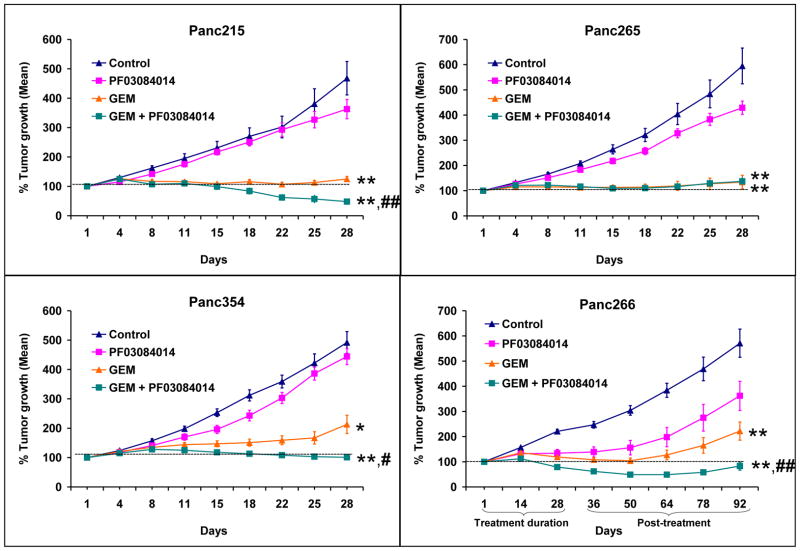
Figure 1
Figure 1
A combination of PF-03084014 and gemcitabine (GEM) produces durable tumor growth inhibition in subcutaneously implanted pancreatic cancer xenografts. Tumors from four individual patient-derived pancreatic cancer xenografts were implanted in athymic mice. Animals with established tumors were dosed with vehicle, PF-03084014, GEM or a combination of GEM with PF-03084014 as mentioned in the materials and methods. Tumor size was evaluated twice per week by caliper measurements. After 4 weeks drug treatment, Panc266 xenograft animals were maintained without further therapy. Tumor re-growth curves plotted after drug treatments demonstrate that the effect of the combination therapy was sustainable than that of GEM. Points, mean of tumor volume; bars, SEM (N = 8–10 tumors; *p<0.05, **p<0.01 compared to Control; #p<0.05, # #p<0.01 compared to GEM).
Figure 2
Figure 2
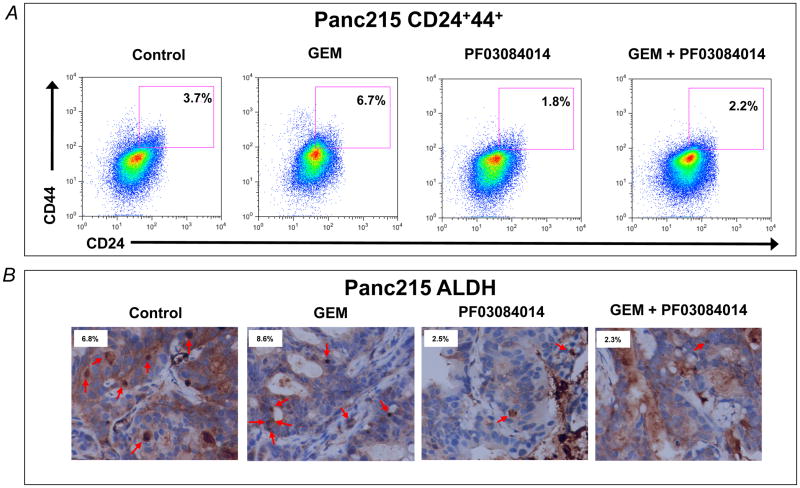
PF-03084014 monotherapy and combination of PF-03084014 with GEM is highly effective in reducing putative pancreatic cancer stem cells. A) Flow cytometry of tumor cells sorted from Panc215 (after 4 weeks of treatment). GEM treatment was not capable of diminishing the CSC pool as compared to the vehicle treated mice. However, PF-03084014 alone, and combination of PF-03084014 with GEM decreased in CD24+CD44+ tumor cells compared with GEM treatment (3.72 and 3.04-fold, respectively). B) Representative photomicrographs of ALDH staining, indicating that PF-03084014 and combination of PF-03084014 with GEM is highly effective in reducing ALDH+ cells. Both ALDH+ and ALDH- tumor cells were counted in 5 random high power fields of 2 tumors each from treatment arms and expressed as % ALDH+ cells. Arrowheads point towards ALDH+ cells. PF-03084014 alone, and combination of PF-03084014 with GEM decreased in ALDH+ tumor cells compared with GEM treatment (3.4 and 3.7-fold, respectively). Numbers inside the figures shows the average (%) of positively stained cells.
Figure 3
Figure 3
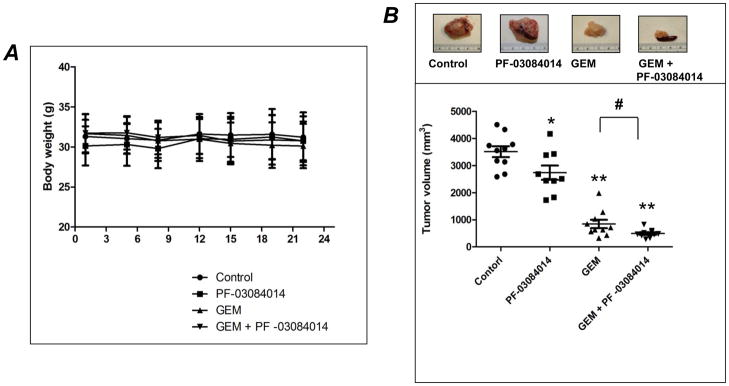
Combination of PF-03084014 with GEM blocks primary tumor progression in orthotopic pancreatic cancer xenograft (Panc265) model. A) Body weights of mice remained relatively stable during treatment period showing that therapies were well-tolerated and did not alter body weight compared to vehicle treated animals. B) Representative photomicrographs of primary tumors resected from control, PF-03084014, GEM and GEM plus PF-03084014 treated mice (upper panel). Primary tumor volumes of mice demonstrating that GEM + PF-03084014 combination is remarkably effective in suppressing primary tumor growth (lower panel). Photographs of excised primary tumors from representative mouse are shown in inset. Points, mean of tumor volume, bars SEM, N = 9–10 mice/group. *p<0.05 and **p<0.01 vs. control; # p<0.05 vs. GEM.
Figure 4
Figure 4
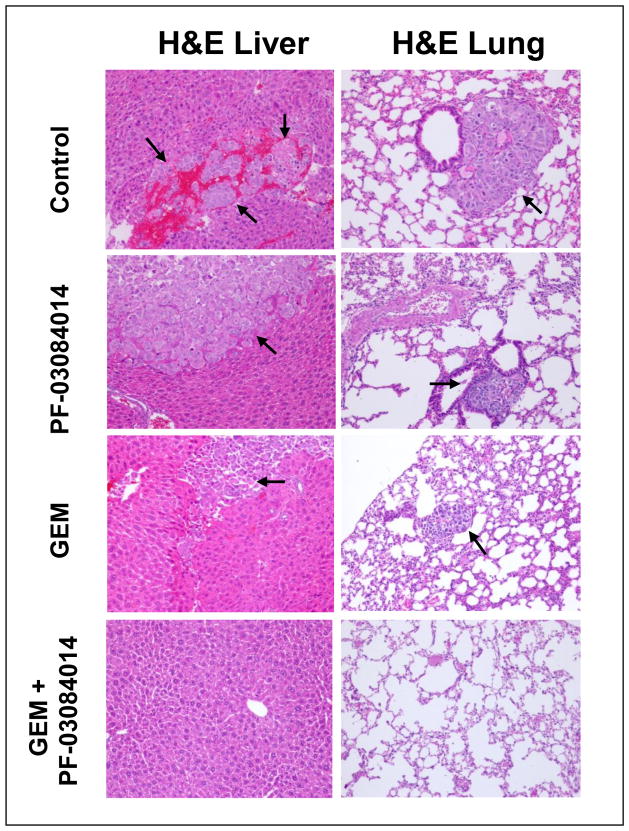
GEM + PF-03084014 combination therapy prevents the metastasis in liver and lungs. Representative H&E stained sections showing that GEM + PF-03084014 combination therapy prevents the metastasis in liver and lungs (10x magnifications). Arrowheads point towards metastatic area.
Figure 5
Figure 5
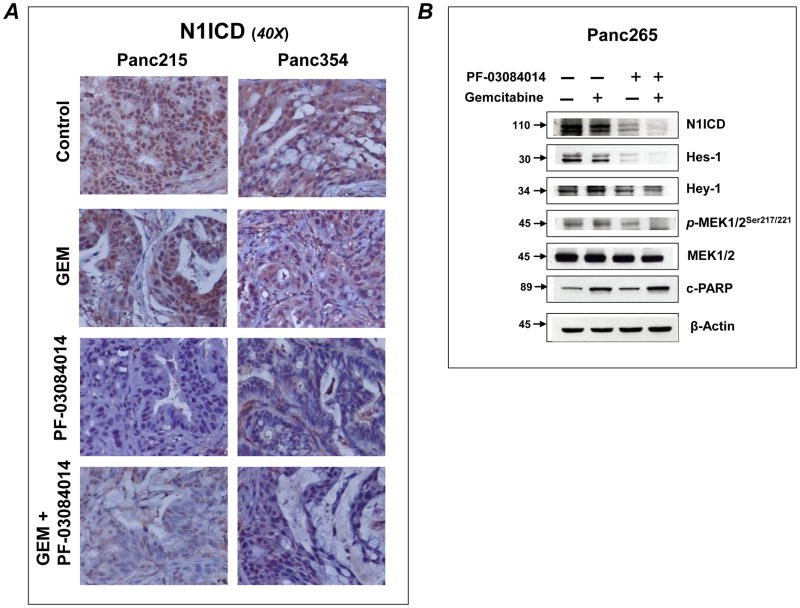
PF-03084014 treatment blocks the activation of N1ICD and inhibits the expression of Notch targets. A) Representative photo micrographs of Panc215 and Panc354 showing that PF-03084014 and combination of GEM plus PF-03084014 strongly inhibit the nuclear staining of N1ICD. B) Immunobloting of lysates from Panc265 orthotopic experiment demonstrating that PF-03084014 and combination of GEM plus PF-03084014 strongly inhibit N1ICD and the expression of Notch targets Hes-1 and Hey-1. Cleaved-PARP (c-PARP) levels were elevated in GEM and GEM plus PF-03084014 treatment, indicating higher apoptosis compared to Control or PF-03084014 treatment groups. While the treatments could not modulate MEK1/2 protein expression, PF-03084014 and combination of GEM plus PF-03084014 treatment inhibit MEK1/2 phosphorylation. Numbers on the left side of the blots indicate the molecular weight of the proteins in kilodaltons.
Figure 6
Figure 6
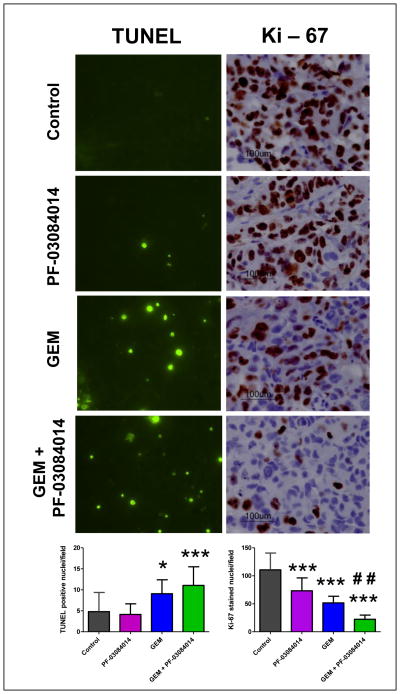
Combination PF-03084014 with GEM induces apoptosis, suppresses cell proliferation. Representative photomicrographs of TUNEL and Ki-67 stained tumor sections (40x magnifications). Quantitation of TUNEL+ and Ki-67+ tumor nuclei (bottom). Data represent the mean ± SD of TUNEL or Ki-67 positive nuclei in five different high-power fields per xenograft sections from 3 independent tumours of treatment arms. *p<0.05 and ***p<0.0001 vs. control; ## p<0.001 vs. GEM.
Figure 7
Figure 7
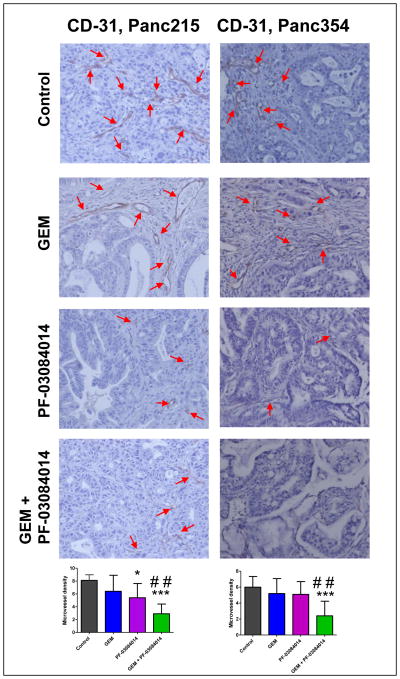
Representative photo micrograph of CD31 immunostaining (20x) in Panc215 and Panc354. In Panc215, treatment with PF-03084014 or combination of GEM plus PF-03084014 leads to a significant reduction in endothelial-specific antigen CD-31, when compared to vehicle-treated tumors. Arrowheads point towards CD31 stained endothelial cells. *p<05, ***p<0.0001 vs. control; ##p<0.001 vs. GEM.
Figure 8
Figure 8
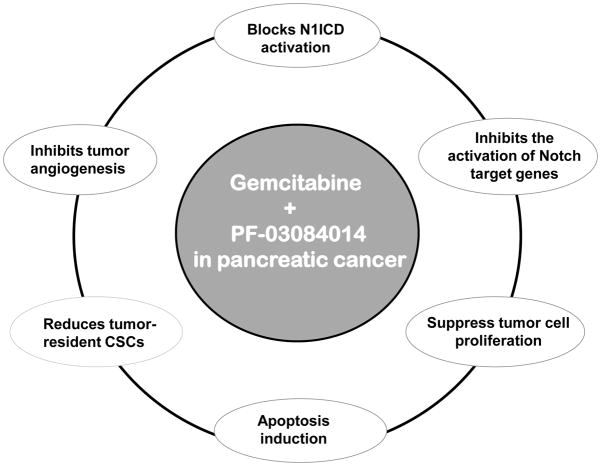
A simplified schematic diagram illustrating the mechanisms responsible for the enhanced anti-tumor and anti-metastatic properties of PF-03084014 plus GEM combination in pancreatic cancer xenografts.

References

    1. Feig C, Gopinathan A, Neesse A, Chan DS, Cook N, Tuveson DA. The pancreas cancer microenvironment. Clin Cancer Res. 2012;18:4266–4276. - PMC - PubMed
    1. Maitra A, Hruban RH. Pancreatic cancer. Annu Rev Pathol. 2008;3:157–188. - PMC - PubMed
    1. Hidalgo M. Pancreatic cancer. N Engl J Med. 2010;362:1605–1617. - PubMed
    1. Jones S, Zhang X, Parsons DW, Lin JC, Leary RJ, Angenendt P, Mankoo P, Carter H, Kamiyama H, Jimeno A, Hong SM, Fu B, Lin MT, Calhoun ES, Kamiyama M, Walter K, Nikolskaya T, Nikolsky Y, Hartigan J, Smith DR, Hidalgo M, Leach SD, Klein AP, Jaffee EM, Goggins M, Maitra A, Iacobuzio-Donahue C, Eshleman JR, Kern SE, Hruban RH, Karchin R, Papadopoulos N, Parmigiani G, Vogelstein B, Velculescu VE, Kinzler KW. Core signaling pathways in human pancreatic cancers revealed by global genomic analyses. Science. 2008;321:1801–1806. - PMC - PubMed
    1. De La OJ, Emerson LL, Goodman JL, Froebe SC, Illum BE, Curtis AB, Murtaugh LC. Notch and Kras reprogram pancreatic acinar cells to ductal intraepithelial neoplasia. Proc Natl Acad Sci U S A. 2008;105:18907–18912. - PMC - PubMed

Publication types

MeSH terms