Frequencies and prognostic impact of RAS mutations in MLL-rearranged acute lymphoblastic leukemia in infants
- PMID: 23403319
- PMCID: PMC3669451
- DOI: 10.3324/haematol.2012.067983
Frequencies and prognostic impact of RAS mutations in MLL-rearranged acute lymphoblastic leukemia in infants
Abstract
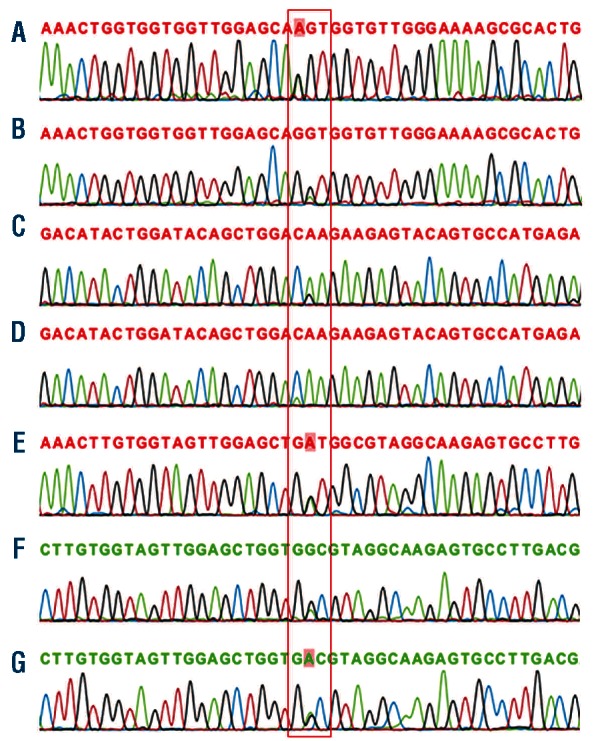
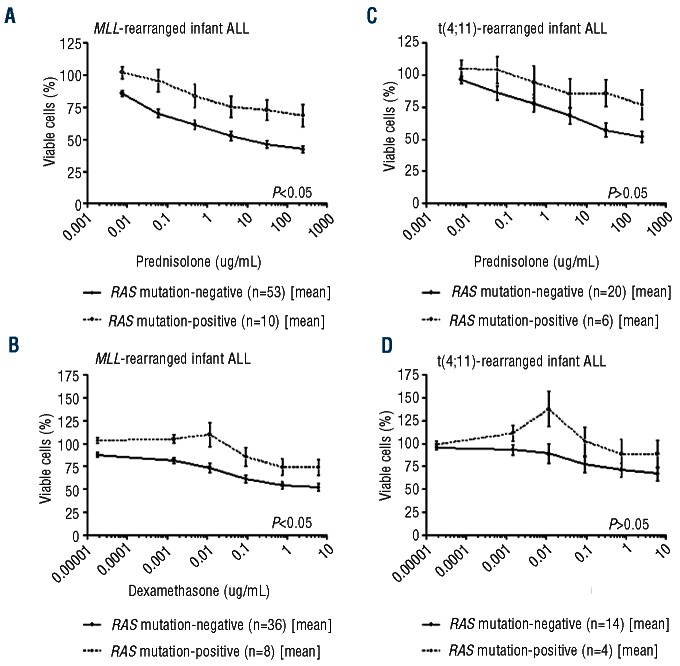
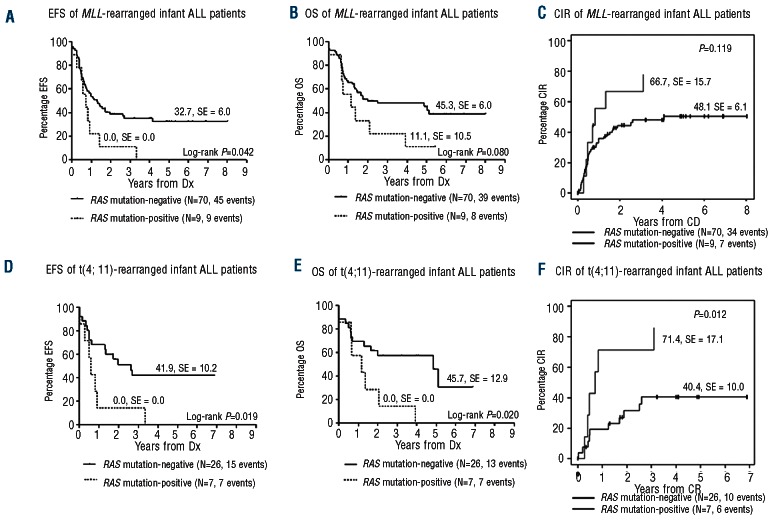
Acute lymphoblastic leukemia in infants represents an aggressive malignancy associated with a high incidence (approx. 80%) of translocations involving the Mixed Lineage Leukemia (MLL) gene. Attempts to mimic Mixed Lineage Leukemia fusion driven leukemogenesis in mice raised the question whether these fusion proteins require secondary hits. RAS mutations are suggested as candidates. Earlier results on the incidence of RAS mutations in Mixed Lineage Leukemia-rearranged acute lymphoblastic leukemia are inconclusive. Therefore, we studied frequencies and relation with clinical parameters of RAS mutations in a large cohort of infant acute lymphoblastic leukemia patients. Using conventional sequencing analysis, we screened neuroblastoma RAS viral (v-ras) oncogene homolog gene (NRAS), v-Ki-ras Kirsten rat sarcoma viral oncogene homolog gene (KRAS), and v-raf murine sarcoma viral oncogene homolog B1 gene (BRAF) for mutations in a large cohort (n=109) of infant acute lymphoblastic leukemia patients and studied the mutations in relation to several clinical parameters, and in relation to Homeobox gene A9 expression and the presence of ALL1 fused gene 4-Mixed Lineage Leukemia (AF4-MLL). Mutations were detected in approximately 14% of all cases, with a higher frequency of approximately 24% in t(4;11)-positive patients (P=0.04). Furthermore, we identified RAS mutations as an independent predictor (P=0.019) for poor outcome in Mixed Lineage Leukemia-rearranged infant acute lymphoblastic leukemia, with a hazard ratio of 3.194 (95% confidence interval (CI):1.211-8.429). Also, RAS-mutated infants have higher white blood cell counts at diagnosis (P=0.013), and are more resistant to glucocorticoids in vitro (P<0.05). Finally, we demonstrate that RAS mutations, and not the lack of Homeobox gene A9 expression nor the expression of AF4-MLL are associated with poor outcome in t(4;11)-rearranged infants. We conclude that the presence of RAS mutations in Mixed Lineage Leukemia-rearranged infant acute lymphoblastic leukemia is an independent predictor for a poor outcome. Therefore, future risk-stratification based on abnormal RAS-pathway activation and RAS-pathway inhibition could be beneficial in RAS-mutated infant acute lymphoblastic leukemia patients.
Figures
References
-
- Greaves MF. Infant leukaemia biology, aetiology and treatment. Leukemia. 1996;10(2): 372–7 - PubMed
-
- Pieters R, Schrappe M, De Lorenzo P, Hann I, De Rossi G, Felice M, et al. A treatment protocol for infants younger than 1 year with acute lymphoblastic leukaemia (Interfant-99): an observational study and a multicentre randomised trial. Lancet. 2007; 370(9583):240–50 - PubMed
-
- Metzler M, Forster A, Pannell R, Arends MJ, Daser A, Lobato MN, et al. A conditional model of MLL-AF4 B-cell tumourigenesis using invertor technology. Oncogene. 2006; 25(22):3093–103 - PubMed
Publication types
MeSH terms
Substances
LinkOut - more resources
Full Text Sources
Other Literature Sources
Molecular Biology Databases
Research Materials
Miscellaneous