Norms and trends of sleep time among US children and adolescents
- PMID: 23403646
- PMCID: PMC5814130
- DOI: 10.1001/jamapediatrics.2013.423
Norms and trends of sleep time among US children and adolescents
Abstract
Objectives: To develop national sleep norms conditional on age and to examine stratification by sex, race/ethnicity, and changes over time.
Design: Secondary analysis of a panel survey.
Setting: The 3 waves (1997, 2002, and 2007) of the Child Development Supplement of the Panel Study of Income Dynamics, a nationally representative survey.
Participants: Children from birth to 18 years with time-diary data were included: 2832 children in 1997, 2520 children in 2002, and 1424 children in 2007.
Main exposure: Age.
Main outcome measures: Minutes of sleep for daytime and total sleep.
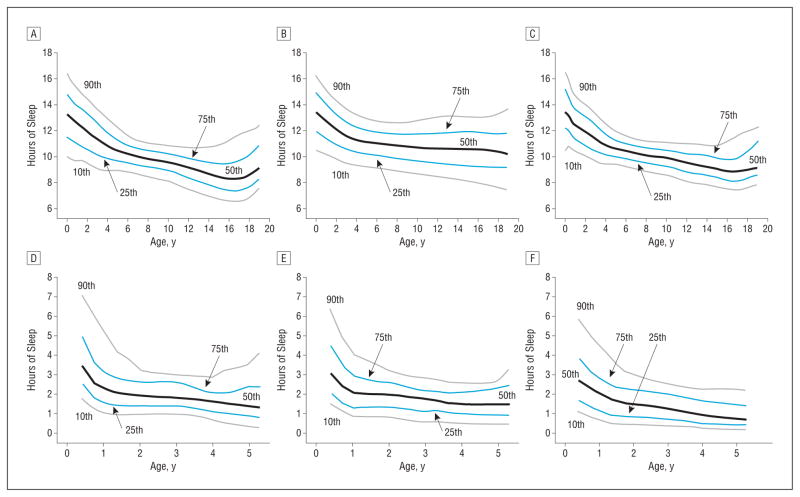
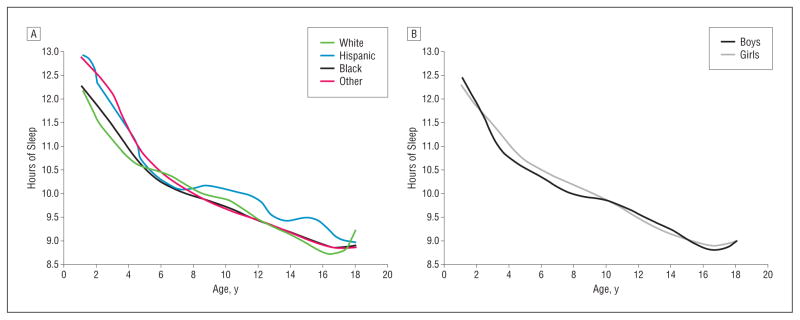
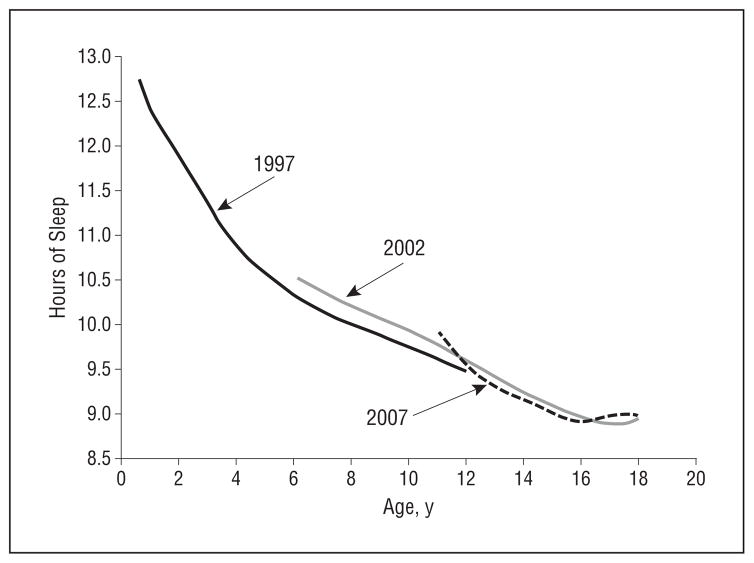
Results: The 10th, 25th, 50th, 75th, and 90th percentiles of the distribution of children's minutes of sleep conditional on age were estimated using a double-kernel estimator that incorporates sample weights. Total average sleep was estimated at more than 13 hours a day for infants, decreasing steadily throughout childhood and early adolescence, reaching about 9 hours a day for 14- to 18-year-olds. The estimated conditional percentiles were higher on weekends than on weekdays for older children. The conditional percentiles for the weekend sleep minutes were flatter with respect to age than the weekday sleep minutes. The interquartile ranges were greater for children younger than 6 years and for teenagers. The medians stratified by race/ethnicity and sex were similar for most ages. For different survey years, the estimated medians were within a few minutes of each other.
Conclusions: These estimates are consistent with the amount of sleep recommended for children, and no evidence was found of racial/ethnic differences.
Conflict of interest statement
Figures
Comment in
-
How much sleep is "normal" in children and adolescents?JAMA Pediatr. 2013 Jan;167(1):91-2. doi: 10.1001/jamapediatrics.2013.429. JAMA Pediatr. 2013. PMID: 23403792 No abstract available.
References
-
- Chervin RD, Dillon JE, Bassetti C, Ganoczy DA, Pituch KJ. Symptoms of sleep disorders, inattention, and hyperactivity in children. Sleep. 1997;20(12):1185–1192. - PubMed
-
- Stein MA, Mendelsohn J, Obermeyer WH, Amromin J, Benca R. Sleep and behavior problems in school-aged children [published online April 1, 2001] [Accessed September 11, 2012];Pediatrics. 2001 107(4):E60. http://pediatrics.aappublications.org/content/107/4/e60.long. - PubMed
-
- Gupta NK, Mueller WH, Chan W, Meininger JC. Is obesity associated with poor sleep quality in adolescents? Am J Hum Biol. 2002;14(6):762–768. - PubMed
MeSH terms
Grants and funding
LinkOut - more resources
Full Text Sources
Other Literature Sources
Medical