


Degraded environments alter prey risk assessment
- PMID: 23403754
- PMCID: PMC3568841
- DOI: 10.1002/ece3.388
Degraded environments alter prey risk assessment
Erratum in
-
Erratum.Ecol Evol. 2018 May 1;8(10):5219. doi: 10.1002/ece3.4172. eCollection 2018 May. Ecol Evol. 2018. PMID: 29876096 Free PMC article.
Abstract
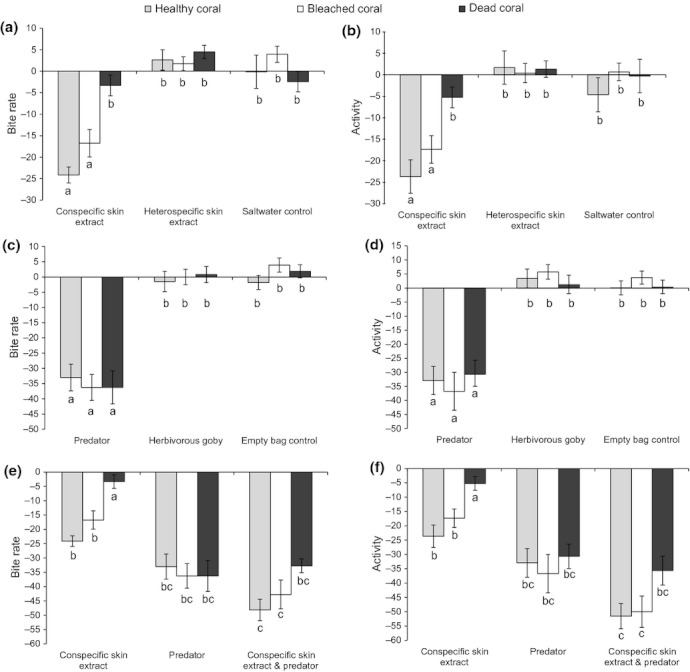
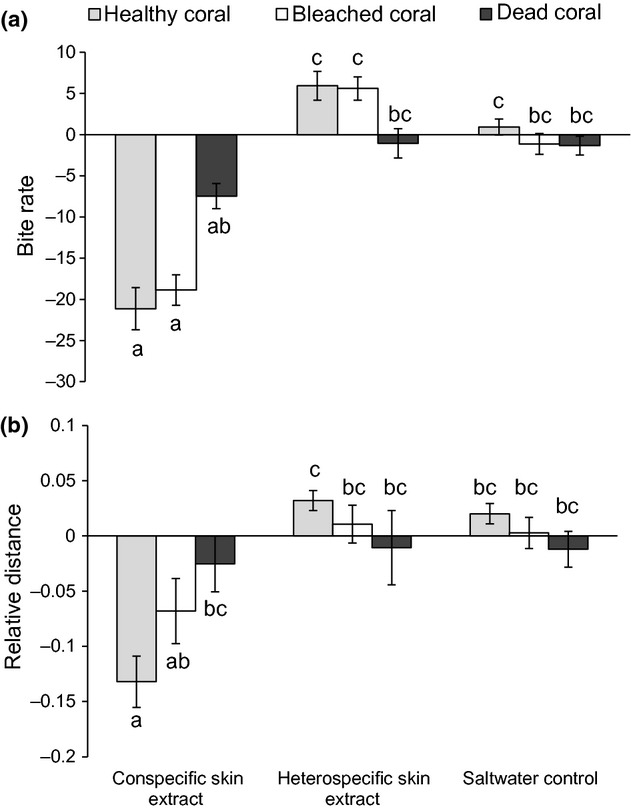
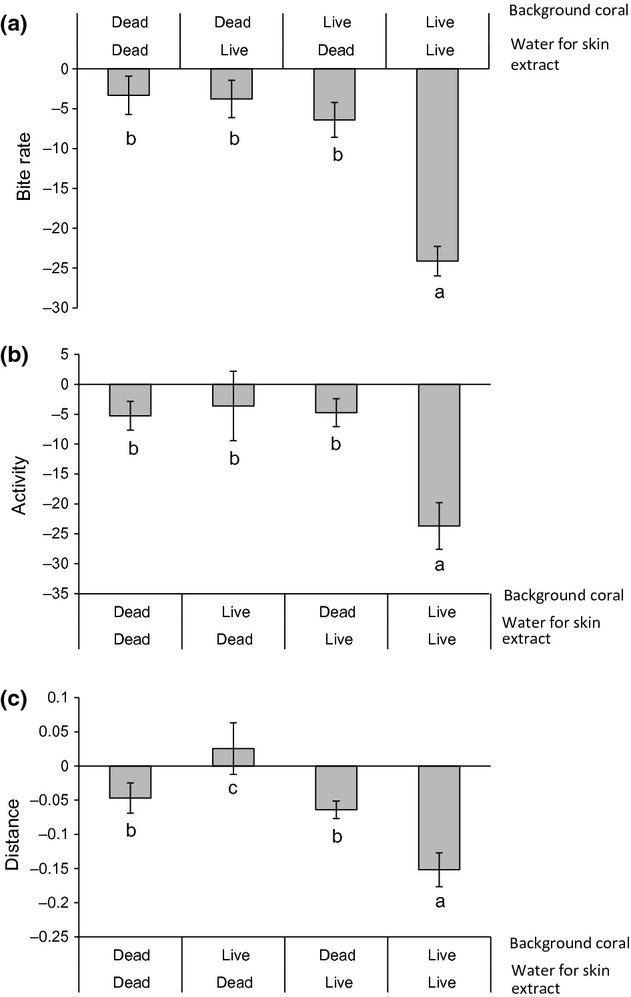
Elevated water temperatures, a decrease in ocean pH, and an increasing prevalence of severe storms have lead to bleaching and death of the hard corals that underpin coral reef ecosystems. As coral cover declines, fish diversity and abundance declines. How degradation of coral reefs affects behavior of reef inhabitants is unknown. Here, we demonstrate that risk assessment behaviors of prey are severely affected by coral degradation. Juvenile damselfish were exposed to visual and olfactory indicators of predation risk in healthy live, thermally bleached, and dead coral in a series of laboratory and field experiments. While fish still responded to visual cues in all habitats, they did not respond to olfactory indicators of risk in dead coral habitats, likely as a result of alteration or degradation of chemical cues. These cues are critical for learning and avoiding predators, and a failure to respond can have dramatic repercussions for survival and recruitment.
Keywords: Chemical alarm cues; Pomacentrus amboinensis; Pseudochromis fuscus; coral degradation; coral reefs; predation.
Figures
References
-
- Abrams PA. The evolution of predator-prey interactions: theory and evidence. Annu. Rev. Ecol. Syst. 2000;31:79–105.
-
- Almany GR, Webster MS. The predation gauntlet: early post-settlement mortality in reef fishes. Coral Reefs. 2006;25:19–22.
-
- Anthony KRN, Connolly SR, Hoegh-Guldberg O. Bleaching, energetics, and coral mortality risk: effects of temperature, light, and sediment regime. Limnol. Oceanogr. 2007;52(2):716–726.
-
- Booth DJ, Beretta GA. Changes in a fish assemblage after a coral bleaching event. Mar. Ecol. Prog. Ser. 2002;245:205–212.
-
- Coker DJ, Pratchett MS, Munday PL. Coral bleaching and habitat degradation increase susceptibility to predation for coral-dwelling fishes. Behav. Ecol. 2009;20:1204–1210.
LinkOut - more resources
Full Text Sources
Other Literature Sources
Research Materials
