


Simulated 50 % radiation dose reduction in coronary CT angiography using adaptive iterative dose reduction in three-dimensions (AIDR3D)
- PMID: 23404384
- PMCID: PMC3701132
- DOI: 10.1007/s10554-013-0190-1
Simulated 50 % radiation dose reduction in coronary CT angiography using adaptive iterative dose reduction in three-dimensions (AIDR3D)
Abstract
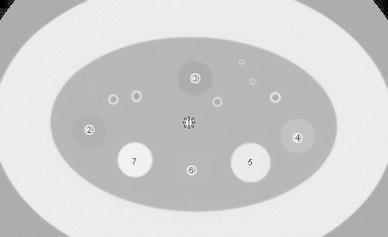
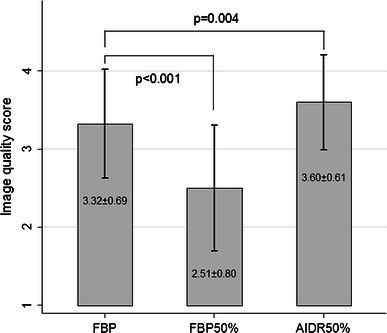
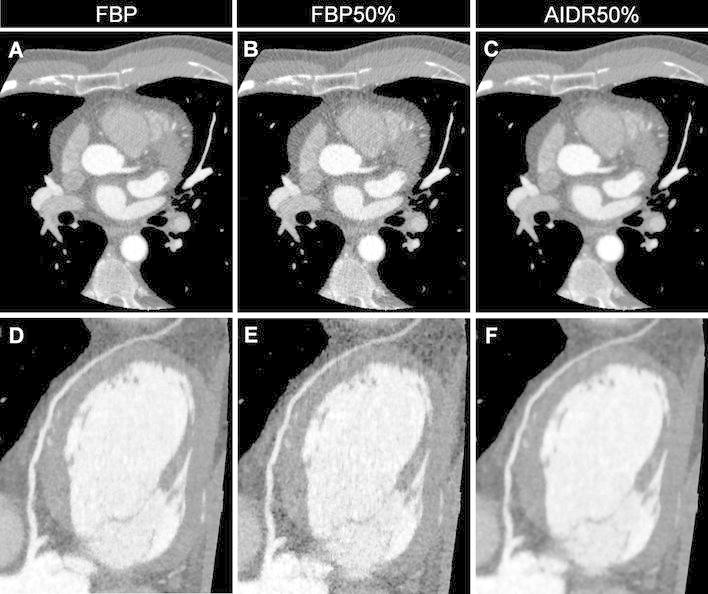
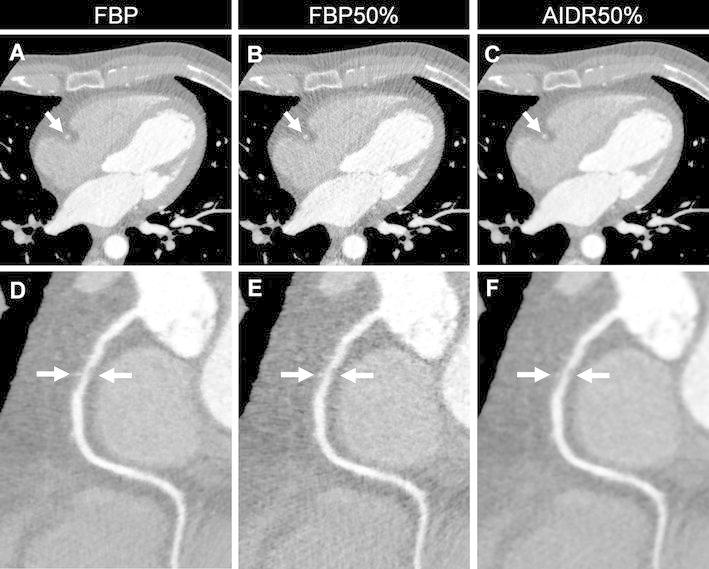
To compare the image quality of coronary CT angiography (CTA) studies between standard filtered back projection (FBP) and adaptive iterative dose reduction in three-dimensions (AIDR3D) reconstruction using CT noise additional software to simulate reduced radiation exposure. Images from 93 consecutive clinical coronary CTA studies were processed utilizing standard FBP, FBP with 50% simulated dose reduction (FBP50%), and AIDR3D with simulated 50% dose reduction (AIDR50%). Signal-to-noise ratio (SNR) and contrast-to-noise ratio (CNR) were measured within 5 regions-of-interest, and image quality for each reconstruction strategy was assessed by two independent readers using a 4-point scale. Compared to FBP, the SNR measured from the AIDR50% images was similar or higher (airway: 38.3 ± 12.7 vs. 38.5 ± 14.5, p = 0.81, fat: 5.5 ± 1.9 vs. 5.4 ± 2.0, p = 0.20, muscle: 3.2 ± 1.2 vs. 3.1 ± 1.3, p = 0.38, aorta: 22.6 ± 9.4 vs. 20.2 ± 9.7, p < 0.0001, liver: 2.7 ± 1.0 vs. 2.3 ± 1.1, p < 0.0001), while the SNR of the FBP50 % images were all lower (p values < 0.0001). The CNR measured from AIDR50% images was also higher than that from the FBP images for the aorta relative to muscle (20.5 ± 9.0 vs. 18.3 ± 9.2, p < 0.0001). The interobserver agreement in the image quality score was excellent (κ = 0.82). The quality score was significantly higher for the AIDR50% images compared to the FBP images (3.6 ± 0.6 vs. 3.3 ± 0.7, p = 0.004). Simulated radiation dose reduction applied to clinical coronary CTA images suggests that a 50% reduction in radiation dose can be achieved with adaptive iterative dose reduction software with image quality that is at least comparable to images acquired at standard radiation exposure and reconstructed with filtered back projection.
Figures
References
-
- Mark DB, Berman DS, Budoff MJ, Carr JJ, Gerber TC, Hecht HS, Hlatky MA, Hodgson JM, Lauer MS, Miller JM, Morin RL, Mukherjee D, Poon M, Rubin GD, Schwartz RS. ACCF/ACR/AHA/NASCI/SAIP/SCAI/SCCT 2010 expert consensus document on coronary computed tomographic angiography: a report of the American College of Cardiology Foundation Task Force on Expert Consensus Documents. Circulation. 2010;121(22):2509–2543. doi: 10.1161/CIR.0b013e3181d4b618. - DOI - PubMed
-
- Paech DC, Weston AR. A systematic review of the clinical effectiveness of 64-slice or higher computed tomography angiography as an alternative to invasive coronary angiography in the investigation of suspected coronary artery disease. BMC Cardiovasc Disord. 2011;11:32. doi: 10.1186/1471-2261-11-32. - DOI - PMC - PubMed
Publication types
MeSH terms
Substances
LinkOut - more resources
Full Text Sources
Other Literature Sources
Miscellaneous
