. 2013 Feb 8:4:9.
doi: 10.3389/fmicb.2013.00009. eCollection 2013.

Antibiotics as selectors and accelerators of diversity in the mechanisms of resistance: from the resistome to genetic plasticity in the β-lactamases world

Affiliations

Antibiotics as selectors and accelerators of diversity in the mechanisms of resistance: from the resistome to genetic plasticity in the β-lactamases world

Juan-Carlos Galán et al. Front Microbiol. .

Abstract

Antibiotics and antibiotic resistance determinants, natural molecules closely related to bacterial physiology and consistent with an ancient origin, are not only present in antibiotic-producing bacteria. Throughput sequencing technologies have revealed an unexpected reservoir of antibiotic resistance in the environment. These data suggest that co-evolution between antibiotic and antibiotic resistance genes has occurred since the beginning of time. This evolutionary race has probably been slow because of highly regulated processes and low antibiotic concentrations. Therefore to understand this global problem, a new variable must be introduced, that the antibiotic resistance is a natural event, inherent to life. However, the industrial production of natural and synthetic antibiotics has dramatically accelerated this race, selecting some of the many resistance genes present in nature and contributing to their diversification. One of the best models available to understand the biological impact of selection and diversification are β-lactamases. They constitute the most widespread mechanism of resistance, at least among pathogenic bacteria, with more than 1000 enzymes identified in the literature. In the last years, there has been growing concern about the description, spread, and diversification of β-lactamases with carbapenemase activity and AmpC-type in plasmids. Phylogenies of these enzymes help the understanding of the evolutionary forces driving their selection. Moreover, understanding the adaptive potential of β-lactamases contribute to exploration the evolutionary antagonists trajectories through the design of more efficient synthetic molecules. In this review, we attempt to analyze the antibiotic resistance problem from intrinsic and environmental resistomes to the adaptive potential of resistance genes and the driving forces involved in their diversification, in order to provide a global perspective of the resistance problem.

Keywords: environmental resistome; intrinsic resistome; plasticity; β-lactamase.


Figures
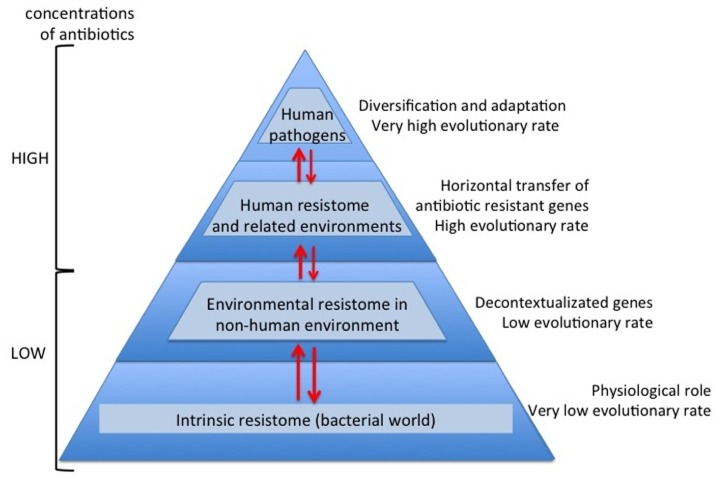
FIGURE 1
FIGURE 1
Overview evolutionary processes of the antibiotic resistance. During millions of years antibiotics and antibiotic resistance genes have co-evolved slowly. In this long period the first transition was the acquisition of pre-resistance genes by different bacteria (exaptation). This genetic transference allowed the evolution toward true and more efficient antibiotic resistance genes. However, the great evolutionary transition was the discovery, mass production and consumption of antibiotics. Antibiotics accelerated dramatically the diversification of resistance genes and selection for reaching extraordinary efficient variants.
FIGURE 2
FIGURE 2
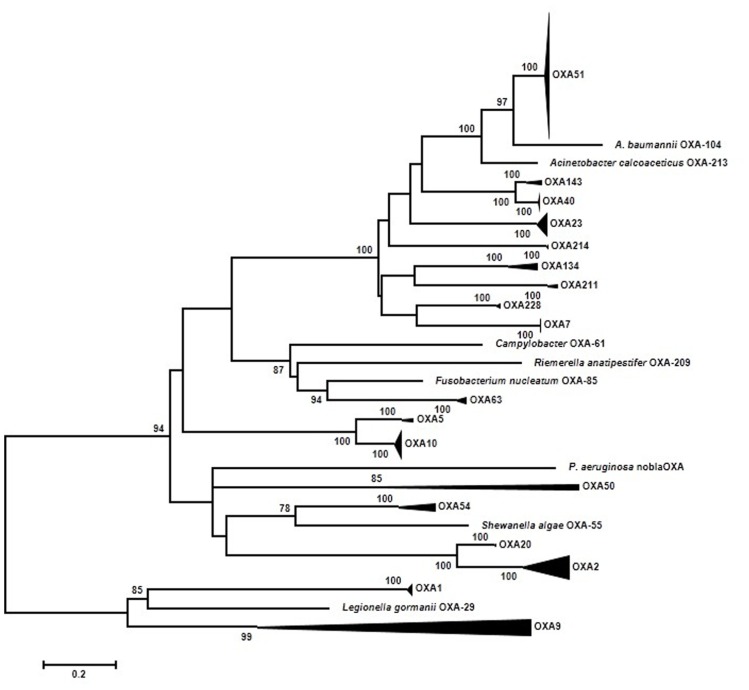
Summarized representation of the maximum-likelihood tree of OXA genes obtained with the K2P + GI model of evolution. Multiple nucleotide sequence alignments were obtained using the corresponding amino acid sequences with Muscle (Edgar, 2004a,b). Maximum-likelihood trees were obtained using the most appropriate model of evolution resulting from the comparison of Bayesian Information Criterion (BIC) values for 24 alternative models including gamma-distributed heterogeneous rates of evolution among and invariant sites. Support of the inferred clusters was evaluated with 1000 bootstrap replicates; BS values >70% are indicated. All these methods were used as implemented in MEGA 5 (Tamura et al., 2011). The scale bar corresponds to substitutions/site. The role of natural selection was investigated at the codon level by analyzing the difference between dN–dS substitution rates at different positions. Based on the corresponding maximum likelihood trees using a Muse–Gaut model (Muse and Gaut, 1994) of codon substitution and the Tamura–Nei model of nucleotide substitution (Tamura and Nei, 1993). Computation of dN/dS was performed with the Hyphy software package (Kosakovsky Pond et al., 2005). Additionally, two tests of neutrality were applied to the three data sets: the Fisher’s exact test of neutrality and a test based on bootstrapping (1000 replicates) of dN–dS values from which a variance of the corresponding statistic is derived in order to test the null hypothesis of neutrality (dN = dS). These tests were performed using MEGA 5 (Tamura et al., 2011).
FIGURE 3
FIGURE 3
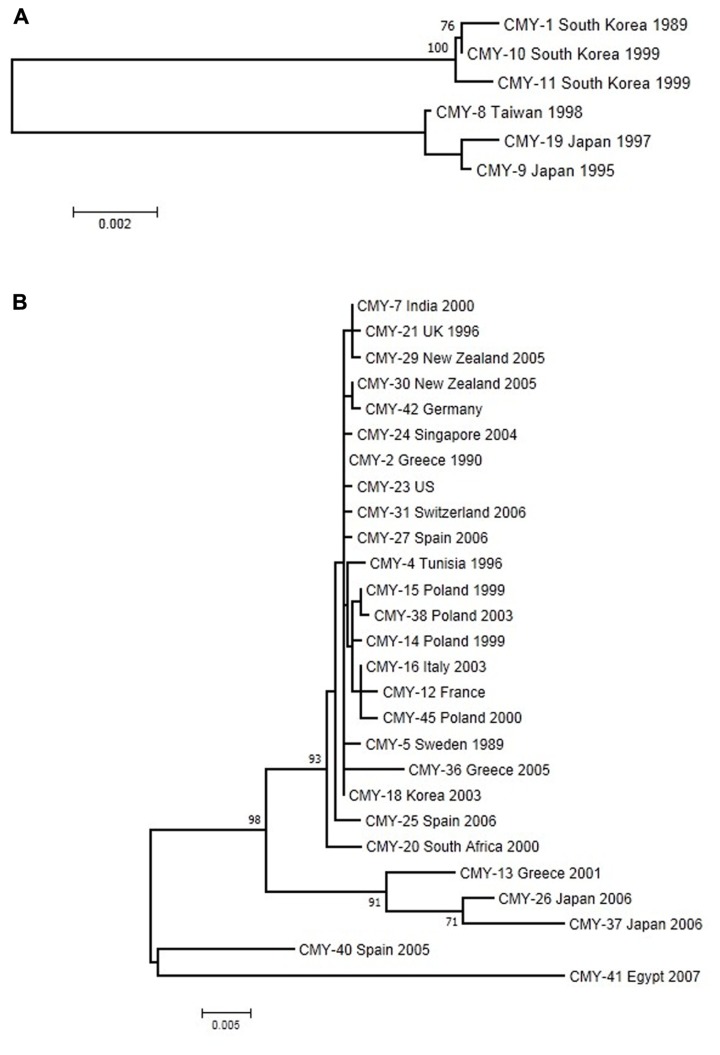
Maximum-likelihood tree of CMY genes obtained with the Tamura-3P + G model of evolution. (A) The upper tree corresponds to CMY-1 group. (B) The lower one to the CMY-2 group of sequences. Multiple sequence alignments were obtained using the corresponding amino acid sequences with Muscle (Edgar, 2004a,b). Maximum-likelihood trees were obtained using the most appropriate model of evolution resulting from the comparison of Bayesian Information Criterion (BIC) values for 24 alternative models including gamma-distributed heterogeneous rates of evolution among and invariant sites. Support of the inferred clusters was evaluated with 1000 bootstrap replicates, BS values >70% are indicated. All these methods were used as implemented in MEGA 5 (Tamura et al., 2011). The scale bar corresponds to substitutions/site. Detection of positive selection and neutrality tests were performed as described in Figure 2.
FIGURE 4
FIGURE 4
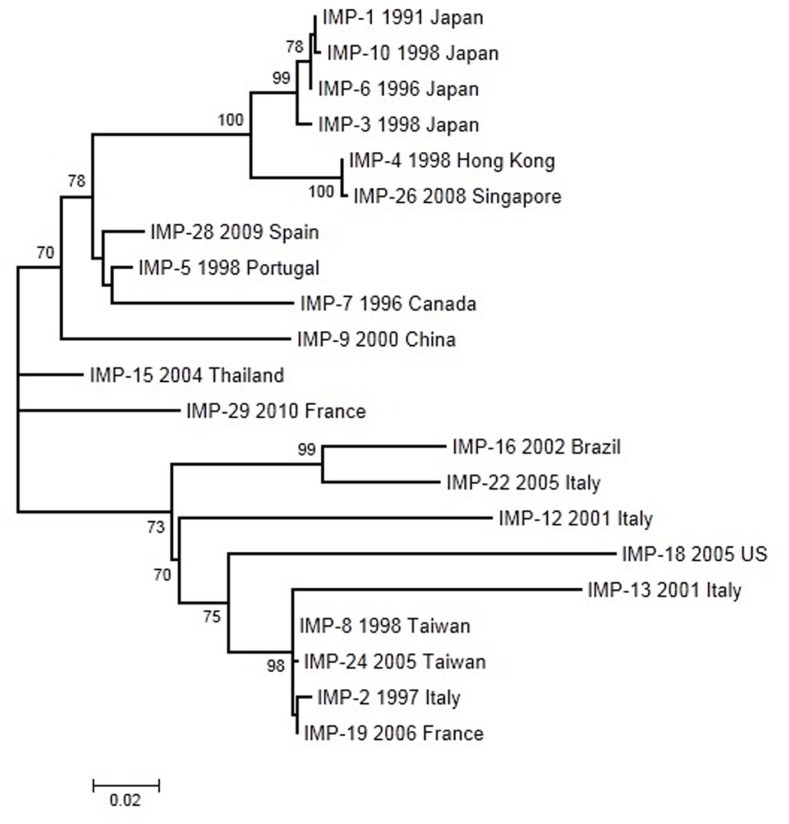
Maximum-likelihood tree of IMP genes obtained with the Tamura-3P model of evolution. Multiple sequence alignments were obtained using the corresponding amino acid sequences with Muscle (Edgar, 2004a,b). Maximum-likelihood trees were obtained using the most appropriate model of evolution resulting from the comparison of Bayesian Information Criterion (BIC) values for 24 alternative models including gamma-distributed heterogeneous rates of evolution among and invariant sites. Support of the inferred clusters was evaluated with 1000 bootstrap replicates, BS values >70% are indicated. All these methods were used as implemented in MEGA 5 (Tamura et al., 2011). The scale bar corresponds to substitutions/site. Detection of positive selection and neutrality tests were performed as described in Figure 2.

References

    1. Abriata L. A., Merijn L., Salverda M., Tomatis P. E. (2012). Sequence-function-stability relationships in proteins from datasets of functionally annotated variants: the case of TEM β-lactamases. FEBS Lett. 586 3330–3335 - PubMed
    1. Alekshun M. N., Levy S. B. (2007). Molecular mechanisms of antibacterial multidrug resistance. Cell 128 1037–1050 - PubMed
    1. Allen H. K., Donato J., Wang H. H., Cloud-Hansen K. A., Davies J., Handelsman J. (2010). Call of the wild: antibiotic resistance genes in natural environments. Nat. Rev. Microbiol. 8 251–259 - PubMed
    1. Allen H. K., Moe L. A., Rodbumrer J., Gaarder A., Handelsman J. (2009). Functional metagenomics reveals diverse beta-lactamases in a remote Alaskan soil. ISME J. 3 243–251 - PubMed
    1. Archetti M. (2009). Survival of the steepest: hypersensitivity to mutations as an adaptation to soft selection. J. Evol. Biol. 22 740–750 - PubMed

LinkOut - more resources