


Impact of the World Health Organization's Surgical Safety Checklist on safety culture in the operating theatre: a controlled intervention study
- PMID: 23404986
- PMCID: PMC3630285
- DOI: 10.1093/bja/aet005
Impact of the World Health Organization's Surgical Safety Checklist on safety culture in the operating theatre: a controlled intervention study
Abstract
Background: Positive changes in safety culture have been hypothesized to be one of the mechanisms behind the reduction in mortality and morbidity after the introduction of the World Health Organization's Surgical Safety Checklist (SSC). We aimed to study the checklist effects on safety culture perceptions in operating theatre personnel using a prospective controlled intervention design at a single Norwegian university hospital.
Methods: We conducted a study with pre- and post-intervention surveys using the intervention and control groups. The primary outcome was the effects of the Norwegian version of the SSC on safety culture perceptions. Safety culture was measured using the validated Norwegian version of the Hospital Survey on Patient Safety Culture. Descriptive characteristics of operating theatre personnel and checklist compliance data were also recorded. A mixed linear regression model was used to assess changes in safety culture.
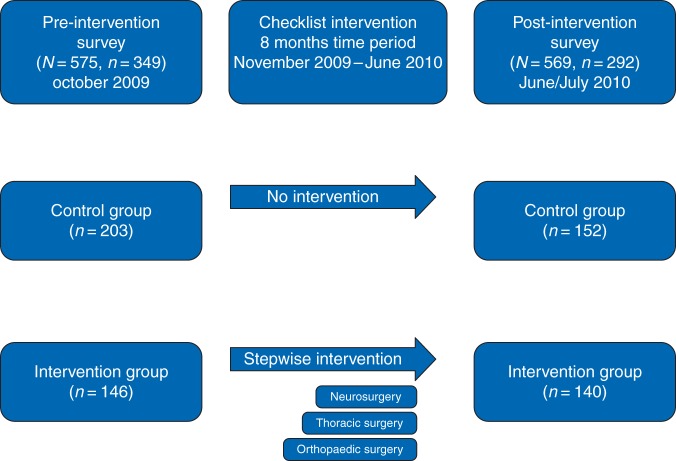
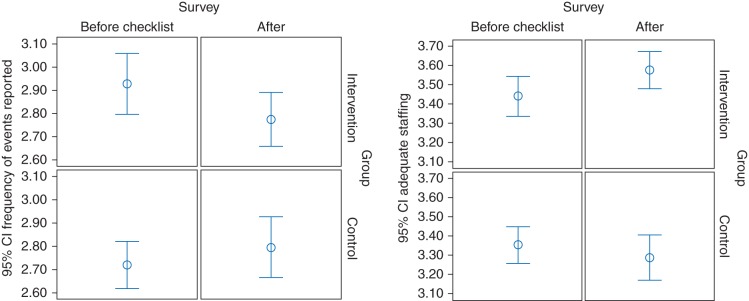
Results: The response rate was 61% (349/575) at baseline and 51% (292/569) post-intervention. Checklist compliance ranged from 77% to 85%. We found significant positive changes in the checklist intervention group for the culture factors 'frequency of events reported' and 'adequate staffing' with regression coefficients at -0.25 [95% confidence interval (CI), -0.47 to -0.07] and 0.21 (95% CI, 0.07-0.35), respectively. Overall, the intervention group reported significantly more positive culture scores-including at baseline.
Conclusions: Implementation of the SSC had rather limited impact on the safety culture within this hospital.
Figures
Comment in
-
Evidence appraisal of Haugen AS, Søfteland E, Eide GE, et al. Impact of the World Health Organization's Surgical Safety Checklist on safety culture in the operating theatre: a controlled intervention study. Br J Anaesth. 2013;110(5):807-815.AORN J. 2013 Dec;98(6):663-8. doi: 10.1016/j.aorn.2013.10.003. AORN J. 2013. PMID: 24396941 No abstract available.
References
-
- Weiser TG, Regenbogen SE, Thompson KD, et al. An estimation of the global volume of surgery: a modelling strategy based on available data. Lancet. 2008;372:139–44. doi:10.1016/S0140-6736(08)60878-8. - DOI - PubMed
-
- Kohn LT, Corrigan JM, Donaldson MS. To Err Is Human: Building a Safer Health System. Washington, DC: National Academy Press; 2000. - PubMed
-
- IOM. Crossing the Quality Chasm: A New Health System for the 21st Century. Washington, DC: National Academy Press; 2001. - PubMed
-
- de Vries EN, Ramrattan MA, Smorenburg SM, Gouma DJ, Boermeester MA. The incidence and nature of in-hospital adverse events: a systematic review. Qual Saf Health Care. 2008;17:216–23. doi:10.1136/qshc.2007.023622. - DOI - PMC - PubMed
-
- WHO. World Health Organization Guidelines for Safe Surgery. 2009. Available from http://whqlibdoc.who.int/publications/2009/9789241598552_eng.pdf. (accessed 27 July 2012) - PubMed
Publication types
MeSH terms
LinkOut - more resources
Full Text Sources
Other Literature Sources
