


Body conscious? Interoceptive awareness, measured by heartbeat perception, is negatively correlated with self-objectification
- PMID: 23405173
- PMCID: PMC3565964
- DOI: 10.1371/journal.pone.0055568
Body conscious? Interoceptive awareness, measured by heartbeat perception, is negatively correlated with self-objectification
Abstract
Background: 'Self-objectification' is the tendency to experience one's body principally as an object, to be evaluated for its appearance rather than for its effectiveness. Within objectification theory, it has been proposed that self-objectification accounts for the poorer interoceptive awareness observed in women, as measured by heartbeat perception. Our study is, we believe, the first specifically to test this relationship.
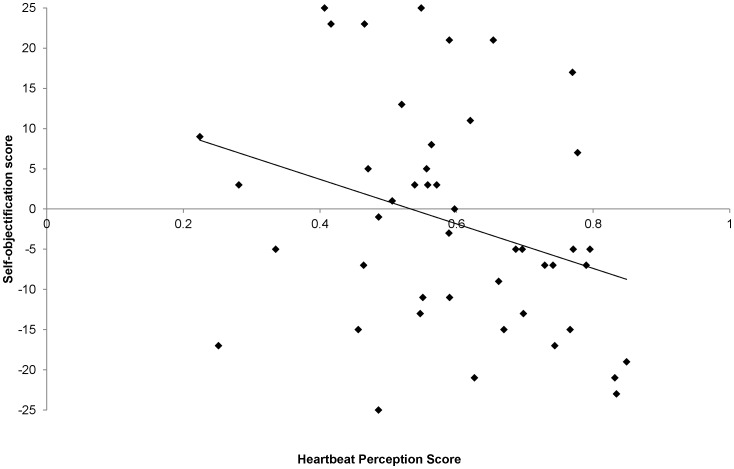
Methodology/principal findings: Using a well-validated and reliable heartbeat perception task, we measured interoceptive awareness in women and compared this with their scores on the Self-Objectification Questionnaire, the Self-Consciousness Scale and the Body Consciousness Questionnaire. Interoceptive awareness was negatively correlated with self-objectification. Interoceptive awareness, public body consciousness and private body consciousness together explained 31% of the variance in self-objectification. However, private body consciousness was not significantly correlated with interoceptive awareness, which may explain the many nonsignificant results in self-objectification studies that have used private body consciousness as a measure of body awareness.
Conclusions/significance: We propose interoceptive awareness, assessed by heartbeat perception, as a measure of body awareness in self-objectification studies. Our findings have implications for those clinical conditions, in women, which are characterised by self-objectification and low interoceptive awareness, such as eating disorders.
Conflict of interest statement
Figures
References
-
- Blanke O, Metzinger T (2009) Full-body illusions and minimal phenomenal selfhood. Trends Cog Sci 13 (1) 7–13 doi:10.1016/j.tics.2008.10.003. - DOI - PubMed
-
- Keenan JP, Wheeler MA, Gallup GG, Pascal-Leone A (2000) Self-recognition and the right prefrontal cortex. Trends Cog Sci 4 (9) 338–344 doi:10.1016/S1364-6613(00)01521-7. - DOI - PubMed
-
- Rochat P, Zahavi D (2010) The uncanny mirror: A re-framing of mirror self-experience. Con Cog 20 (2) 204–213 doi:10.1016/j.concog.2010.06.007. - DOI - PubMed
-
- Mor N, Winquist J (2002) Self-focused attention and negative affect: A meta-analysis. Psychol Bull 128 (4) 638–662 doi:10.1037//0033-2909.128.4.638. - DOI - PubMed
-
- Moradi B, Huang Y-P (2008) Objectification theory and psychology of women: A decade of advances and future directions. Psychol Women Q 32 (4) 377–398 doi:10.1111/j.1471-6402.2008.00452.x. - DOI
Publication types
MeSH terms
LinkOut - more resources
Full Text Sources
Other Literature Sources
