BMI change, fitness change and cardiometabolic risk factors among 8th grade youth
- PMID: 23406707
- PMCID: PMC3702158
- DOI: 10.1123/pes.25.1.52
BMI change, fitness change and cardiometabolic risk factors among 8th grade youth
Abstract
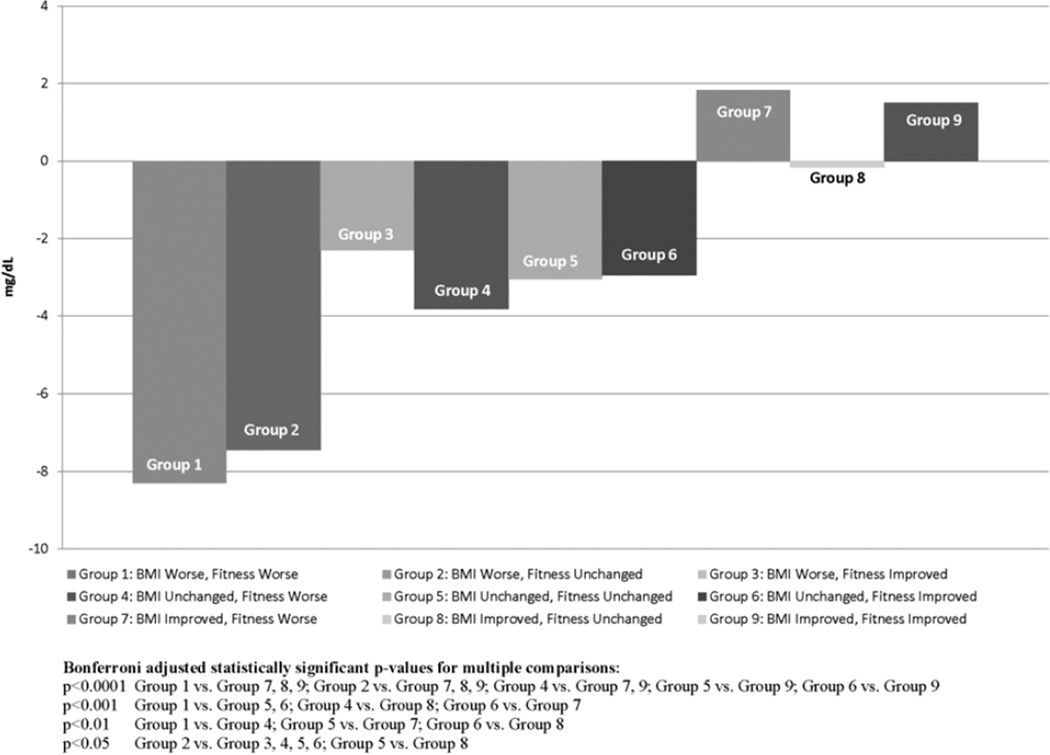
This paper examined whether a two-year change in fitness, body mass index (BMI) or the additive effect of change in fitness and BMI were associated with change in cardiometabolic risk factors among youth. Cardiometabolic risk factors, BMI group (normal weight, overweight or obese) were obtained from participants at the start of 6th grade and end of 8th grade. Shuttle run laps were assessed and categorized in quintiles at both time points. Regression models were used to examine whether changes in obesity, fitness or the additive effect of change in BMI and fitness were associated with change in risk factors. There was strong evidence (p < .001) that change in BMI was associated with change in cardiometabolic risk factors. There was weaker evidence of a fitness effect, with some evidence that change in fitness was associated with change in total cholesterol, HDL-C, LDL-C and clustered risk score among boys, as well as HDL-C among girls. Male HDL-C was the only model for which there was some evidence of a BMI, fitness and additive BMI*fitness effect. Changing body mass is central to the reduction of youth cardiometabolic risk. Fitness effects were negligible once change in body mass had been taken into account.
Figures
References
-
- American Medical Association. Expert Committee Recommendations on the Assessment, Prevention, and Treatment of Child and Adolescent Overweight and Obesity. [Accessed 11/02/2007];2007 Available at: www.ama-assn.org/ama1/pub/upload/mm/433/ped_obesity_recs.pdf.
-
- Andersen LB, Harro M, Sardinha LB, et al. Physical activity and clustered cardiovascular risk in children: a cross-sectional study (The European Youth Heart Study) Lancet. 2006;368:299–304. - PubMed
-
- Bao W, Threefoot SA, Srinivasan SR, Berenson GS. Essential hypertension predicted by tracking of elevated blood pressure from childhood to adulthood: The Bogalusa Heart Study. Am. J. Hypertens. 1995;8:657–665. - PubMed
-
- Blair SN, Cheng Y, Holder S. Is physical activity or physical fitness more important in defining health benefits? Med. Sci. Sports Exerc. 2001;33:S379–S399. - PubMed
-
- Blair SN, Kohl HW, 3rd, Barlow CE, Paffenbarger RS, Jr, Gibbons LW, Macera CA. Changes in physical fitness and all-cause mortality. A prospective study of healthy and unhealthy men. JAMA. 1995;273:1093–1098. - PubMed