


CDC Grand Rounds: the growing threat of multidrug-resistant gonorrhea
- PMID: 23407126
- PMCID: PMC4604802
Item in Clipboard
CDC Grand Rounds: the growing threat of multidrug-resistant gonorrhea
MMWR Morb Mortal Wkly Rep.
.
Abstract
Although gonorrhea has afflicted humans for centuries, and the causative bacterium, Neisseria gonorrhoeae, was identified more than a century ago, gonorrhea remains a public health problem in the United States. Gonorrhea is the second most commonly reported notifiable infection in the United States; >300,000 cases were reported in 2011. In the United States, health inequities persist; the incidence of reported gonorrhea among blacks is 17 times the rate among whites, likely because of structural socioeconomic factors.
Figures
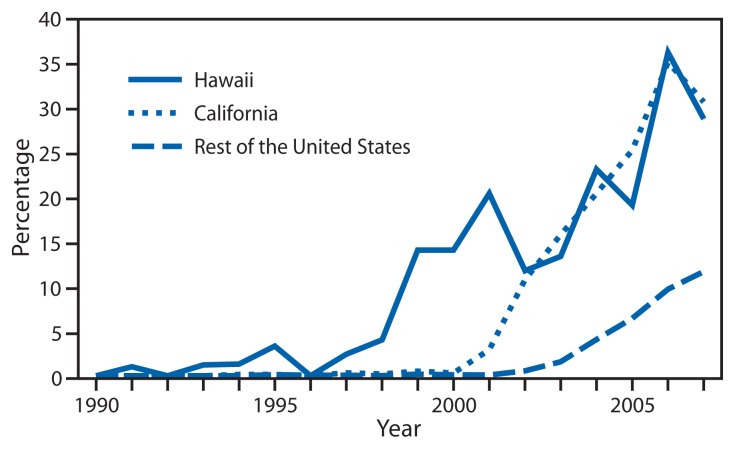
Prevalence of ciprofloxacin resistance* in urethral Neisseria gonorrhoeae isolates collected from men in the United States, by location — Gonococcal Isolate Surveillance Project, 1990–2007 * Defined as minimum inhibitory concentrations ≥1 μg/mL.
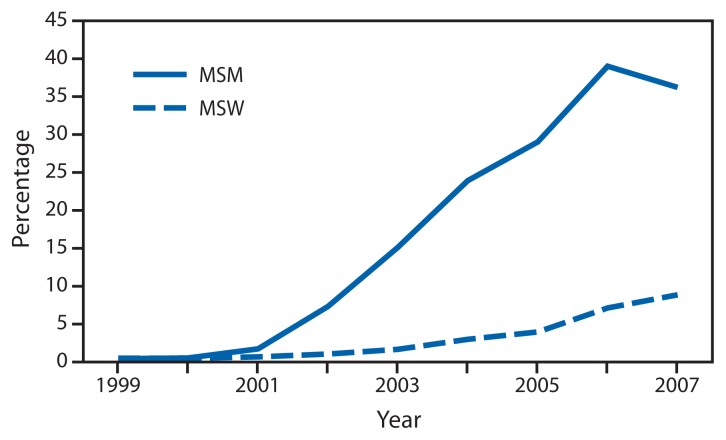
Prevalence of ciprofloxacin resistance* in urethral Neisseria gonorrhoeae isolates collected from men in the United States, by gender of sex partner — Gonococcal Isolate Surveillance Project, 1999–2007 Abbreviations: MSM = men who have sex with men; MSW = men who have sex exclusively with women. * Defined as minimum inhibitory concentrations ≥1 μg/mL.
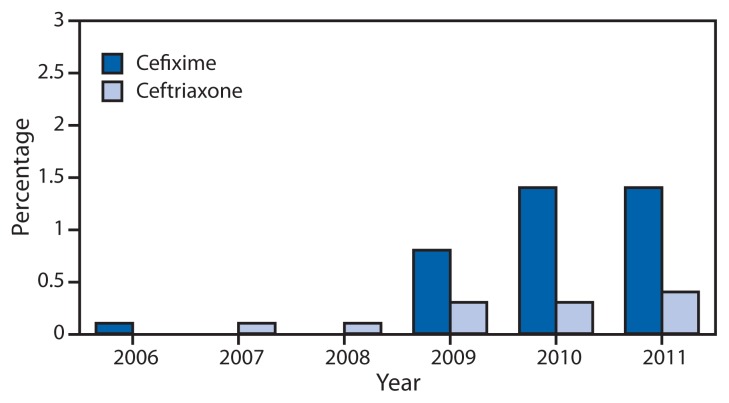
Percentage of urethral Neisseria gonorrhoeae isolates with elevated cefixime minimum inhibitory concentrations (MICs) and elevated ceftriaxone MICs* — Gonococcal Isolate Surveillance Project, 2006–2011† * Elevated cefixime MICs defined as ≥0.25 μg/mL; elevated ceftriaxone MICs defined as ≥0.125 μg/mL. † Isolates not tested for cefixime susceptibility in 2007 and 2008.
References
-
- CDC. Sexually transmitted disease surveillance 2011. Atlanta, GA: US Department of Health and Human Services; 2012. Available at http://www.cdc.gov/std/stats11/surv2011.pdf.
-
- Newman LM, Berman SM. Epidemiology of STD disparities in African American communities. Sex Transm Dis. 2008;35(12 Suppl):S4–12. - PubMed
-
- CDC. Update to CDC’s sexually transmitted diseases treatment guidelines, 2006: fluoroquinolones no longer recommended for treatment of gonococcal infections. MMWR. 2007;56:332–6. - PubMed
-
- CDC. Sexually transmitted diseases treatment guidelines, 2010. MMWR. 2010;59(RR-12) - PubMed
Publication types
MeSH terms
Substances
LinkOut - more resources
Full Text Sources
Other Literature Sources
Medical
