


Combined use of ALK immunohistochemistry and FISH for optimal detection of ALK-rearranged lung adenocarcinomas
- PMID: 23407557
- PMCID: PMC3573350
- DOI: 10.1097/JTO.0b013e31827db604
Combined use of ALK immunohistochemistry and FISH for optimal detection of ALK-rearranged lung adenocarcinomas
Abstract
Introduction: ALK gene rearrangements occur in approximately 5% of lung adenocarcinomas (ACAs), leading to anaplastic lymphoma kinase (ALK) overexpression and predicting response to targeted therapy. Fluorescence in situ hybridization (FISH) is the standard procedure for detection of ALK rearrangements in lung ACA but requires specialized equipment and expertise. Immunohistochemistry (IHC) for ALK protein overexpression is a promising screening modality, with reports of newer antibodies showing excellent sensitivity and specificity for ALK-rearranged lung ACA.
Methods: In this study, we analyzed ALK IHC (5A4 clone) in 186 cases from our clinical service and compared it with ALK FISH and EGFR and KRAS mutation status.
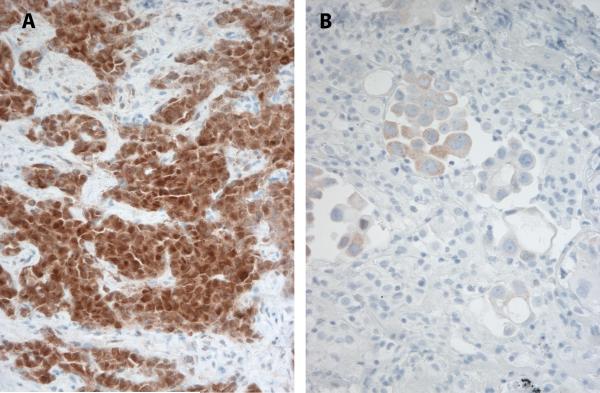
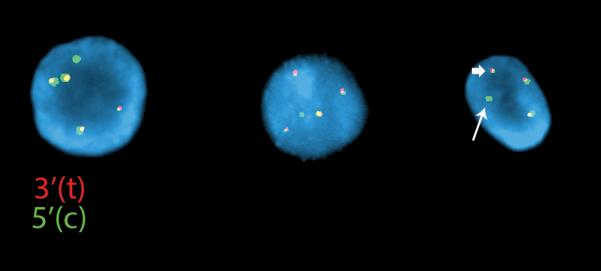
Results: Twelve cases had concordant ALK protein overexpression and ALK rearrangement by FISH. Three ALK-rearranged cases lacked ALK protein expression. Of these discrepant cases, one had a coexisting EGFR mutation and a subtle atypical ALK rearrangement manifested as a break in the 5' centromeric portion of the FISH probe. One case had a concurrent BRAF mutation. Follow-up testing on a metastasis revealed absence of the ALK rearrangement, with persistent BRAF mutation. In one ALK-rearranged protein negative case, very limited tissue remained for ALK IHC, raising the possibility of false negativity because of protein expression heterogeneity. Importantly, ALK protein expression was detected in one case initially thought not to have an ALK rearrangement. In this case, FISH was falsely negative because of interference by benign reactive nuclei. After correcting for these cases, ALK IHC was 93% sensitive and 100% specific as compared with FISH.
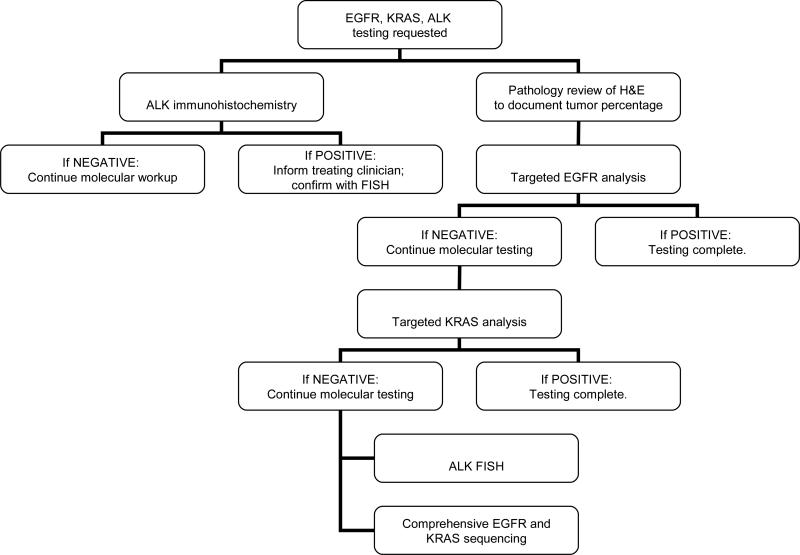
Conclusions: ALK IHC improves the detection of ALK rearrangements when used together with FISH, and its use in lung ACA genetic testing algorithms should be considered.
Figures
Comment in
-
Optimal detection of ALK rearranged lung adenocarcinomas.J Thorac Oncol. 2013 Mar;8(3):255-6. doi: 10.1097/JTO.0b013e318282ddc3. J Thorac Oncol. 2013. PMID: 23407554 No abstract available.
-
ALK FISH in non-small-cell carcinomas of the lung: what about false-positive results?J Thorac Oncol. 2014 Feb;9(2):e18-9. doi: 10.1097/JTO.0000000000000047. J Thorac Oncol. 2014. PMID: 24419430 No abstract available.
Similar articles
-
Concordance of Immunohistochemistry and Fluorescence In Situ Hybridization in the Detection of Anaplastic Lymphoma Kinase (ALK) and Ros Proto-oncogene 1 (ROS1) Gene Rearrangements in Non-Small Cell Lung Carcinoma: A 4.5-Year Experience Highlighting Challenges and Pitfalls.Arch Pathol Lab Med. 2024 Aug 1;148(8):928-937. doi: 10.5858/arpa.2023-0229-OA. Arch Pathol Lab Med. 2024. PMID: 38054562
-
On the relevance of a testing algorithm for the detection of ROS1-rearranged lung adenocarcinomas.Lung Cancer. 2014 Feb;83(2):168-73. doi: 10.1016/j.lungcan.2013.11.019. Epub 2013 Dec 1. Lung Cancer. 2014. PMID: 24380695
-
Dual IHC and FISH testing for ALK gene rearrangement in lung adenocarcinomas in a routine practice: a French study.J Thorac Oncol. 2012 Feb;7(2):348-54. doi: 10.1097/JTO.0b013e3182381535. J Thorac Oncol. 2012. PMID: 22071784
-
ALK and ROS1 testing on lung cancer cytologic samples: Perspectives.Cancer Cytopathol. 2017 Nov;125(11):817-830. doi: 10.1002/cncy.21899. Epub 2017 Jul 25. Cancer Cytopathol. 2017. PMID: 28743163 Review.
-
Biomarkers for ALK and ROS1 in Lung Cancer: Immunohistochemistry and Fluorescent In Situ Hybridization.Arch Pathol Lab Med. 2018 Aug;142(8):922-928. doi: 10.5858/arpa.2017-0502-RA. Epub 2018 Jun 14. Arch Pathol Lab Med. 2018. PMID: 29902067 Review.
Cited by
-
[Predictive immunocytochemistry in non-small cell lung carcinoma].Pathologe. 2022 May;43(3):222-228. doi: 10.1007/s00292-022-01066-4. Epub 2022 Apr 11. Pathologe. 2022. PMID: 35403870 Free PMC article. Review. German.
-
Therapeutical Options in ROS1-Rearranged Advanced Non Small Cell Lung Cancer.Int J Mol Sci. 2023 Jul 15;24(14):11495. doi: 10.3390/ijms241411495. Int J Mol Sci. 2023. PMID: 37511255 Free PMC article. Review.
-
Quantification of Anaplastic Lymphoma Kinase Protein Expression in Non-Small Cell Lung Cancer Tissues from Patients Treated with Crizotinib.Clin Chem. 2016 Jan;62(1):252-61. doi: 10.1373/clinchem.2015.245860. Epub 2015 Nov 19. Clin Chem. 2016. PMID: 26585927 Free PMC article.
-
Circulating free tumor DNA in non-small cell lung cancer (NSCLC): clinical application and future perspectives.J Thorac Dis. 2019 Jan;11(Suppl 1):S113-S126. doi: 10.21037/jtd.2018.12.18. J Thorac Dis. 2019. PMID: 30775034 Free PMC article. Review.
-
Clinical Implications of Variant ALK FISH Rearrangement Patterns.J Thorac Oncol. 2015 Nov;10(11):1648-52. doi: 10.1097/JTO.0000000000000665. J Thorac Oncol. 2015. PMID: 26536196 Free PMC article.
References
-
- Shaw AT, Solomon B. Targeting anaplastic lymphoma kinase in lung cancer. Clin Cancer Res. 2011;17:2081–2086. - PubMed
-
- Febbo PG, Ladanyi M, Aldape KD, et al. NCCN Task Force report: Evaluating the clinical utility of tumor markers in oncology. J Natl Compr Canc Netw. 2011;9(Suppl 5):S1–32. - PubMed
-
- Maemondo M, Inoue A, Kobayashi K, et al. Gefitinib or chemotherapy for non-small-cell lung cancer with mutated EGFR. N Engl J Med. 2010;362:2380–2388. - PubMed
Publication types
MeSH terms
Substances
Grants and funding
LinkOut - more resources
Full Text Sources
Other Literature Sources
Medical
Research Materials
Miscellaneous
