Outbreak investigation using high-throughput genome sequencing within a diagnostic microbiology laboratory
- PMID: 23408689
- PMCID: PMC3647928
- DOI: 10.1128/JCM.03332-12
Outbreak investigation using high-throughput genome sequencing within a diagnostic microbiology laboratory
Abstract
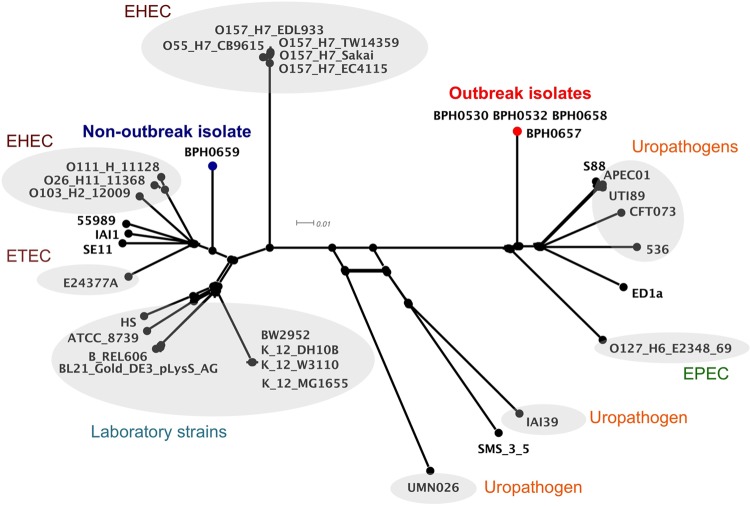
Next-generation sequencing (NGS) of bacterial genomes has recently become more accessible and is now available to the routine diagnostic microbiology laboratory. However, questions remain regarding its feasibility, particularly with respect to data analysis in nonspecialist centers. To test the applicability of NGS to outbreak investigations, Ion Torrent sequencing was used to investigate a putative multidrug-resistant Escherichia coli outbreak in the neonatal unit of the Mercy Hospital for Women, Melbourne, Australia. Four suspected outbreak strains and a comparator strain were sequenced. Genome-wide single nucleotide polymorphism (SNP) analysis demonstrated that the four neonatal intensive care unit (NICU) strains were identical and easily differentiated from the comparator strain. Genome sequence data also determined that the NICU strains belonged to multilocus sequence type 131 and carried the bla(CTX-M-15) extended-spectrum beta-lactamase. Comparison of the outbreak strains to all publicly available complete E. coli genome sequences showed that they clustered with neonatal meningitis and uropathogenic isolates. The turnaround time from a positive culture to the completion of sequencing (prior to data analysis) was 5 days, and the cost was approximately $300 per strain (for the reagents only). The main obstacles to a mainstream adoption of NGS technologies in diagnostic microbiology laboratories are currently cost (although this is decreasing), a paucity of user-friendly and clinically focused bioinformatics platforms, and a lack of genomics expertise outside the research environment. Despite these hurdles, NGS technologies provide unparalleled high-resolution genotyping in a short time frame and are likely to be widely implemented in the field of diagnostic microbiology in the next few years, particularly for epidemiological investigations (replacing current typing methods) and the characterization of resistance determinants. Clinical microbiologists need to familiarize themselves with these technologies and their applications.
Figures
Comment in
-
Internet-based solutions for analysis of next-generation sequence data.J Clin Microbiol. 2013 Sep;51(9):3162. doi: 10.1128/JCM.01348-13. J Clin Microbiol. 2013. PMID: 23956403 Free PMC article. No abstract available.
-
Reply to "Internet-based solutions for analysis of next-generation sequence data".J Clin Microbiol. 2013 Sep;51(9):3163. doi: 10.1128/JCM.01393-13. J Clin Microbiol. 2013. PMID: 23956404 Free PMC article. No abstract available.
References
-
- Brown TA. 2002. Genomes, 2nd ed Wiley-Liss, Oxford, United Kingdom - PubMed
-
- Pallen MJ, Loman NJ, Penn CW. 2010. High-throughput sequencing and clinical microbiology: progress, opportunities and challenges. Curr. Opin. Microbiol. 13:625–631 - PubMed
-
- Köser CU, Holden MT, Ellington MJ, Cartwright EJ, Brown NM, Ogilvy-Stuart AL, Hsu LY, Chewapreecha C, Croucher NJ, Harris SR, Sanders M, Enright MC, Dougan G, Bentley SD, Parkhill J, Fraser LJ, Betley JR, Schulz-Trieglaff OB, Smith GP, Peacock SJ. 2012. Rapid whole-genome sequencing for investigation of a neonatal MRSA outbreak. N. Engl. J. Med. 366:2267–2275 - PMC - PubMed
-
- Hornsey M, Loman N, Wareham DW, Ellington MJ, Pallen MJ, Turton JF, Underwood A, Gaulton T, Thomas CP, Doumith M, Livermore DM, Woodford N. 2011. Whole-genome comparison of two Acinetobacter baumannii isolates from a single patient, where resistance developed during tigecycline therapy. J. Antimicrob. Chemother. 66:1499–1503 - PubMed
Publication types
MeSH terms
Substances
LinkOut - more resources
Full Text Sources
Other Literature Sources
Medical