


Glutamate receptor subunit and calmodulin kinase II expression, with and without T maze training, in the rat hippocampus following bilateral vestibular deafferentation
- PMID: 23408944
- PMCID: PMC3567128
- DOI: 10.1371/journal.pone.0054527
Glutamate receptor subunit and calmodulin kinase II expression, with and without T maze training, in the rat hippocampus following bilateral vestibular deafferentation
Abstract
Many previous studies have shown that lesions of the peripheral vestibular system result in spatial memory deficits and electrophysiological dysfunction in the hippocampus. Given the importance of glutamate as a neurotransmitter in the hippocampus, it was predicted that bilateral vestibular deafferentation (BVD) would alter the expression of NMDA and AMPA receptors in this area of the brain.
Methods: The expression of the NR1, NR2A, NR2B, GluR1, GluR2, GluR3 and GluR 4 glutamate receptor subunits, as well as calmodulin kinase IIα (CaMKIIα) and phosphorylated CaMKIIα (pCaMKIIα), was measured in the rat CA1, CA2/3 and dentate gyrus (DG) subregions of the hippocampus, at 24 h, 72 h, 1 week, 1 month and 6 months following BVD, using western blotting. In the 6 month group, half of the animals underwent spatial forced alternating training in a T-maze.
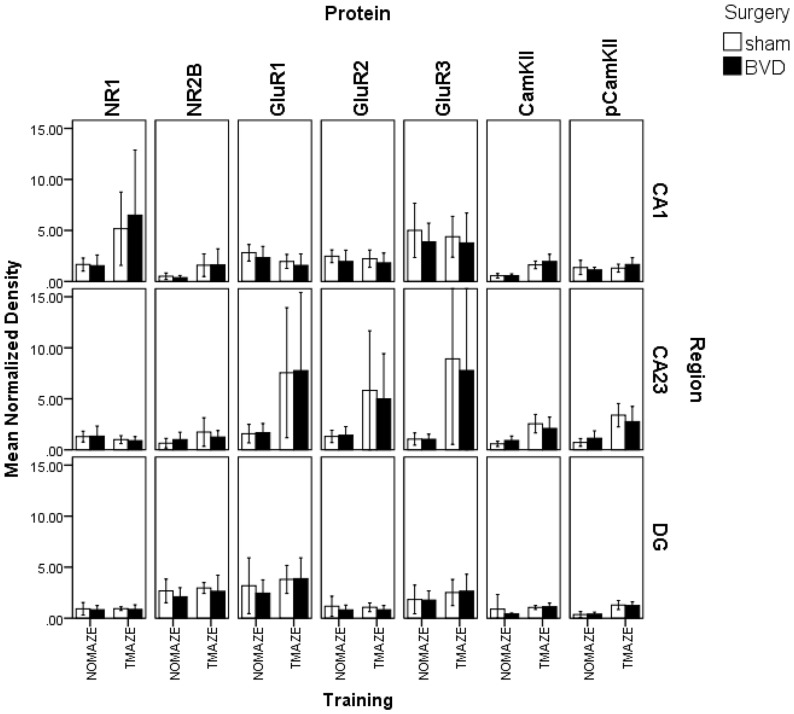
Results and discussion: For the 24 h, 72 h, 1 week and 1 month data, there was no significant effect of surgery for any hippocampal subregion. However, for the 6 month data set, T maze training had a significant effect independently of surgery. The results of these experiments suggest that BVD is not associated with large changes in glutamate receptor subunit or CaMKIIα expression in the rat hippocampus, at least in terms of both the intra-cytoplasmic and membrane receptor subunits together, that western blotting can measure. However, spatial training-associated increases in glutamate receptor and CaMKIIα expression can be induced in BVD rats with impaired spatial performance. Therefore, the neurophysiological changes underlying BVD-induced spatial learning and memory deficits are more likely to be due to up and down regulation or changes in affinity/efficacy of glutamate receptors at the membrane level than changes in subunit transcription and transduction at the intra-cytoplasmic level.
Conflict of interest statement
Figures



References
-
- Stackman R, Herbert A (2002) Rats with lesions of the vestibular system require a visual landmark for spatial navigation. Behav Brain Res 128: 27–40. - PubMed
-
- Russell N, Horii A, Smith PF, Darlington CL, Bilkey DK (2003) Bilateral peripheral vestibular lesions produce long-term changes in spatial learning in the rat. J Vest Res 13: 9–16. - PubMed
-
- Zheng Y, Darlington C, Smith PF (2006) Impairment and recovery on a food foraging task following unilateral vestibular deafferentation in rats. Hippocampus 16: 368–378. - PubMed
-
- Zheng Y, Goddard M, Darlington C, Smith PF (2007) Bilateral vestibular deafferentation impairs performance in a spatial forced alternation task in rats. Hippocampus 17: 253–256. - PubMed
Publication types
MeSH terms
Substances
LinkOut - more resources
Full Text Sources
Other Literature Sources
Miscellaneous
