


Candidate sequence variants and fetal hemoglobin in children with sickle cell disease treated with hydroxyurea
- PMID: 23409025
- PMCID: PMC3567082
- DOI: 10.1371/journal.pone.0055709
Candidate sequence variants and fetal hemoglobin in children with sickle cell disease treated with hydroxyurea
Abstract
Background: Fetal hemoglobin level is a heritable complex trait that strongly correlates swith the clinical severity of sickle cell disease. Only few genetic loci have been identified as robustly associated with fetal hemoglobin in patients with sickle cell disease, primarily adults. The sole approved pharmacologic therapy for this disease is hydroxyurea, with effects largely attributable to induction of fetal hemoglobin.
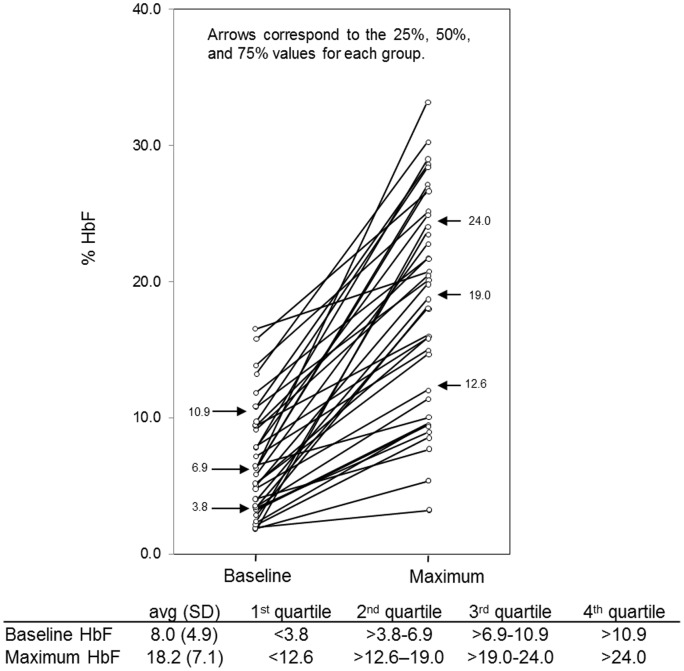
Methodology/principal findings: In a multi-site observational analysis of children with sickle cell disease, candidate single nucleotide polymorphisms associated with baseline fetal hemoglobin levels in adult sickle cell disease were examined in children at baseline and induced by hydroxyurea therapy. For baseline levels, single marker analysis demonstrated significant association with BCL11A and the beta and epsilon globin loci (HBB and HBE, respectively), with an additive attributable variance from these loci of 23%. Among a subset of children on hydroxyurea, baseline fetal hemoglobin levels explained 33% of the variance in induced levels. The variant in HBE accounted for an additional 13% of the variance in induced levels, while variants in the HBB and BCL11A loci did not contribute beyond baseline levels.
Conclusions/significance: These findings clarify the overlap between baseline and hydroxyurea-induced fetal hemoglobin levels in pediatric disease. Studies assessing influences of specific sequence variants in these and other genetic loci in larger populations and in unusual hydroxyurea responders are needed to further understand the maintenance and therapeutic induction of fetal hemoglobin in pediatric sickle cell disease.
Conflict of interest statement
Figures
Similar articles
-
Emerging science of hydroxyurea therapy for pediatric sickle cell disease.Pediatr Res. 2014 Jan;75(1-2):196-204. doi: 10.1038/pr.2013.227. Epub 2013 Nov 19. Pediatr Res. 2014. PMID: 24252885 Free PMC article. Review.
-
A systematic review of known mechanisms of hydroxyurea-induced fetal hemoglobin for treatment of sickle cell disease.Expert Rev Hematol. 2015 Oct;8(5):669-79. doi: 10.1586/17474086.2015.1078235. Epub 2015 Sep 1. Expert Rev Hematol. 2015. PMID: 26327494 Free PMC article.
-
[From Hemoglobin SS to SF: interest of hydroxyurea in the management of sickle cell disease in two Congolese children and review of the literature].Pan Afr Med J. 2015 Jun 15;21:124. doi: 10.11604/pamj.2015.21.124.5784. eCollection 2015. Pan Afr Med J. 2015. PMID: 26327961 Free PMC article. Review. French.
-
Genetic modifiers of HbF and response to hydroxyurea in sickle cell disease.Pediatr Blood Cancer. 2011 Feb;56(2):177-81. doi: 10.1002/pbc.22754. Epub 2010 Sep 9. Pediatr Blood Cancer. 2011. PMID: 20830771 Free PMC article. Review.
-
Genetic modifiers of sickle cell anemia in the BABY HUG cohort: influence on laboratory and clinical phenotypes.Am J Hematol. 2013 Jul;88(7):571-6. doi: 10.1002/ajh.23457. Epub 2013 May 30. Am J Hematol. 2013. PMID: 23606168 Clinical Trial.
Cited by
-
HbF Levels in Sickle Cell Disease Are Associated with Proportion of Circulating Hematopoietic Stem and Progenitor Cells and CC-Chemokines.Cells. 2020 Sep 29;9(10):2199. doi: 10.3390/cells9102199. Cells. 2020. PMID: 33003401 Free PMC article.
-
Do Genetic Polymorphisms Affect Fetal Hemoglobin (HbF) Levels in Patients With Sickle Cell Anemia Treated With Hydroxyurea? A Systematic Review and Pathway Analysis.Front Pharmacol. 2022 Jan 21;12:779497. doi: 10.3389/fphar.2021.779497. eCollection 2021. Front Pharmacol. 2022. PMID: 35126118 Free PMC article. Review.
-
Association Between Selected Single Nucleotide Polymorphisms in Globin and Related Genes and Response to Hydroxyurea Therapy in Ghanaian Children with Sickle Cell Disease.Pharmgenomics Pers Med. 2022 Mar 10;15:205-214. doi: 10.2147/PGPM.S351599. eCollection 2022. Pharmgenomics Pers Med. 2022. PMID: 35300055 Free PMC article.
-
Whole exome sequencing identifies novel genes for fetal hemoglobin response to hydroxyurea in children with sickle cell anemia.PLoS One. 2014 Oct 31;9(10):e110740. doi: 10.1371/journal.pone.0110740. eCollection 2014. PLoS One. 2014. PMID: 25360671 Free PMC article. Clinical Trial.
-
Genetic Variation and Sickle Cell Disease Severity: A Systematic Review and Meta-Analysis.JAMA Netw Open. 2023 Oct 2;6(10):e2337484. doi: 10.1001/jamanetworkopen.2023.37484. JAMA Netw Open. 2023. PMID: 37851445 Free PMC article.
References
-
- Bunn HF (1987) Subunit assembly of hemoglobin: an important determinant of hematologic phenotype. Blood 69: 1–6. - PubMed
-
- Powars DR, Weiss JN, Chan LS, Schroeder WA (1984) Is there a threshold level of fetal hemoglobin that ameliorates morbidity in sickle cell anemia? Blood 63: 921–926. - PubMed
-
- Platt OS (2008) Hydroxyurea for the treatment of sickle cell anemia. N Engl J Med 358: 1362–1369. - PubMed
-
- Steinberg MH, Voskaridou E, Kutlar A, Loukopoulos D, Koshy M, et al. (2003) Concordant fetal hemoglobin response to hydroxyurea in siblings with sickle cell disease. Am J Hematol 72: 121–126. - PubMed
Publication types
MeSH terms
Substances
Grants and funding
- UL1 RR024139/RR/NCRR NIH HHS/United States
- UL1 RR025750/RR/NCRR NIH HHS/United States
- UL1 RR024996/RR/NCRR NIH HHS/United States
- UL1 RR024131/RR/NCRR NIH HHS/United States
- 3UL1RR024156-04S4/RR/NCRR NIH HHS/United States
- 5UL1RR024156/RR/NCRR NIH HHS/United States
- UL1 RR024160/RR/NCRR NIH HHS/United States
- 5UL1RR024160/RR/NCRR NIH HHS/United States
- 5UL1RR025750/RR/NCRR NIH HHS/United States
- UL1 TR000457/TR/NCATS NIH HHS/United States
- UL1 RR024156/RR/NCRR NIH HHS/United States
- 5UL1RR024139/RR/NCRR NIH HHS/United States
- 5UL1RR024996/RR/NCRR NIH HHS/United States
- 5UL1RR024131/RR/NCRR NIH HHS/United States
LinkOut - more resources
Full Text Sources
Other Literature Sources
Medical
