


Hepatocyte growth factor activator inhibitor-1 is induced by bone morphogenetic proteins and regulates proliferation and cell fate of neural progenitor cells
- PMID: 23409135
- PMCID: PMC3567048
- DOI: 10.1371/journal.pone.0056117
Hepatocyte growth factor activator inhibitor-1 is induced by bone morphogenetic proteins and regulates proliferation and cell fate of neural progenitor cells
Abstract
Background: Neural progenitor cells (NPCs) in the developing neuroepithelium are regulated by intrinsic and extrinsic factors. There is evidence that NPCs form a self-supporting niche for cell maintenance and proliferation. However, molecular interactions and cell-cell contacts and the microenvironment within the neuroepithelium are largely unknown. We hypothesized that cellular proteases especially those associated with the cell surface of NPCs play a role in regulation of progenitor cells in the brain.
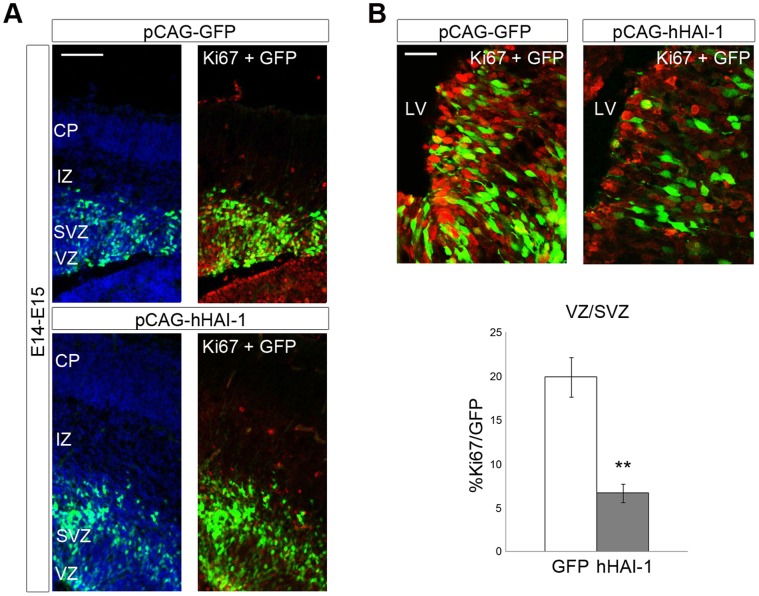
Methodology/principal findings: In this work, we show that NPCs, isolated from striatal anlage of developing rat brain, express hepatocyte growth factor activator inhibitor-1 and -2 (HAI-1 and HAI-2) that are cell surface-linked serine protease inhibitors. In addition, radial glia cells derived from mouse embryonic stem cells also express HAI-1 and HAI-2. To study the functional significance of HAI-1 and HAI-2 in progenitor cells, we modulated their levels using expression plasmids or silencing RNA (siRNA) transfected into the NPCs. Data showed that overexpression of HAI-1 or HAI-2 decreased cell proliferation of cultured NPCs, whilst their siRNAs had opposite effects. HAI-1 also influenced NPC differentiation by increasing the number of glial fibrillary acidic protein (GFAP) expressing cells in the culture. Expression of HAI-1 in vivo decreased cell proliferation in developing neuroepithelium in E15 old animals and promoted astrocyte cell differentiation in neonatal animals. Studying the regulation of HAI-1, we observed that Bone morphogenetic protein-2 (BMP-2) and BMP-4 increased HAI-1 levels in the NPCs. Experiments using HAI-1-siRNA showed that these BMPs act on the NPCs partly in a HAI-1-dependent manner.
Conclusions: This study shows that the cell-surface serine protease inhibitors, HAI-1 and HAI-2 influence proliferation and cell fate of NPCs and their expression levels are linked to BMP signaling. Modulation of the levels and actions of HAI-1 in NPCs may be of a potential value in stem cell therapies in various brain diseases.
Conflict of interest statement
Figures



References
-
- Temple S (2001) The development of neural stem cells. Nature 414: 112–117. - PubMed
-
- Kataoka H, Suganuma T, Shimomura T, Itoh H, Kitamura N, et al. (1999) Distribution of hepatocyte growth factor activator inhibitor type 1 (HAI-1) in human tissues. Cellular surface localization of HAI-1 in simple columnar epithelium and its modulated expression in injured and regenerative tissues. J Histochem Cytochem 47: 673–682. - PubMed
Publication types
MeSH terms
Substances
LinkOut - more resources
Full Text Sources
Other Literature Sources
Molecular Biology Databases
Miscellaneous
