. 2013 Feb 14:13:37.
doi: 10.1186/1471-2180-13-37.

Nucleotide substitutions in dengue virus serotypes from Asian and American countries: insights into intracodon recombination and purifying selection

Affiliations

Nucleotide substitutions in dengue virus serotypes from Asian and American countries: insights into intracodon recombination and purifying selection

Susanta K Behura et al. BMC Microbiol. .

Abstract

Background: Dengue virus (DENV) infection represents a significant public health problem in many subtropical and tropical countries. Although genetically closely related, the four serotypes of DENV differ in antigenicity for which cross protection among serotypes is limited. It is also believed that both multi-serotype infection as well as the evolution of viral antigenicity may have confounding effects in increased dengue epidemics. Numerous studies have been performed that investigated genetic diversity of DENV, but the precise mechanism(s) of dengue virus evolution are not well understood.

Results: We investigated genome-wide genetic diversity and nucleotide substitution patterns in the four serotypes among samples collected from different countries in Asia and Central and South America and sequenced as part of the Genome Sequencing Center for Infectious Diseases at the Broad Institute. We applied bioinformatics, statistical and coalescent simulation methods to investigate diversity of codon sequences of DENV samples representing the four serotypes. We show that fixation of nucleotide substitutions is more prominent among the inter-continental isolates (Asian and American) of serotypes 1, 2 and 3 compared to serotype 4 isolates (South and Central America) and are distributed in a non-random manner among the genes encoded by the virus. Nearly one third of the negatively selected sites are associated with fixed mutation sites within serotypes. Our results further show that of all the sites showing evidence of recombination, the majority (~84%) correspond to sites under purifying selection in the four serotypes. The analysis further shows that genetic recombination occurs within specific codons, albeit with low frequency (< 5% of all recombination sites) throughout the DENV genome of the four serotypes and reveals significant enrichment (p < 0.05) among sites under purifying selection in the virus.

Conclusion: The study provides the first evidence for intracodon recombination in DENV and suggests that within codons, genetic recombination has a significant role in maintaining extensive purifying selection of DENV in natural populations. Our study also suggests that fixation of beneficial mutations may lead to virus evolution via translational selection of specific sites in the DENV genome.


Figures
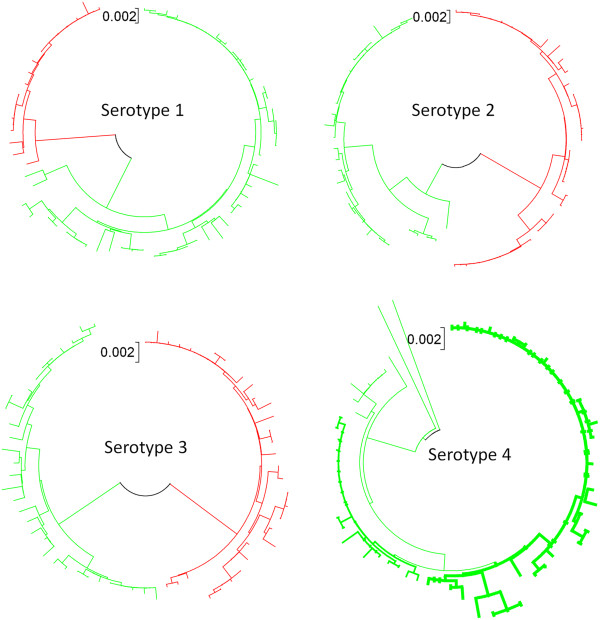
Figure 1
Figure 1
Geographical structuring within dengue virus serotypes evident from phylogenetic (neighbor-joining tree) analysis. Asian isolates (red) and American isolates (green) are compared for serotypes 1, 2 and 3. For serotype 4, isolates from Central America (light green) are compared with isolates from South America (dark green). The unit of branch length is shown for each tree.
Figure 2
Figure 2
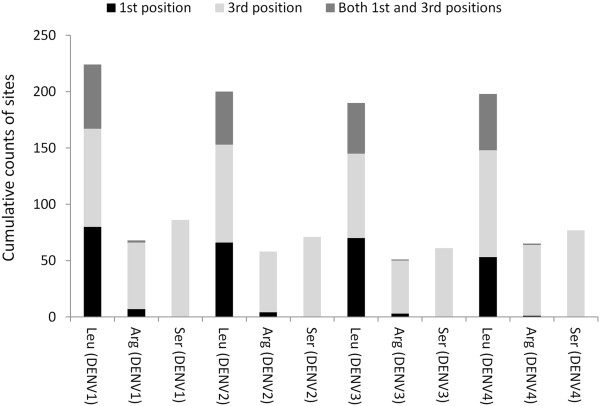
Distribution of substitution sites in codons. Stacked bar graphs show the distribution of substitution sites in the 1st, 3rd and 1st + 3rd positions of specific codons in dengue virus serotypes.
Figure 3
Figure 3
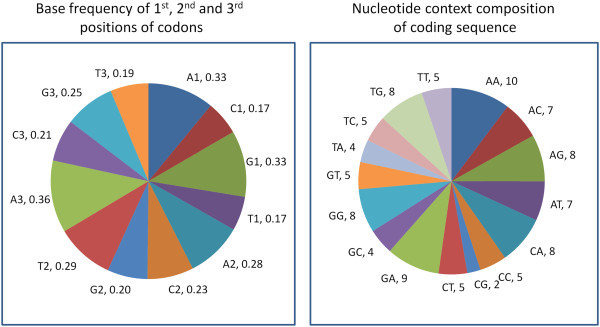
Distribution of nucleotide frequency in codons. Pie chart representation of mean frequencies of the four nucleotides at 1st, 2nd and 3rd positions of codons in dengue virus (left). The chart on the right shows nucleotide context pattern (based on mean dinucleotide frequencies) in the coding sequences of dengue virus. The number after each nucleotide and nucleotide pair represents its proportion compared to the total nucleotide counts for that codon position (left) or total counts of dinucleotides in the coding sequences (right). The nucleotide frequency as well as the dinucleotide frequency varies in highly correlated manner (Pearson correlation > 0.93), hence the mean value represents the nucleotide composition pattern of coding sequences of DENV within as well as between the four serotypes.
Figure 4
Figure 4
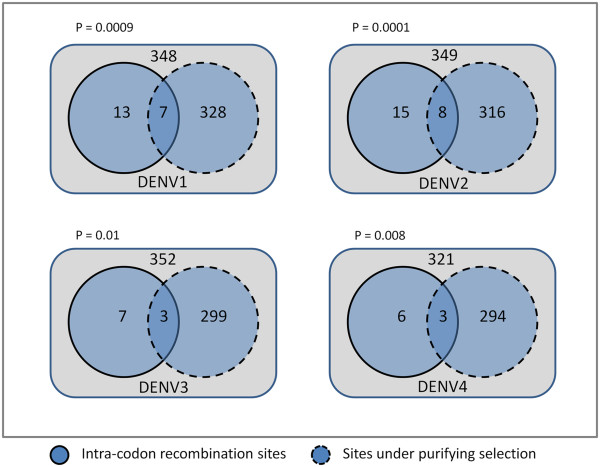
Distribution of purifying selection sites and sites of intracodon recombination. Enrichment of sites under purifying selection among codon sites showing evidence of intracodon recombination in dengue virus serotypes. The total number of sites that show evidence of recombination is shown within the box but outside the two circles. Of these, the number of sites showing intracodon recombination and sites under purifying selection is shown in solid and dashed line circles. The number of sites under both selection and intracodon recombination is shown in the overlapping region of the two circles. The p-value above each serotype (shown as DENV-1, DENV-2, DENV-3 and DENV-4) represents the statistical significance of a hypergeometric test to reject the null assumption that the observed enrichment pattern is a random event.
Figure 5
Figure 5
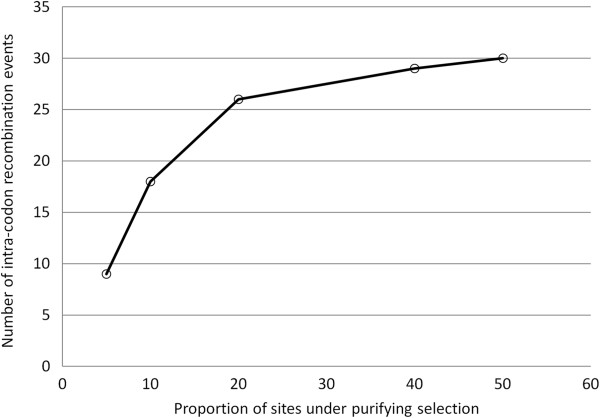
Relationship between purifying selection and intracodon recombination. The x-axis shows the proportion of sites under purifying selection and the y-axis shows the number of intracodon recombination events in the simulated sequences.

References

    1. Kyle JL, Harris E. Global spread and persistence of dengue. Annu Rev Microbiol. 2008;62:71–92. doi: 10.1146/annurev.micro.62.081307.163005. - DOI - PubMed
    1. Gubler DJ. Cities spawn epidemic dengue viruses. Nat Med. 2004;10:129–130. doi: 10.1038/nm0204-129. - DOI - PubMed
    1. Ramanathan MP, Kuo YC, Selling BH, Li Q, Sardesai NY, Kim JJ, Weiner DB. Development of a novel DNA SynCon tetravalent dengue vaccine that elicits immune responses against four serotypes. Vaccine. 2009;27:6444–6453. doi: 10.1016/j.vaccine.2009.06.061. - DOI - PubMed
    1. Guzman MG, Halstead SB, Artsob H, Buchy P, Farrar J, Gubler DJ, Hunsperger E, Kroeger A, Margolis HS, Martínez E, Nathan MB, Pelegrino JL, Simmons C, Yoksan S, Peeling RW. Dengue: a continuing global threat. Nat Rev Microbiol. 2010;8(Suppl 12):7–16. - PMC - PubMed
    1. Gubler DJ, Trent DW. Emergence of epidemic dengue/dengue hemorrhagic fever as a public health problem in the Americas. Infect Agents Dis. 1993;2:383–393. - PubMed

Publication types