


Bridging the transgenerational gap with epigenetic memory
- PMID: 23410786
- PMCID: PMC3595609
- DOI: 10.1016/j.tig.2012.12.008
Bridging the transgenerational gap with epigenetic memory
Abstract
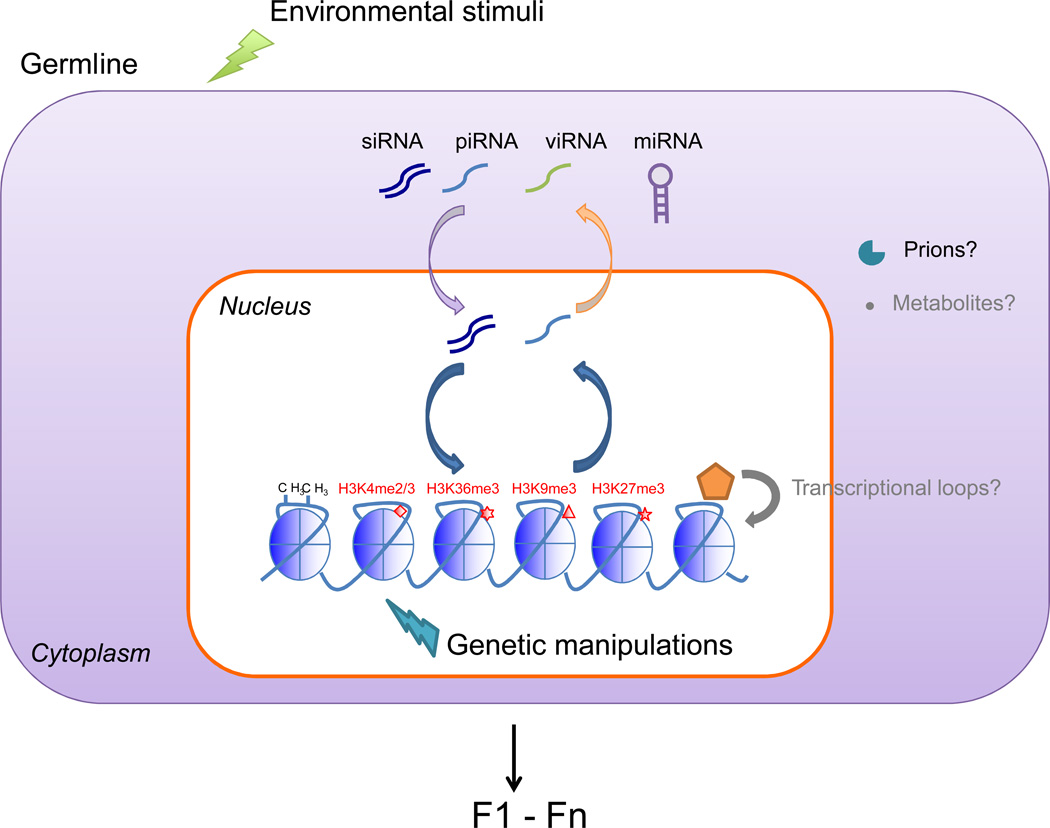
It is textbook knowledge that inheritance of traits is governed by genetics, and that the epigenetic modifications an organism acquires are largely reset between generations. Recently, however, transgenerational epigenetic inheritance has emerged as a rapidly growing field, providing evidence suggesting that some epigenetic changes result in persistent phenotypes across generations. Here, we survey some of the most recent examples of transgenerational epigenetic inheritance in animals, ranging from Caenorhabditis elegans to humans, and describe approaches and limitations to studying this phenomenon. We also review the current body of evidence implicating chromatin modifications and RNA molecules in mechanisms underlying this unconventional mode of inheritance and discuss its evolutionary implications.
Copyright © 2013 Elsevier Ltd. All rights reserved.
Conflict of interest statement
The authors declare no financial conflicts of interest.
Figures
References
-
- Kammerer P. The inheritance of acquired characteristics. New York: Boni and Liveright; 1924.
-
- Vargas AO. Did Paul Kammerer discover epigenetic inheritance? A modern look at the controversial midwife toad experiments. J Exp Zool B Mol Dev Evol. 2009;312:667–678. - PubMed
-
- Waddington CH. The epigenotype. Endeavor. 1942;1:18–20.
-
- Waddington CH. Genetic Assimilation of an Acquired Character. Evolution. 1953;7:118–126.
Publication types
MeSH terms
Grants and funding
LinkOut - more resources
Full Text Sources
Other Literature Sources
Miscellaneous
