


Citric acid cycle and the origin of MARS
- PMID: 23415030
- PMCID: PMC3634881
- DOI: 10.1016/j.tibs.2013.01.005
Citric acid cycle and the origin of MARS
Abstract
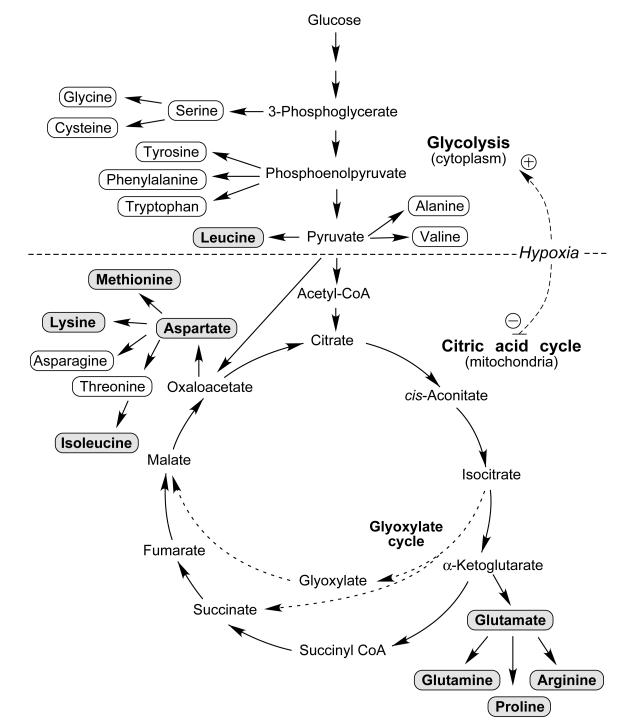
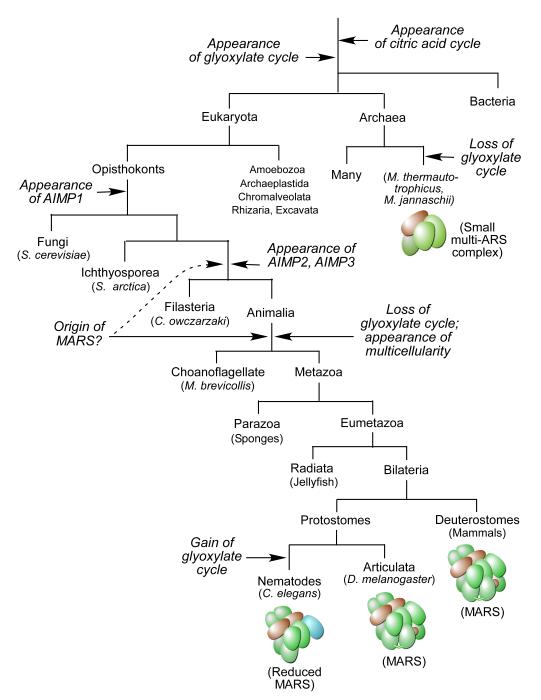
The vertebrate multiaminoacyl tRNA synthetase complex (MARS) is an assemblage of nine aminoacyl tRNA synthetases (ARSs) and three non-synthetase scaffold proteins, aminoacyl tRNA synthetase complex-interacting multifunctional protein (AIMP)1, AIMP2, and AIMP3. The evolutionary origin of the MARS is unclear, as is the significance of the inclusion of only nine of 20 tRNA synthetases. Eight of the nine amino acids corresponding to ARSs of the MARS are derived from two citric acid cycle intermediates, α-ketoglutatrate and oxaloacetate. We propose that the metabolic link with the citric acid cycle, the appearance of scaffolding proteins AIMP2 and AIMP3, and the subsequent disappearance of the glyoxylate cycle, together facilitated the origin of the MARS in a common ancestor of metazoans and choanoflagellates.
Copyright © 2013 Elsevier Ltd. All rights reserved.
Figures
References
-
- Krogan NJ, et al. Global landscape of protein complexes in the yeast Saccharomyces cerevisiae. Nature. 2006;440:637–643. - PubMed
-
- Mirande M, et al. A complex from cultured Chinese hamster ovary cells containing nine aminoacyl-tRNA synthetases. Thermolabile leucyl-tRNA synthetase from the tsH1 mutant cell line is an integral component of this complex. Eur. J. Biochem. 1985;147:281–289. - PubMed
-
- Kerjan P, et al. The multienzyme complex containing nine aminoacyl-tRNA synthetases is ubiquitous from Drosophila to mammals. Biochim. Biophys. Acta. 1994;1199:293–297. - PubMed
-
- Han JM, et al. Hierarchical network between the components of the multi-tRNA synthetase complex: implications for complex formation. J. Biol. Chem. 2006;281:38663–38667. - PubMed
-
- Norcum MT. Isolation and electron microscopic characterization of the high molecular mass aminoacyl-tRNA synthetase complex from murine erythroleukemia cells. J. Biol. Chem. 1989;264:15043–15051. - PubMed
Publication types
MeSH terms
Substances
Grants and funding
LinkOut - more resources
Full Text Sources
Other Literature Sources
Miscellaneous
