. 2013 Mar 5;21(3):394-401.
doi: 10.1016/j.str.2013.01.005. Epub 2013 Feb 14.

Cell-free expressed bacteriorhodopsin in different soluble membrane mimetics: biophysical properties and NMR accessibility

Affiliations

Cell-free expressed bacteriorhodopsin in different soluble membrane mimetics: biophysical properties and NMR accessibility

Manuel Etzkorn et al. Structure. .

Abstract

Selecting a suitable membrane-mimicking environment is of fundamental importance for the investigation of membrane proteins. Nonconventional surfactants, such as amphipathic polymers (amphipols) and lipid bilayer nanodiscs, have been introduced as promising environments that may overcome intrinsic disadvantages of detergent micelle systems. However, structural insights into the effects of different environments on the embedded protein are limited. Here, we present a comparative study of the heptahelical membrane protein bacteriorhodopsin in detergent micelles, amphipols, and nanodiscs. Our results confirm that nonconventional environments can increase stability of functional bacteriorhodopsin, and demonstrate that well-folded heptahelical membrane proteins are, in principle, accessible by solution-NMR methods in amphipols and phospholipid nanodiscs. Our data distinguish regions of bacteriorhodopsin that mediate membrane/solvent contacts in the tested environments, whereas the protein's functional inner core remains almost unperturbed. The presented data allow comparing the investigated membrane mimetics in terms of NMR spectral quality and thermal stability required for structural studies.


Figures

Figure 1
Figure 1
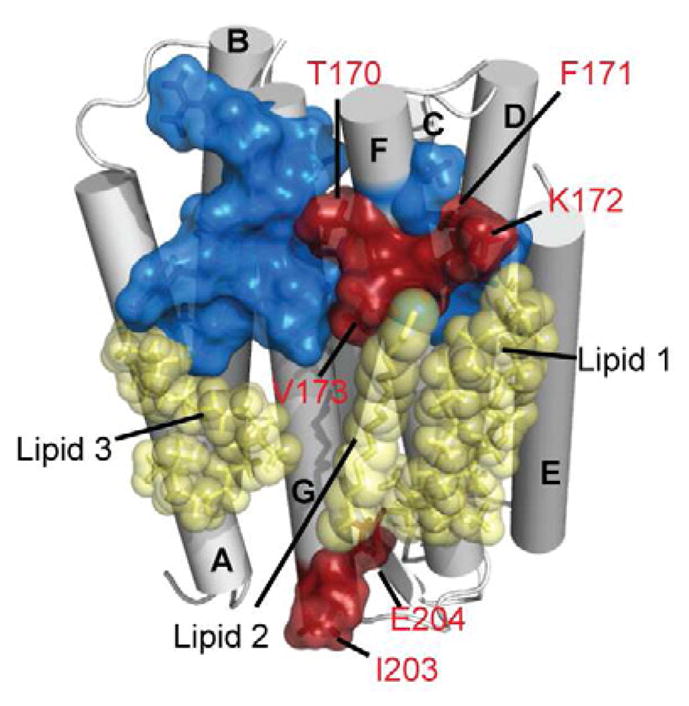
Differences between bR in DDM micelles when extracted from the native purple membrane (Schubert et al., 2002) or when refolded after cell-free expression. Residues in the transmembrane region which experience chemical shift alterations due to the different sample preparation are highlighted in red (on the crystal structure (Luecke et al., 1999b)). Blue residues do not display any significant difference. Lipids (fragments) as present in the crystal are shown in yellow. See Figure S1 for experimental data and more details.
Figure 2
Figure 2
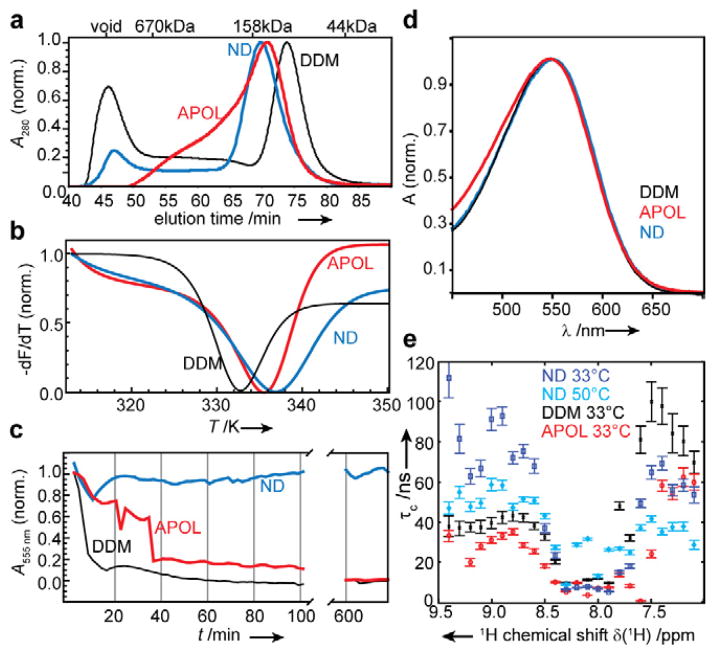
Biophysical properties of cell-free expressed bR refolded into different soluble membrane-mimicking environments. a) Size exclusion chromatograph of bR in DDM micelles (bR-DDM, black), in A8-35 amphipols (bR-APOL, red) and in DMPC lipid bilayer nanodiscs (bR-ND, blue). b) Thermal denaturation curves of bR in the same environments, measured by fluorescence intensity of Sypro Orange (Sigma-Aldrich). First derivatives of fitting curves are shown (see Figure S2 for full experimental data). c) Lifetimes of bR in different environments as measured by time-resolved absorption spectroscopy at a wavelength of 550 nm (indicative of intact tertiary structure) at 58°C. d) Absorption profile of bR in the different environments. To enable a better comparison, data in a) - d) were normalized (also see Figure S2 for experimental data on light/dark adaptation). e) NMR analysis of bR rotational correlation times τc as a function of proton resonance frequency in indicated environments and temperatures. Values were determined using the TRACT experiment (Lee et al., 2006).
Figure 3
Figure 3
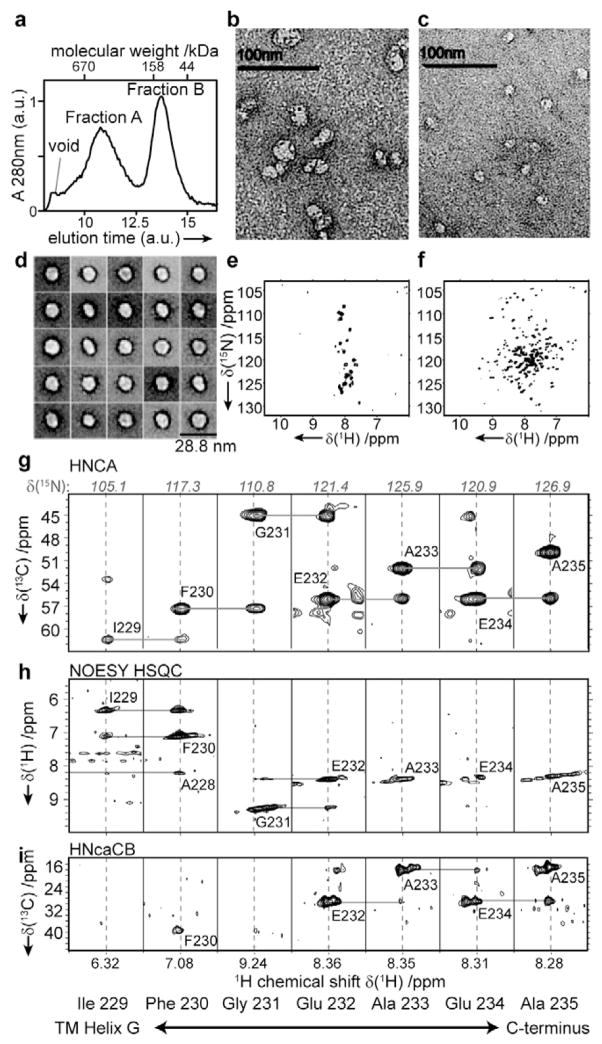
Characterization of bR-ND. a) Size exclusion chromatography of bR directly incorporated into nanodiscs during cell-free expression. Representative negative-stained EM images of fraction A (b) and of fraction B (c). d) Representative class averages obtained with fraction B (see Figure S3 for full set). TROSY-HSQC NMR spectra of fraction A (e) and fraction B (f). g–i) Set of 3D TROSY NMR data recorded on bR in DMPC nanodiscs after optimization of refolding conditions. g) HNCA, h) NOESY-HSQC, i) HNcaCB). Strip plots for residues from the end of helix G towards the C terminus are shown. 3D spectra were recorded at 48°C. (See supporting information Figure S3 for more details.)
Figure 4
Figure 4
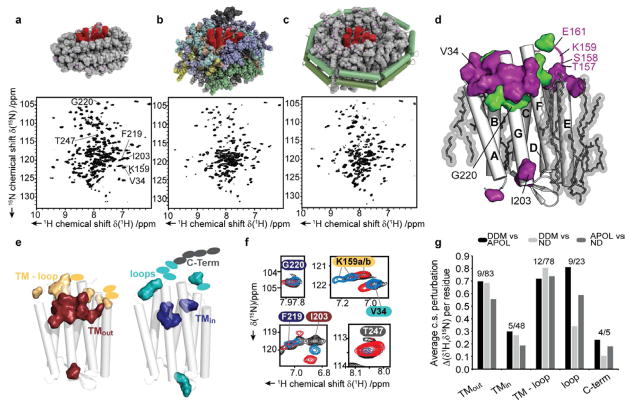
Effects induced by different membrane-mimetic environments on local bR structure. a-c) Illustration of bR in the different environments and corresponding TROSY-HSQC NMR spectra. All spectra were recorded at 40°C on cell-free expressed and refolded bR. The illustration in a) shows bR (red) in micelles with 126 detergent molecules. In b) 8 amphipol molecules are shown in different shading. The nanodisc shown in c) is comprised of 100 DMPC molecules and two copies of MSP1D1 (green). (Note that the shown particles are drawn to scale to illustrate the different environments and are not energy minimized.) d) Overall chemical shift perturbations for assigned residues mapped on the structure of bR (green: no perturbation, purple: changes in at least one environment). Lipids as identified in the crystal structure (Luecke et al., 1999b) are shown in transparent grey. (See supporting information Figure S4 for complete residue-specific, pairwise analysis). e) Classification of regions interacting differently with the surrounding membrane mimetic. Only residues for which chemical shift changes could be assigned in all environments (39 in total) are highlighted. Residues not present in the x-ray structure are indicated as ellipses in matching colors. f) Example of selected peaks for all classes (colors of residue labels indicate the respective classes shown in e); the color code for the NMR spectra is: black=bR-DDM; blue=bR-ND; red=bR-APOL). g) Average chemical shift perturbation per residue for the different classes. Numbers above bars indicate the amount of assigned/total residues per class. The pairwise differences between the three environments are shown separately.

References

    1. Bajaj VS, Mak-Jurkauskas ML, Belenky M, Herzfeld J, Griffin RG. Functional and shunt states of bacteriorhodopsin resolved by 250 GHz dynamic nuclear polarization-enhanced solid-state NMR. Proc Natl Acad Sci U S A. 2009;106:9244–9249. - PMC - PubMed
    1. Bayburt TH, Grinkova YV, Sligar SG. Assembly of single bacteriorhodopsin trimers in bilayer nanodiscs. Arch Biochem Biophys. 2006;450:215–222. - PubMed
    1. Bermel W, Bertini I, Felli IC, Peruzzini R, Pierattelli R. Exclusively heteronuclear NMR experiments to obtain structural and dynamic information on proteins. Chemphyschem. 2010;11:689–695. - PubMed
    1. Brouillette CG, McMichens RB, Stern LJ, Khorana HG. Structure and thermal stability of monomeric bacteriorhodopsin in mixed phospholipid/detergent micelles. Proteins. 1989;5:38–46. - PubMed
    1. Cappuccio JA, Blanchette CD, Sulchek TA, Arroyo ES, Kralj JM, Hinz AK, Kuhn EA, Chromy BA, Segelke BW, Rothschild KJ, et al. Cell-free co-expression of functional membrane proteins and apolipoprotein, forming soluble nanolipoprotein particles. Mol Cell Proteomics. 2008;7:2246–2253. - PMC - PubMed

Publication types

MeSH terms