


Association between celiac disease and iron deficiency in Caucasians, but not non-Caucasians
- PMID: 23416278
- PMCID: PMC3843318
- DOI: 10.1016/j.cgh.2013.02.009
Association between celiac disease and iron deficiency in Caucasians, but not non-Caucasians
Abstract
Background & aims: Celiac disease is an increasingly recognized disorder in Caucasian populations of European origin. Little is known about its prevalence in non-Caucasians. Although it is thought to be a cause of iron-deficiency anemia, little is known about the extent to which celiac disease contributes to iron deficiency in Caucasians, and especially non-Caucasians. We analyzed samples collected from participants in the Hemochromatosis and Iron Overload Screening study to identify individuals with iron deficiency and to assess the frequency of celiac disease.
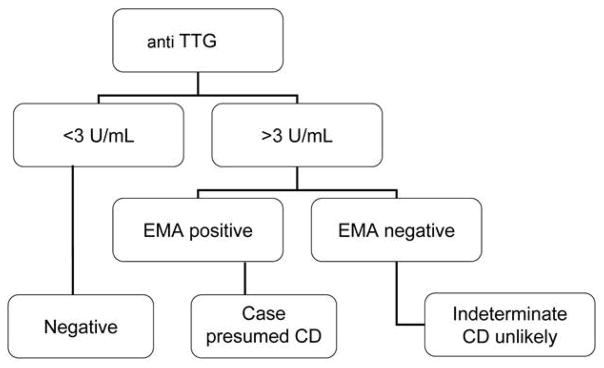
Methods: We analyzed serum samples from white men (≥25 y) and women (≥50 y) who participated in the Hemochromatosis and Iron Overload Screening study; cases were defined as individuals with iron deficiency (serum ferritin level, ≤12 μg/L) and controls were those without (serum ferritin level, >100 μg/L in men and >50 μg/L in women). All samples also were analyzed for human recombinant tissue transglutaminase immunoglobulin A; positive results were confirmed by an assay for endomysial antibodies. Patients with positive results from both celiac disease tests were presumed to have untreated celiac disease, and those with a positive result from only 1 test were excluded from analysis. We analyzed HLA genotypes and frequencies of celiac disease between Caucasians and non-Caucasians with iron deficiency.
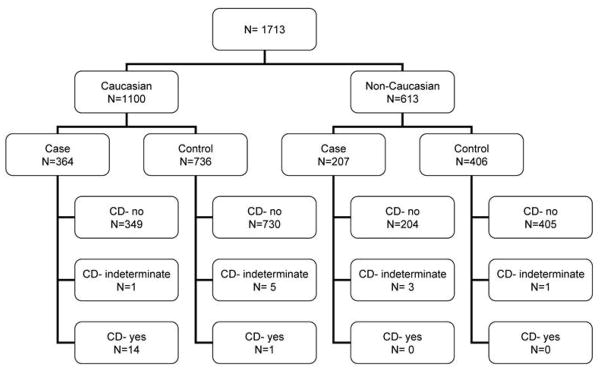
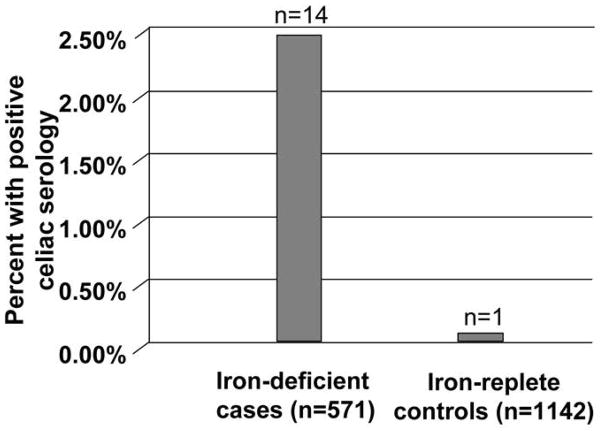
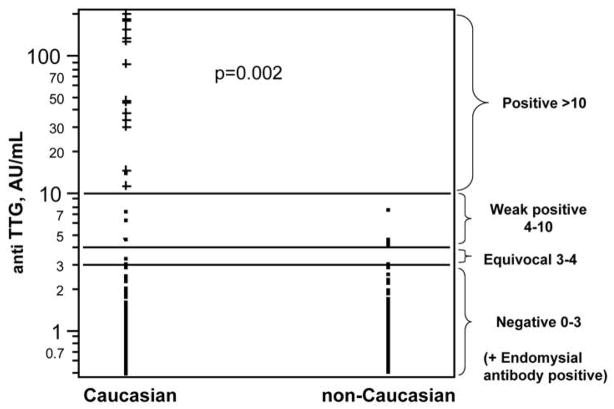
Results: Celiac disease occurred in 14 of 567 cases (2.5%) and in only 1 of 1136 controls (0.1%; Fisher exact test, P = 1.92 × 10(-6)). Celiac disease was more common in Caucasian cases (14 of 363; 4%) than non-Caucasian cases (0 of 204; P = .003). Only 1 Caucasian control and no non-Caucasian controls had celiac disease. The odds of celiac disease in individuals with iron deficiency was 28-fold (95% confidence interval, 3.7-212.8) that of controls; 13 of 14 cases with celiac disease carried the DQ2.5 variant of the HLA genotype.
Conclusions: Celiac disease is associated with iron deficiency in Caucasians. Celiac disease is rare among non-Caucasians-even among individuals with features of celiac disease, such as iron deficiency. Celiac disease also is rare among individuals without iron deficiency. Men and postmenopausal women with iron deficiency should be tested for celiac disease.
Copyright © 2013 AGA Institute. Published by Elsevier Inc. All rights reserved.
Conflict of interest statement
CONFLICT OF INTEREST
Guarantor of the article: Joseph A. Murray, MD.
Substantial contributions to the study concept and design; conducted data analysis and data interpretation; critically revised the article: Stela McLachlan, Chad P. Garner
Substantial contributions to the concept and design, as well as data acquisition, critically revised the article: Ronald T. Acton, Paul C. Adams, John H. Eckfeldt, Victor R. Gordeuk, Christine E. McLaren, Gordon D. McLaren
Conducted data analysis; critically revised the article: Tricia Brantner, Catherine Leiendecker-Foster,
Participated in data interpretation; critically revised the article: Lisa F. Barcellos, Kenneth B. Beckman, Antony A. Killeen, Deborah A Nickerson, Chris D. Vulpe
All authors have approved the final revision
Figures
References
-
- WHO. Turning the tide of malnutrition: Responding to the challenge of the 21st century (WHO/NHD/00.7) 2000.
-
- Lieu PT, Heiskala M, Peterson PA, et al. The roles of iron in health and disease. Mol Aspects Med. 2001;22:1–87. - PubMed
-
- Adams PC, Reboussin DM, Barton JC, et al. Hemochromatosis and iron-overload screening in a racially diverse population. The New England journal of medicine. 2005;352:1769–1778. - PubMed
-
- McLaren CE, Barton JC, Adams PC, et al. Hemochromatosis and Iron Overload Screening (HEIRS) study design for an evaluation of 100,000 primary care-based adults. Am J Med Sci. 2003;325:53–62. - PubMed
Publication types
MeSH terms
Substances
Grants and funding
- N01-HC-05188/HC/NHLBI NIH HHS/United States
- N01 HC005192/HC/NHLBI NIH HHS/United States
- N01-HC-05186/HC/NHLBI NIH HHS/United States
- N01 HC005189/HC/NHLBI NIH HHS/United States
- N01 HC005191/HC/NHLBI NIH HHS/United States
- R01 HL083328/HL/NHLBI NIH HHS/United States
- N01-HC-05191/HC/NHLBI NIH HHS/United States
- N01 HC005191/HL/NHLBI NIH HHS/United States
- R25 HL003679/HL/NHLBI NIH HHS/United States
- P30 CA062203/CA/NCI NIH HHS/United States
- N01 HC005186/HC/NHLBI NIH HHS/United States
- N01 HC005189/HL/NHLBI NIH HHS/United States
- N01-HC-05190/HC/NHLBI NIH HHS/United States
- M01-RR10284/RR/NCRR NIH HHS/United States
- UH1-HL03679-05/HL/NHLBI NIH HHS/United States
- M01 RR010284/RR/NCRR NIH HHS/United States
- M01 RR000032/RR/NCRR NIH HHS/United States
- N01-HC-05189/HC/NHLBI NIH HHS/United States
- M01RR 00827-29/RR/NCRR NIH HHS/United States
- N01 HC005185/HL/NHLBI NIH HHS/United States
- N01 HC005185/HC/NHLBI NIH HHS/United States
- N01 HC005188/HL/NHLBI NIH HHS/United States
- M01 RR000827/RR/NCRR NIH HHS/United States
- N01 HC005186/HL/NHLBI NIH HHS/United States
- UH1 HL003679/HL/NHLBI NIH HHS/United States
- N01 HC005188/HC/NHLBI NIH HHS/United States
- N01-HC-05185/HC/NHLBI NIH HHS/United States
- M01-RR00032/RR/NCRR NIH HHS/United States
- N01 HC005190/HL/NHLBI NIH HHS/United States
LinkOut - more resources
Full Text Sources
Other Literature Sources
Medical
Research Materials
