


Satiety, but not total PYY, Is increased with continuous and intermittent exercise
- PMID: 23418154
- PMCID: PMC3661741
- DOI: 10.1002/oby.20335
Satiety, but not total PYY, Is increased with continuous and intermittent exercise
Abstract
Objective: This study determined the hormonal and subjective appetite responses to exercise (1-h continuous versus intermittent exercise throughout the day) in obese individuals.
Design and methods: Eleven obese subjects (>30 kg/m(2) ) underwent three 12-h study days: control condition [sedentary behavior (SED)], continuous exercise condition [(EX) 1-h exercise], and intermittent exercise condition [(INT) 12 hourly, 5-min bouts]. Blood samples (every 10 min) were measured for serum insulin and total peptide YY (PYY) concentrations, with ratings of appetite (visual analog scale [VAS): every 20 min]. Both total area under the curve (AUC), and subjective appetite ratings were calculated.
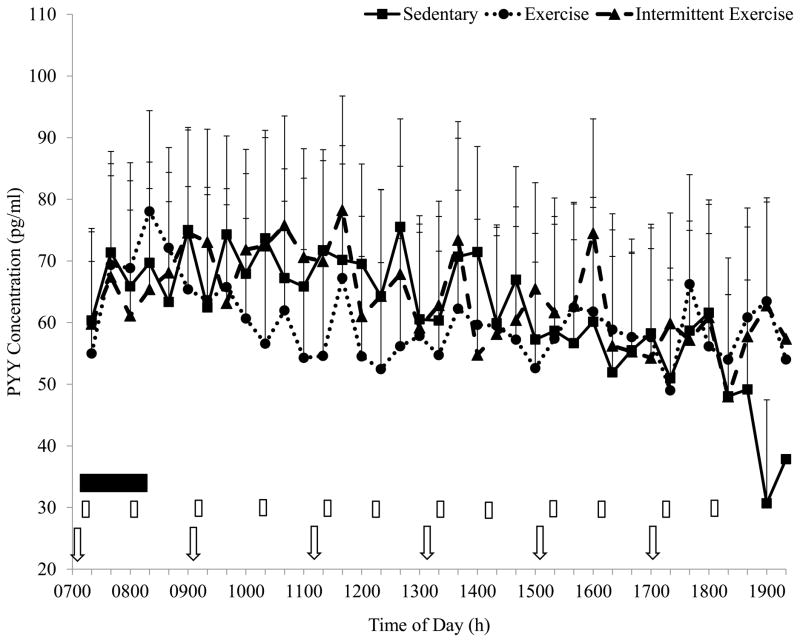
Results: No differences were observed in total PYY AUC between conditions, but hunger was reduced with INT (INT < EX; P < 0.05), and satiety was increased with both SED and INT conditions (INT > EX and SED > EX; P < 0.05). A correlation existed between the change in total PYY and insulin levels (r = -0.81; P < 0.05), and total PYY and satiety (r = 0.80; P < 0.05) with the EX condition, not the SED and INT conditions.
Conclusions: The total PYY response to meals is not altered over the course of a 12-h day with either intermittent or continuous exercise; however, intermittent exercise increased satiety and reduced hunger to a greater extent than continuous exercise in obese individuals.
Copyright © 2013 The Obesity Society.
Conflict of interest statement
There were no conflicts of interest for any of the authors of this manuscript.
Figures
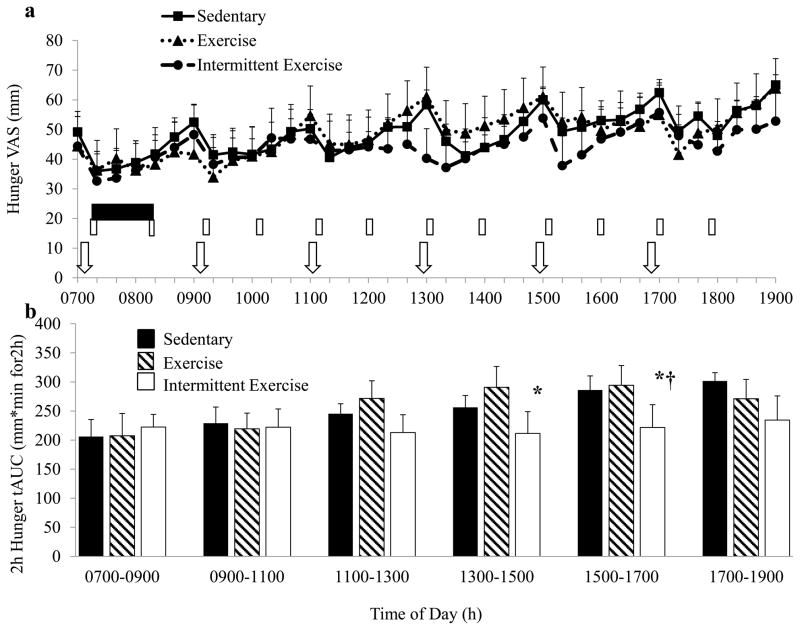
 - exercise condition; 1-hour walking bout. ▯- intermittent exercise condition; hourly 5-minute walking bouts. b) 2 h tAUC for hunger VAS scores. *Significantly different from EX condition (P<0.05). †Significantly different from SED condition (P<0.05).
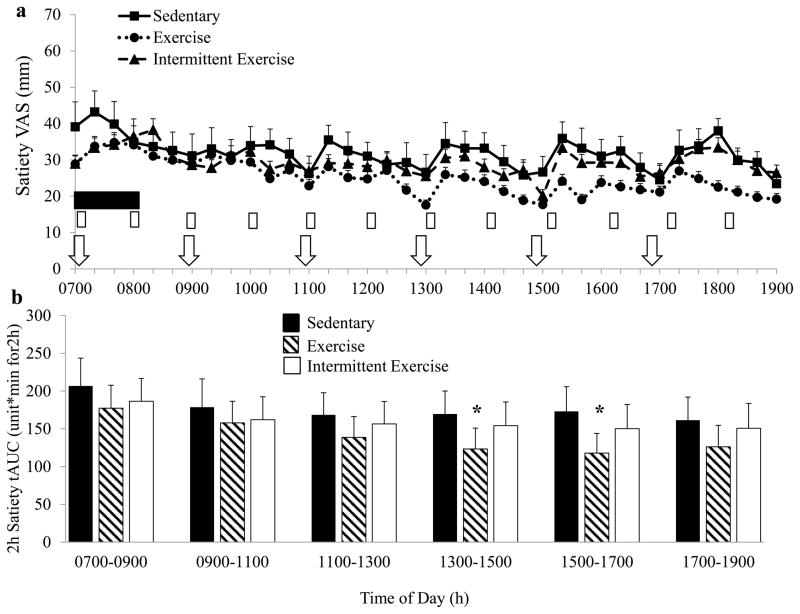 - exercise condition; 1-hour walking bout. ▯- intermittent exercise condition; hourly 5-minute walking bouts. b) 2 h tAUC for satiety VAS scores. *Significantly different from SED and INT conditions (P<0.05).
References
-
- McGowan BM, Bloom SR. Peptide YY and appetite control. Curr Opin Pharmacol. 2004;4(6):583–588. - PubMed
-
- Roth CL, Bongiovanni KD, Gohlke B, Woelfle J. Changes in dynamic insulin and gastrointestinal hormone secretion in obese children. J Pediatr Endocrinol Metab. 2010;23(12):1299–1309. - PubMed
-
- Batterham RL, Cohen MA, Ellis SM, et al. Inhibition of food intake in obese subjects by peptide YY3-36. N Engl J Med. 2003;349(10):941–948. - PubMed
-
- Jebb SA, Siervo M, Fruhbeck G, Goldberg GR, Murgatroyd PR, Prentice AM. Variability of appetite control mechanisms in response to 9 weeks of progressive overfeeding in humans. Int J Obes (Lond) 2006;30(7):1160–1162. - PubMed
Publication types
MeSH terms
Substances
Grants and funding
LinkOut - more resources
Full Text Sources
Other Literature Sources
Medical
