Comparative Study
. 2013 Feb 19:7:14.
doi: 10.1186/1752-0509-7-14.

Multilevel omic data integration in cancer cell lines: advanced annotation and emergent properties

Affiliations
Comparative Study

Multilevel omic data integration in cancer cell lines: advanced annotation and emergent properties

Yuanhua Liu et al. BMC Syst Biol. .

Abstract

Background: High-throughput (omic) data have become more widespread in both quantity and frequency of use, thanks to technological advances, lower costs and higher precision. Consequently, computational scientists are confronted by two parallel challenges: on one side, the design of efficient methods to interpret each of these data in their own right (gene expression signatures, protein markers, etc.) and, on the other side, realization of a novel, pressing request from the biological field to design methodologies that allow for these data to be interpreted as a whole, i.e. not only as the union of relevant molecules in each of these layers, but as a complex molecular signature containing proteins, mRNAs and miRNAs, all of which must be directly associated in the results of analyses that are able to capture inter-layers connections and complexity.

Results: We address the latter of these two challenges by testing an integrated approach on a known cancer benchmark: the NCI-60 cell panel. Here, high-throughput screens for mRNA, miRNA and proteins are jointly analyzed using factor analysis, combined with linear discriminant analysis, to identify the molecular characteristics of cancer. Comparisons with separate (non-joint) analyses show that the proposed integrated approach can uncover deeper and more precise biological information. In particular, the integrated approach gives a more complete picture of the set of miRNAs identified and the Wnt pathway, which represents an important surrogate marker of melanoma progression. We further test the approach on a more challenging patient-dataset, for which we are able to identify clinically relevant markers.

Conclusions: The integration of multiple layers of omics can bring more information than analysis of single layers alone. Using and expanding the proposed integrated framework to integrate omic data from other molecular levels will allow researchers to uncover further systemic information. The application of this approach to a clinically challenging dataset shows its promising potential.


Figures
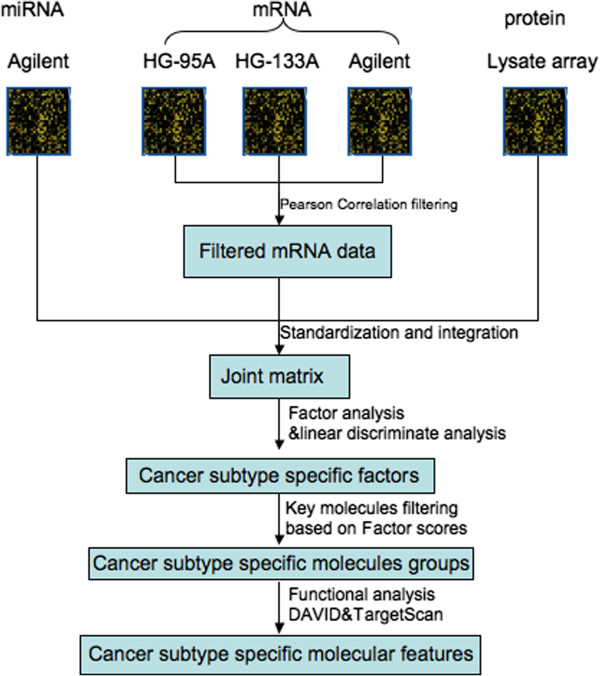
Figure 1
Figure 1
Flowchart of data integration analysis. General outline of data integration, where three steps are involved: (1) mRNA, miRNA and protein omic data are standardized and merged into one matrix (joint matrix); (2) FA is done on the joint matrix to identify the tissue-specific factors, through which key molecules, including mRNAs, miRNAs and proteins, are filtered; (3) Functional analysis is performed using DAVID to extract cancer-related features.
Figure 2
Figure 2
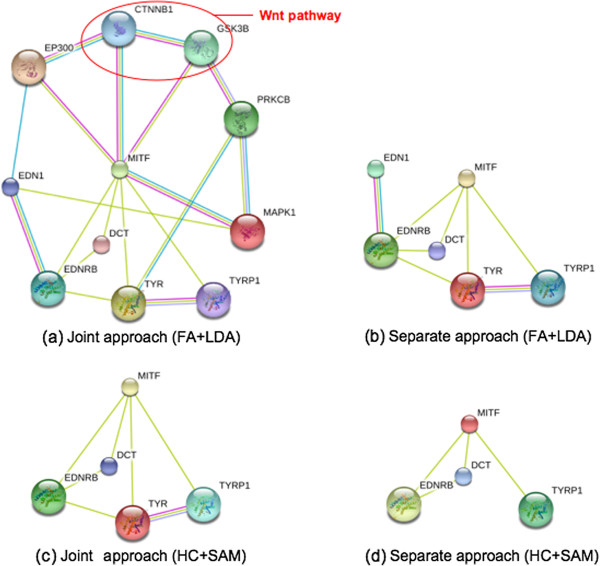
Melanogenesis. Network of interaction among the molecules related to Melanogenes using STRING (http://string.embl.de/) obtained from different methods, including joint and separate analysis based on FA+LDA (combination of factor analysis and linear discriminant analysis) and HC+SAM (combination of hierarchical clustering and SAM). (a) Joint approach (FA+LDA) and (b)Separate approach (FA+LDA) are from the joint and separate analyses based on FA+LDA methods, respectively. The loss of connectivity due to the lack of molecules CTNNB1 and GSK3B in the separate analysis corresponds to a loss of information related to the Wnt signaling pathway which is of utmost relevance in melanocyte differentiation and melanoma onset. (c) Joint approach (HC+SAM) and (d) Separate approach (HC+SAM) illustrate the results from the joint and separate analyses based on HC+SAM methods, respectively. Similarly to the FA+LDA methods, joint analysis shows better performance than the separate analysis since the latter is not able to identify the key factor TYR for melanogenesis. Overall, regarding melanogenesis, FA+LDA methods outperforms HC+SAM, and the joint analysis is more informative than the separate analysis. Joint analysis based on FA+LDA only is able to uncover the emergent melanogenesis process in melanoma.
Figure 3
Figure 3
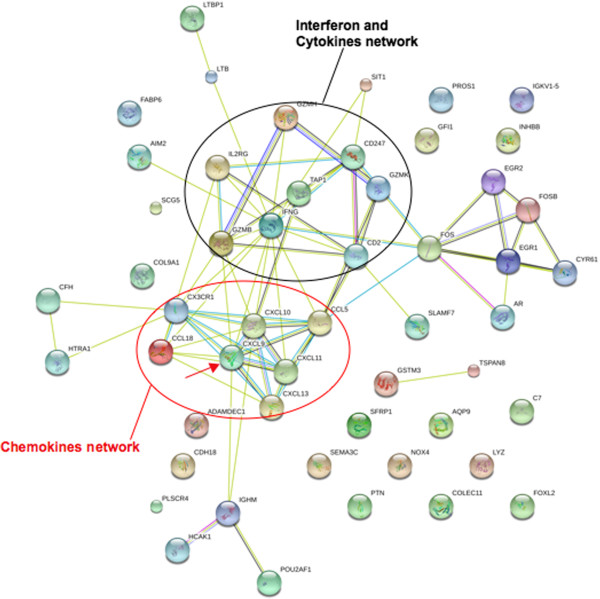
Interactions of genes relevant to the clinical response to Platinum treatment in TCGA. Interactions of the relevant genes in F 8 are reconstructed using STRING (http://string.embl.de/). Highlighted are the chemokines family (red oval) and the Interferon and cytokines (black oval) networks. Of remarkable importance is the central role played by CXCL9 (red arrow) in orchestrating the immune and inflammatory responses, which correlate with the platinum therapy efficacy.

References

    1. Shankavaram UT, Reinhold WC, Nishizuka S, Major S, Morita D, Chary KK, Reimers MA, Scherf U, Kahn A, Dolginow D, Cossman J, Kaldjian EP, Scudiero DA, Petricoin E, Liotta L, Lee JK, Weinstein JN. Transcript and protein expression profiles of the NCI-60 cancer cell panel: an integromic microarray study. Mol Cancer Ther. 2007;6(3):820–832. doi: 10.1158/1535-7163.MCT-06-0650. - DOI - PubMed
    1. Liu H, D’Andrade P, Fulmer-Smentek S, Lorenzi P, Kohn KW, Weinstein JN, Pommier Y, Reinhold WC. mRNA and microRNA expression profiles of the NCI-60 integrated with drug activities. Mol Cancer Ther. 2010;9(5):1080–1091. doi: 10.1158/1535-7163.MCT-09-0965. - DOI - PMC - PubMed
    1. Fronza R, Tramonti M, Atchley WR, Nardini C. Joint analysis of transcriptional and post- transcriptional brain tumor data: searching for emergent properties of cellular systems. BMC Bioinformatics. 2011;12:86–86. doi: 10.1186/1471-2105-12-86. - DOI - PMC - PubMed
    1. Cancer Genome Atlas Research Network. Integrated genomic analyses of ovarian carcinoma. Nature. 2011;474(7353):609–615. doi: 10.1038/nature10166. - DOI - PMC - PubMed
    1. Jolliffe IT. Principal Component Analysis. New York: Springer; 1986.

Publication types

MeSH terms

Substances

LinkOut - more resources