


Review
doi: 10.1038/nrg3351.
Epub 2013 Feb 19.
Understanding, predicting and manipulating the genotypic evolution of antibiotic resistance
Affiliations
- PMID: 23419278
- PMCID: PMC3705945
- DOI: 10.1038/nrg3351
Item in Clipboard
Review
Understanding, predicting and manipulating the genotypic evolution of antibiotic resistance
Nat Rev Genet.
2013 Apr.
Abstract
The evolution of antibiotic resistance can now be rapidly tracked with high-throughput technologies for bacterial genotyping and phenotyping. Combined with new approaches to evolve resistance in the laboratory and to characterize clinically evolved resistant pathogens, these methods are revealing the molecular basis and rate of evolution of antibiotic resistance under treatment regimens of single drugs or drug combinations. In this Progress article, we review these new tools for studying the evolution of antibiotic resistance and discuss how the genomic and evolutionary insights they provide could transform the diagnosis, treatment and predictability of antibiotic resistance in bacterial infections.
Figures

Gradients of drug concentration over time or space facilitate multi-step experimental evolution. a, In a classical selection for antibiotic resistance, a uniform drug concentration selects for only a single mutation. b, A continuous culture device can select for multiple resistance-conferring mutations by dynamically increasing drug concentration in response to increasing drug resistance. c, If bacteria can migrate over a spatial gradient of drug concentration then they can explore larger regions of space only as they evolve increasing levels of drug resistance.

The evolution and transmission of antibiotic resistant bacteria can be studied over scales ranging from continents to organs by different approaches from clinical sampling. Worldwide sampling of isolates reveals intercontinental transmission, sampling within a localized epidemic reveals patient to patient transmission networks, and sampling within a single patient can reveal transfer between sites of the body and possibly organ-specific evolution.
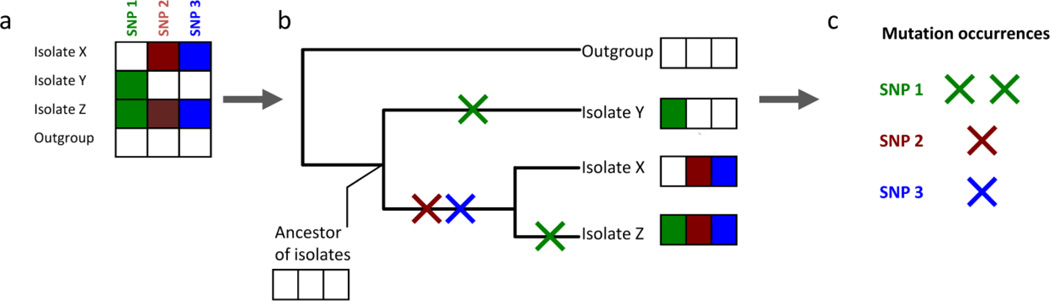
a, A collection of related isolates will possess many shared mutations relative to a more distantly strain (an outgroup), but this does not necessarily imply that any of these mutations repeatedly occurred. b, Phylogenetic inference estimates the likely evolutionary history that connects the isolates and identifies when each mutation occurred. Note that many other mutations would need to have occurred for accurate phylogenetic inference; in this example only 3 mutations are shown to illustrate the principle. c, From the phylogenetic tree, the number of times that a gene mutated independently in separate lineages can be counted to distinguish mutations that are shared merely by common ancestry (red and blue) from mutations that are shared by parallel evolution (green), strongly indicating adaptive evolution. SNP, single-nucleotide polymorphism.

The properties of evolutionary processes can be illustrated by the concept of the ‘fitness landscape’. In this demonstration of several experimentally observed behaviors, height represents drug resistance. Different starting genotypes (A and B) may have a different propensity to evolve resistance owing to their proximities to drug-resistance peaks of varying height. The first genotypic step towards resistance can sometimes define the final genotype and level of resistance (arrows from B). The pathways to resistance can at times be constrained and predictable (dark arrows), but evolutionary pathways can diverge (light arrows) to distinct peaks separated by negative genetic interactions.
References
-
- The evolving threat of antimicrobial resistance: Options for action. Geneva: World Health Organization; 2012.
-
- Paterson DL. Resistance in gram-negative bacteria: enterobacteriaceae. Am J Med. 2006;119:S20–S28. discussion S62-70. - PubMed
-
- Morar M, Wright GD. The genomic enzymology of antibiotic resistance. Annu Rev Genet. 2010;44:25–51. - PubMed
Publication types
MeSH terms
Substances
Grants and funding
LinkOut - more resources
Full Text Sources
Other Literature Sources
Medical
