


Determinants of plasma concentrations of perfluoroalkyl substances in pregnant Norwegian women
- PMID: 23419425
- PMCID: PMC3605228
- DOI: 10.1016/j.envint.2012.12.014
Determinants of plasma concentrations of perfluoroalkyl substances in pregnant Norwegian women
Abstract
Background: Perfluoroalkyl substances (PFASs) are widespread pollutants that have been associated with adverse health effects although not on a consistent basis. Diet has been considered the main source of exposure. The aim of the present study was to identify determinants of four plasma PFASs in pregnant Norwegian women.
Methods: This study is based in the Norwegian Mother and Child Cohort Study (MoBa) conducted by the Norwegian Institute of Public Health. Our sample included 487 women who enrolled in MoBa from 2003 to 2004. A questionnaire regarding sociodemographic, medical, and reproductive history was completed at 17 weeks of gestation and a dietary questionnaire was completed at 22 weeks of gestation. Maternal plasma samples were obtained around 17 weeks of gestation. Plasma concentrations of four PFASs (perfluorooctane sulfonate (PFOS), perfluorooctanoate (PFOA), perfluorohexane sulfonate (PFHxS), and perfluorononanoate (PFNA)) were examined in relation to demographic, lifestyle, dietary, and pregnancy-related covariates. Predictors were identified by optimizing multiple linear regression models using Akaike's information criterion (AIC).
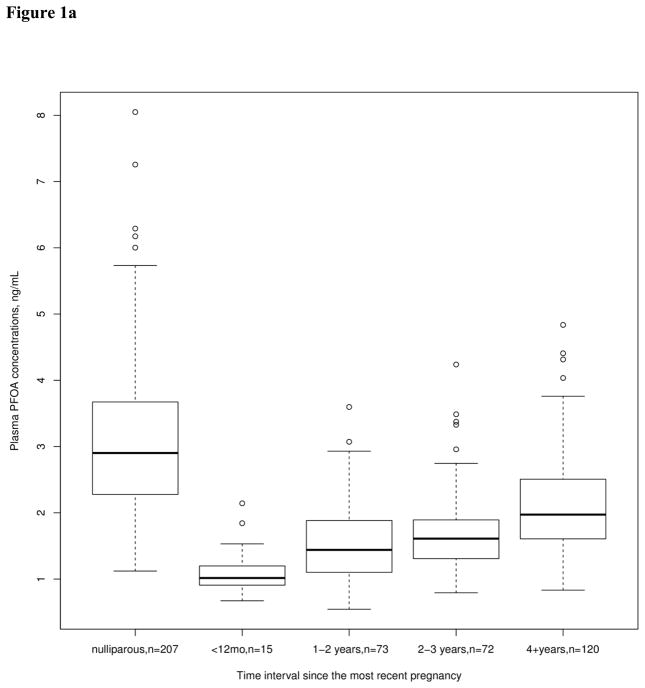
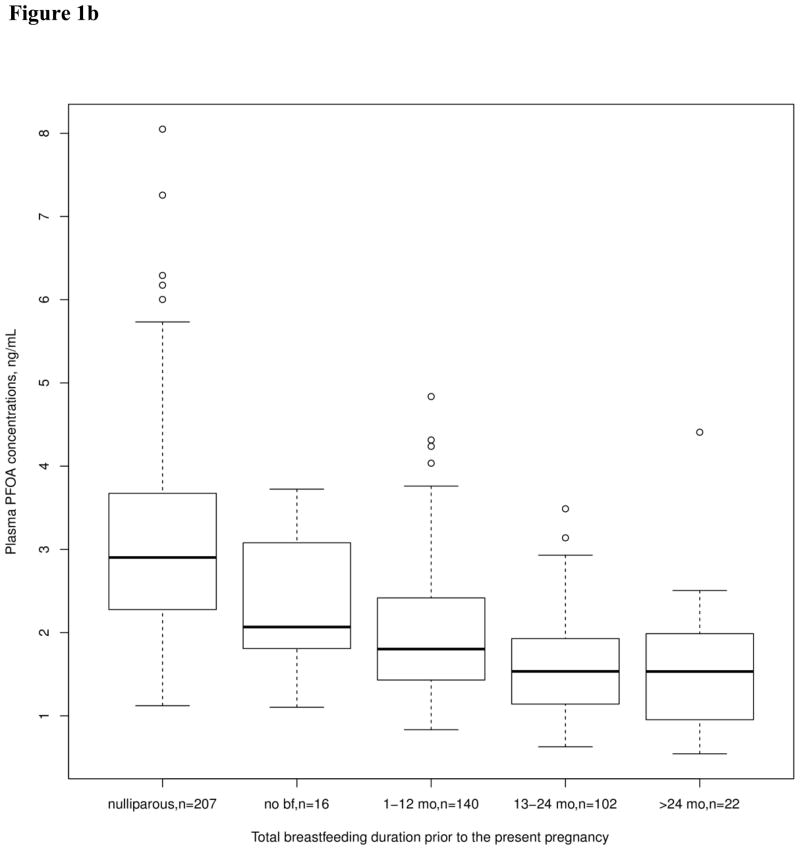
Results: Parity was the determinant with the largest influence on plasma PFAS concentrations, with r(2) between 0.09 and 0.32 in simple regression models. In optimal multivariate models, when compared to nulliparous women, parous women had 46%, 70%, 19%, and 62% lower concentrations of PFOS, PFOA, PFHxS, and PFNA respectively (p<0.001 except for PFHxS, p<0.01). In all these models, duration of breastfeeding was associated with reduced PFAS levels. PFOA showed the largest reduction from breastfeeding, with a 2-3% reduction per month of breastfeeding in typical cases. Levels of PFOS, PFOA, and PFNA increased with time since most recent pregnancy. While pregnancy-related factors were the most important predictors, diet was a significant factor explaining up to 4% of the variance. One quartile increase in estimated dietary PFAS intake was associated with plasma PFOS, PFOA, PFHxS, and PFNA concentration increases of 7.2%, 3.3%, 5.8% and 9.8%, respectively, resulting in small, although non-trivial absolute changes in PFAS concentrations.
Conclusion: Previous pregnancies and breastfeeding duration were the most important determinants of PFASs in this sample of pregnant women.
Copyright © 2013 Elsevier Ltd. All rights reserved.
Figures
References
-
- Andersen ME, Clewell HJ, III, Tan YM, Butenhoff JL, Olsen GW. Pharmacokinetic modeling of saturable, renal resorption of perfluoroalkylacids in monkeys--probing the determinants of long plasma half-lives. Toxicology. 2006;227:156–164. - PubMed
-
- Brantsæter AL, Birgisdottir BE, Meltzer HM, Kvalem HE, Alexander J, Magnus P, et al. Maternal seafood consumption and infant birth weight, length and head circumference in the Norwegian Mother and Child Cohort Study. Br J Nutr. 2012;107:436–444. - PubMed
Publication types
MeSH terms
Substances
Grants and funding
LinkOut - more resources
Full Text Sources
Other Literature Sources
Medical
