


Allogeneic hematopoietic cell transplantation for neuroblastoma: the CIBMTR experience
- PMID: 23419433
- PMCID: PMC3661721
- DOI: 10.1038/bmt.2012.284
Allogeneic hematopoietic cell transplantation for neuroblastoma: the CIBMTR experience
Abstract
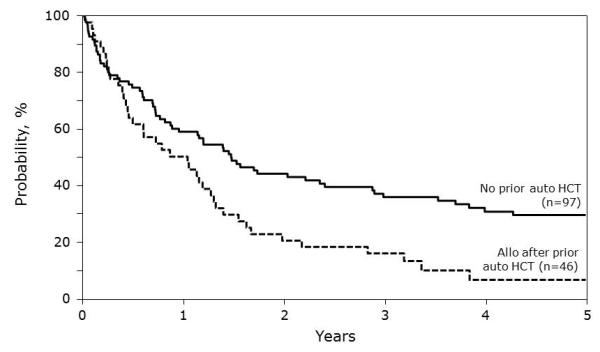
Although the role of autologous hematopoietic cell transplantation (auto-HCT) is well established in neuroblastoma (NBL), the role of allogeneic HCT (allo-HCT) is controversial. The Center for International Blood and Marrow Transplant Research conducted a retrospective review of 143 allo-HCT for NBL reported in 1990-2007. Patients were categorized into two different groups: those who had not (Group 1) and had (Group 2) undergone a prior auto-HCT (n=46 and 97, respectively). One-year and five-year OS were 59% and 29% for Group 1 and 50% and 7% for Group 2, respectively. Among donor types, disease-free survival (DFS) and OS were significantly lower for unrelated transplants at 1 and 3 years but not at 5 years post HCT. Patients in CR or very good partial response (VGPR) at transplant had lower relapse rates and better DFS and OS, compared with those not in CR or VGPR. Our analysis indicates that allo-HCT can cure some neuroblastoma patients, with lower relapse rates and improved survival in patients without a history of prior auto-HCT as compared with those patients who had previously undergone auto-HCT. Although the data do not address why either strategy was chosen for patients, allo-HCT after a prior auto-HCT appears to offer minimal benefit. Disease recurrence remains the most common cause of treatment failure.
Figures
References
-
- Maris JM, Hogarty MD, Bagatell R, Cohn SL. Neuroblastoma. Lancet. 2007;369(9579):2106–20. - PubMed
-
- Matthay KK, Villablanca JG, Seeger RC, Stram DO, Harris RE, Ramsay NK, et al. Treatment of high-risk neuroblastoma with intensive chemotherapy, radiotherapy, autologous bone marrow transplantation, and 13-cis-retinoic acid. Children’s Cancer Group. N Engl J Med. 1999;341(16):1165–73. - PubMed
-
- Matthay KK, Reynolds CP, Seeger RC, Shimada H, Adkins ES, Haas-Kogan D, et al. Long-term results for children with high-risk neuroblastoma treated on a randomized trial of myeloablative therapy followed by 13-cis-retinoic acid: a children’s oncology group study. J Clin Oncol. 2009;27(7):1007–13. - PMC - PubMed
Publication types
MeSH terms
Grants and funding
LinkOut - more resources
Full Text Sources
Other Literature Sources
Medical
