


Neonatal levels of acute phase proteins and later risk of non-affective psychosis
- PMID: 23423137
- PMCID: PMC3591005
- DOI: 10.1038/tp.2013.5
Neonatal levels of acute phase proteins and later risk of non-affective psychosis
Abstract
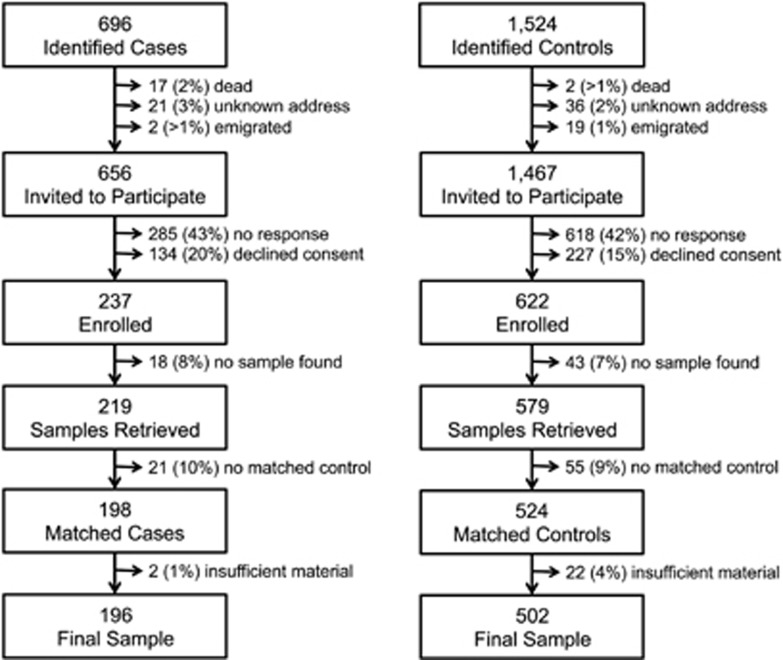
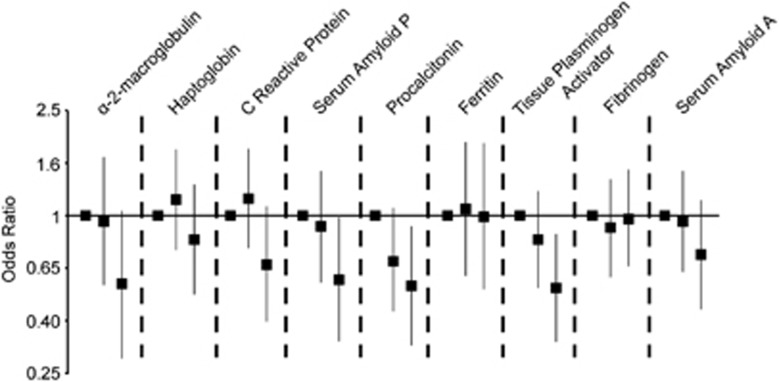
Mounting evidence suggests that immune disturbances in early life may be implicated in the etiology of non-affective psychoses. Our aim was to assess the levels of neonatal acute phase proteins (APPs), central to innate immune function as well as central nervous system development, in neonatal dried blood spots and their association with later risk of non-affective psychoses. This case-control study included 196 individuals with a verified register-based diagnosis of non-affective psychosis and 502 controls matched on age, sex and hospital of birth. Concentrations of nine different APPs were measured in eluates from dried blood spots using a bead-based multiplex assay. Odds ratios (OR) for non-affective psychoses were calculated for log(2)-transformed (continuous) as well as tertiles of APP concentrations. In continuous analysis, higher concentrations of two APPs, tissue plasminogen activator (tPA; OR: 0.90, 95% confidence interval (CI): 0.85-0.96) and serum amyloid P (SAP; OR: 0.88, 95% CI: 0.78-0.99) were protective in terms of risk of non-affective psychosis. These relationships were not affected by the addition of covariates relevant to maternal health, pregnancy and delivery to the model. Tertile analysis confirmed a protective relationship for higher levels of tPA and SAP, as well as for procalcitonin (highest tertile OR: 0.54, 95% CI:0.32-0.91). Our results suggest that persons who develop non-affective psychoses have lower levels of certain APPs at the time of birth. These differences may render individuals more susceptible to infectious diseases or cause deficiencies in pathways critical for neurodevelopment.
Figures
References
-
- Mortensen PB, Pedersen MG, Pedersen CB. Psychiatric family history and schizophrenia risk in Denmark: which mental disorders are relevant. Psychol Med. 2010;40:201–210. - PubMed
-
- Mortensen PB, Pedersen CB, Westergaard T, Wohlfahrt J, Ewald H, Mors O, et al. Effects of family history and place and season of birth on the risk of schizophrenia. N Engl J Med. 1999;340:603–608. - PubMed
Publication types
MeSH terms
Substances
LinkOut - more resources
Full Text Sources
Other Literature Sources
Medical
Miscellaneous
