. 2013 Apr;35(4):386-96.
doi: 10.1002/bies.201200148. Epub 2013 Feb 19.

Identifying the genomic determinants of aging and longevity in human population studies: progress and challenges

Affiliations
Free PMC article

Identifying the genomic determinants of aging and longevity in human population studies: progress and challenges

Joris Deelen et al. Bioessays. 2013 Apr.
Free PMC article

Abstract

Human lifespan variation is mainly determined by environmental factors, whereas the genetic contribution is 25-30% and expected to be polygenic. Two complementary fields go hand in hand in order to unravel the mechanisms of biological aging: genomic and biomarker research. Explorative and candidate gene studies of the human genome by genetic, transcriptomic, and epigenomic approaches have resulted in the identification of a limited number of interesting positive linkage regions, genes, and pathways that contribute to lifespan variation. The possibilities to further exploit these findings are rapidly increasing through the use of novel technologies, such as next-generation sequencing. Genomic research is progressively being integrated with biomarker studies on aging, including the application of (noninvasive) deep phenotyping and omics data - generated using novel technologies - in a wealth of studies in human populations. Hence, these studies may assist in obtaining a more holistic perspective on the role of the genome in aging and lifespan regulation.


Figures

1
1
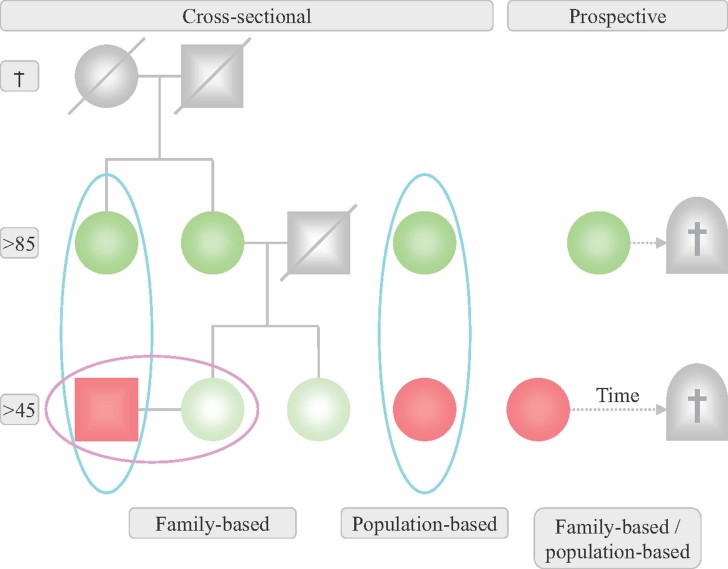
Study designs applied in studies of healthy aging and longevity. Family- or population-based cross-sectional designs usually compare highly aged individuals with younger controls (blue ovals). Alternatively, the offspring of long-lived individuals is compared to age-matched controls (their spouses or random population controls) (purple oval). Thirdly, prospective studies are performed in highly or middle-aged individuals (unrelated or from (long-lived) families) which are followed over time (ranging from 10 to 30 years, depending on the study). Highly aged individuals are depicted in green, their offspring in light green and middle-aged individuals in red.
2
2
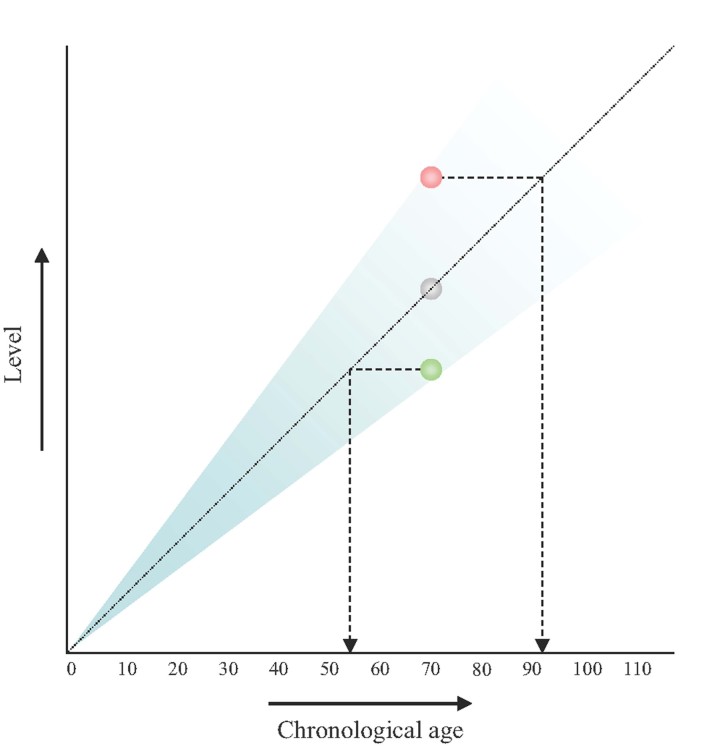
Interpretation of the potential relationship between a marker of chronological age and biological age using categories of increasing age. The blue zone indicates the increasing variance of the marker with age. Individuals can be assigned to having a marker level which matches (i) the expected level for their age in the population (gray dot, 75 years in this example), (ii) the level of a younger age group (green dot, biological age may be lower than chronological age), or (iii) the level of an older age group (red dot, biological age may be higher than chronological age).
3
3
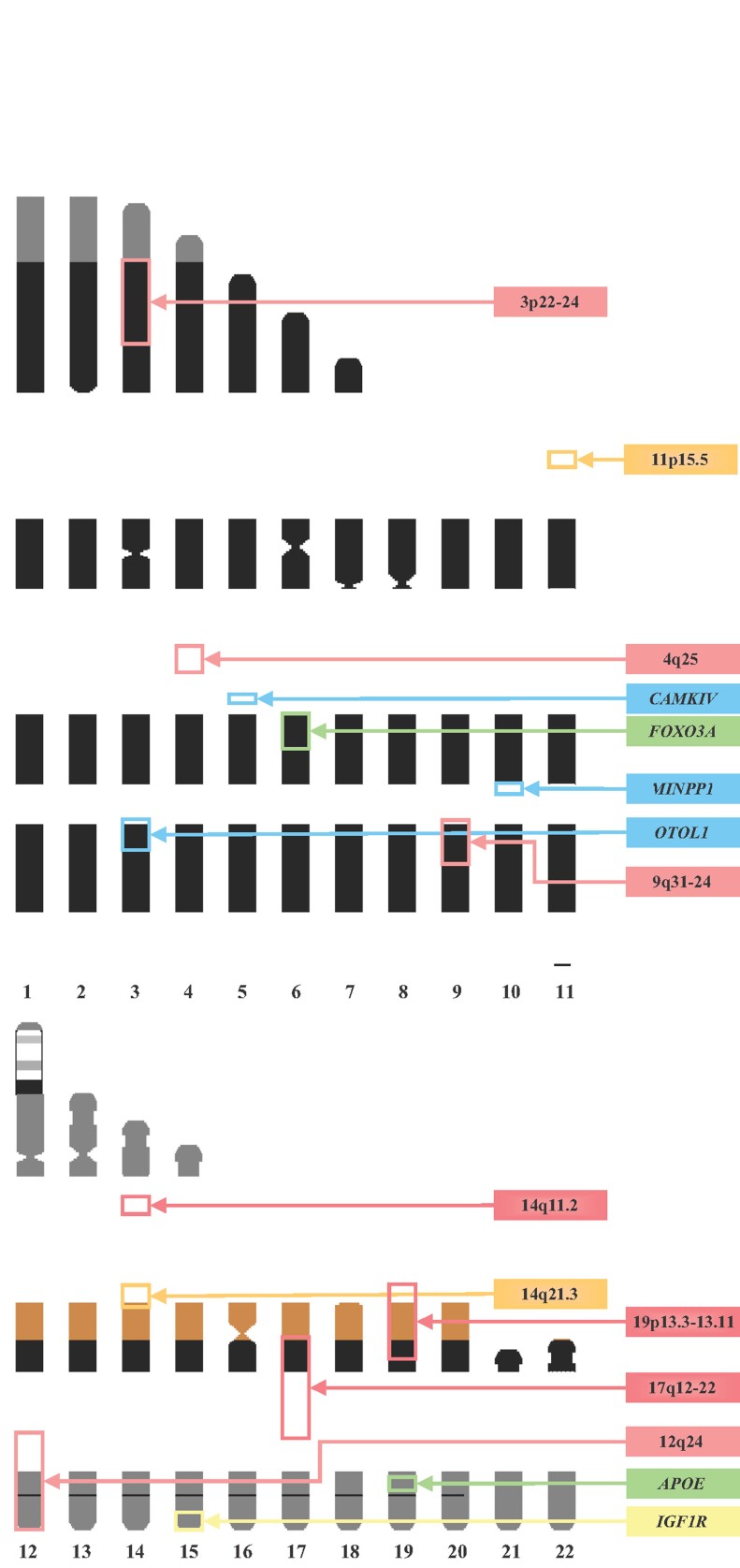
Karyogram (adapted from http://hapmap.ncbi.nlm.nih.gov/karyogram/gwas.html) containing candidate genes whose association with longevity has been replicated in multiple association studies (green), candidate genes with interesting results from sequencing studies (yellow), interesting loci from linkage (LOD ≥ 2.95) (red), and CNV (orange) studies and loci that showed suggestive association with longevity (p ≤ 5 × 10⁻⁶) in GWAS (blue).

References

    1. Oeppen J, Vaupel JW. Demography. Broken limits to life expectancy. Science. 2002;296:1029–31. - PubMed
    1. World Health Organization. World Health Statistics 2012. Geneva: WHO; 2012.
    1. Jagger C, Gillies C, Moscone F, Cambois E, et al. Inequalities in healthy life years in the 25 countries of the European Union in 2005: a cross-national metaregression analysis. Lancet. 2008;372:2124–31. - PubMed
    1. Christensen K, McGue M, Petersen I, Jeune B, et al. Exceptional longevity does not result in excessive levels of disability. Proc Natl Acad Sci USA. 2008;105:13274–9. - PMC - PubMed
    1. Terry DF, Sebastiani P, Andersen SL, Perls TT. Disentangling the roles of disability and morbidity in survival to exceptional old age. Arch Intern Med. 2008;168:277–83. - PMC - PubMed

Publication types