


A statistical model to assess the risk of communicable diseases associated with multiple exposures in healthcare settings
- PMID: 23425160
- PMCID: PMC3599894
- DOI: 10.1186/1471-2288-13-26
A statistical model to assess the risk of communicable diseases associated with multiple exposures in healthcare settings
Abstract
Background: The occurrence of communicable diseases (CD) depends on exposure to contagious persons. The effects of exposure to CD are delayed in time and contagious persons remain contagious for several days during which their contagiousness varies. Moreover when multiple exposures occur, it is difficult to know which exposure is associated with the CD.
Methods: A statistical model at the individual level is presented to estimate the risk of CD to patients, in healthcare settings, with multiple observed exposures to other patients and healthcare workers and unobserved exposures to unobserved or unobservable sources. The model explores the delayed effect of observed exposure, of source contagiousness and of unobserved exposure. It was applied to data on influenza-like illness (ILI) among patients in a university hospital during 3 influenza seasons: from 2004 to 2007. Over a total of 138,411 patients-days of follow-up, 64 incident ILI cases were observed among 21,519 patients at risk of ILI.
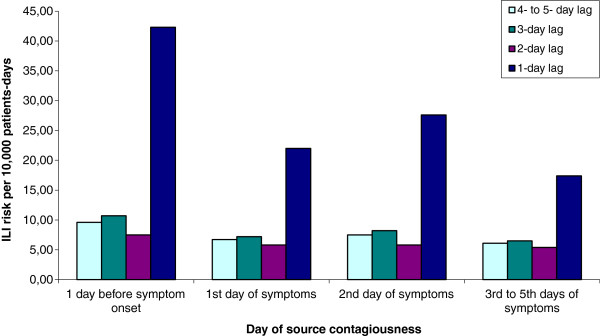
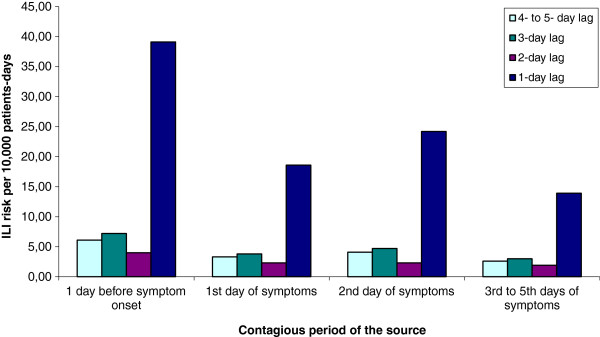
Results: The ILI risk per 10,000 patients-days associated with observed exposure was about 129.1 (95% Credible Interval (CrI): 84.5, 182.9) and was associated at 72% with exposures to patients or healthcare workers 1 day earlier and at 41% with the 1st day of source contagiousness. The ILI risk associated with unobserved exposure was 0.8 (95% CrI: 0.3, 1.6) per 10,000 patients-days in non-epidemic situation in the community and 4.3 (95% CrI: 0.4, 11.0) in epidemic situation.
Conclusions: The model could be an interesting epidemiological tool to further assess the relative contributions of observed and unobserved exposures to CD risk in healthcare settings.
Figures
References
-
- Ross R. An application of the theory of probabilities to the study of a priori pathometry. Part I. Proc R Soc London Series A. 1916;92:204–230. doi: 10.1098/rspa.1916.0007. - DOI
-
- Rhodes PH, Halloran ME, Longini IM. Counting process models for infectious disease data: distinguishing exposure to infection from susceptibility. JR Statist Soc B. 1996;58:751–762.
-
- Anderson RM, May RM. Infectious Diseases of Humans: Dynamics and Control. Oxford: Oxford University Press; 1991.
-
- Roberts MG, Heesterbeek JAP. Mathematical Models in Epidemiology. Mathematical Models: Encyclopedia of Life Support Systems; 2003.
-
- Gilks WR, Richardson S, Spiegelhalter DJ. Markov Chain Monte Carlo in Practice. London: Chapman & Hall; 1996.
Publication types
MeSH terms
LinkOut - more resources
Full Text Sources
Other Literature Sources
Medical
Molecular Biology Databases
