Selection criteria for lung-cancer screening
- PMID: 23425165
- PMCID: PMC3929969
- DOI: 10.1056/NEJMoa1211776
Selection criteria for lung-cancer screening
Erratum in
- N Engl J Med. 2013 Jul 25;369(4):394
Abstract
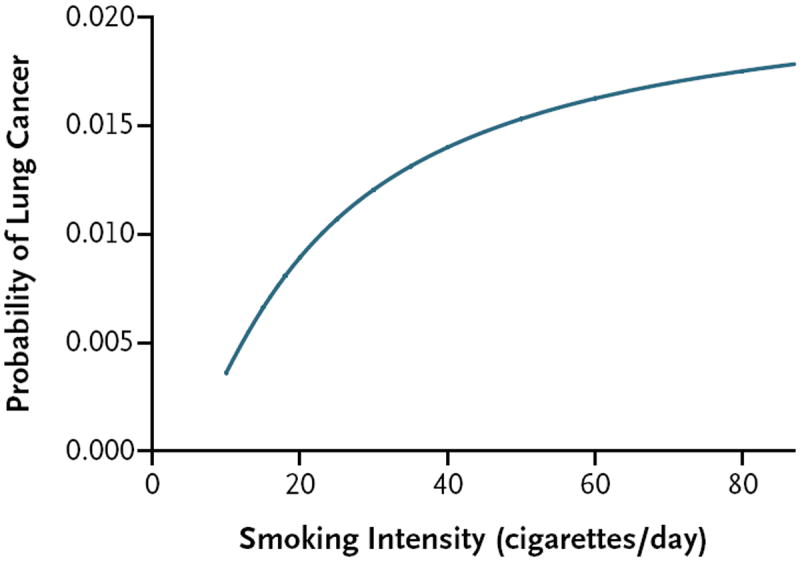
Background: The National Lung Screening Trial (NLST) used risk factors for lung cancer (e.g., ≥30 pack-years of smoking and <15 years since quitting) as selection criteria for lung-cancer screening. Use of an accurate model that incorporates additional risk factors to select persons for screening may identify more persons who have lung cancer or in whom lung cancer will develop.
Methods: We modified the 2011 lung-cancer risk-prediction model from our Prostate, Lung, Colorectal, and Ovarian (PLCO) Cancer Screening Trial to ensure applicability to NLST data; risk was the probability of a diagnosis of lung cancer during the 6-year study period. We developed and validated the model (PLCO(M2012)) with data from the 80,375 persons in the PLCO control and intervention groups who had ever smoked. Discrimination (area under the receiver-operating-characteristic curve [AUC]) and calibration were assessed. In the validation data set, 14,144 of 37,332 persons (37.9%) met NLST criteria. For comparison, 14,144 highest-risk persons were considered positive (eligible for screening) according to PLCO(M2012) criteria. We compared the accuracy of PLCO(M2012) criteria with NLST criteria to detect lung cancer. Cox models were used to evaluate whether the reduction in mortality among 53,202 persons undergoing low-dose computed tomographic screening in the NLST differed according to risk.
Results: The AUC was 0.803 in the development data set and 0.797 in the validation data set. As compared with NLST criteria, PLCO(M2012) criteria had improved sensitivity (83.0% vs. 71.1%, P<0.001) and positive predictive value (4.0% vs. 3.4%, P=0.01), without loss of specificity (62.9% and. 62.7%, respectively; P=0.54); 41.3% fewer lung cancers were missed. The NLST screening effect did not vary according to PLCO(M2012) risk (P=0.61 for interaction).
Conclusions: The use of the PLCO(M2012) model was more sensitive than the NLST criteria for lung-cancer detection.
Figures
Comment in
-
Screening: Improved model for lung cancer detection.Nat Rev Clin Oncol. 2013 Apr;10(4):183. doi: 10.1038/nrclinonc.2013.39. Epub 2013 Mar 12. Nat Rev Clin Oncol. 2013. PMID: 23478286 No abstract available.
References
-
- Jaklitsch MT, Jacobson FL, Austin JH, et al. The American Association for Thoracic Surgery guidelines for lung cancer screening using low-dose computed tomography scans for lung cancer survivors and other high-risk groups. J Thorac Cardiovasc Surg. 2012;144:33–8. - PubMed
-
- Royston P, Altman DG, Sauerbrei W. Dichotomizing continuous predictors in multiple regression: a bad idea. Stat Med. 2006;25:127–41. - PubMed
Publication types
MeSH terms
Grants and funding
- N01-CN-25524/CN/NCI NIH HHS/United States
- U01-CA-79778/CA/NCI NIH HHS/United States
- N01-CN-25513/CN/NCI NIH HHS/United States
- N01-CN-75022/CN/NCI NIH HHS/United States
- N01-CN-25514/CN/NCI NIH HHS/United States
- N01 CN025511/CA/NCI NIH HHS/United States
- N01-CN-25515/CN/NCI NIH HHS/United States
- N01 CN075022/CA/NCI NIH HHS/United States
- N02 CN063300/CA/NCI NIH HHS/United States
- U01-CA-80098/CA/NCI NIH HHS/United States
- U01 CA079778/CA/NCI NIH HHS/United States
- N01 CN025518/CA/NCI NIH HHS/United States
- ImNIH/Intramural NIH HHS/United States
- N01-CN-25516/CN/NCI NIH HHS/United States
- N01 CN025515/CA/NCI NIH HHS/United States
- N01-CN-25476/CN/NCI NIH HHS/United States
- N01-CN-25522/CN/NCI NIH HHS/United States
- N01-CN-25511/CN/NCI NIH HHS/United States
- N01 CN025512/CA/NCI NIH HHS/United States
- U01 CA080098/CA/NCI NIH HHS/United States
- N01-CN-25512/CN/NCI NIH HHS/United States
- N01 CN025522/CA/NCI NIH HHS/United States
- N01 CN025513/CA/NCI NIH HHS/United States
- N01 CN025524/CA/NCI NIH HHS/United States
- N01 CN025476/CA/NCI NIH HHS/United States
- N02-CN-63300/CN/NCI NIH HHS/United States
- N01 CN025516/CA/NCI NIH HHS/United States
- N01-CN-25518/CN/NCI NIH HHS/United States
- N01 CN025514/CA/NCI NIH HHS/United States
LinkOut - more resources
Full Text Sources
Other Literature Sources
Medical
Research Materials
Miscellaneous