


Trastuzumab for the treatment of salivary duct carcinoma
- PMID: 23429737
- PMCID: PMC3607526
- DOI: 10.1634/theoncologist.2012-0369
Trastuzumab for the treatment of salivary duct carcinoma
Abstract
Objective: Salivary duct carcinoma (SDC) is a rare and aggressive malignancy with high mortality and poor response to treatment. A significant fraction of SDCs are HER2 positive. This retrospective review examines HER2 testing in SDC and the outcome of trastuzumab-based therapy in adjuvant and palliative settings.
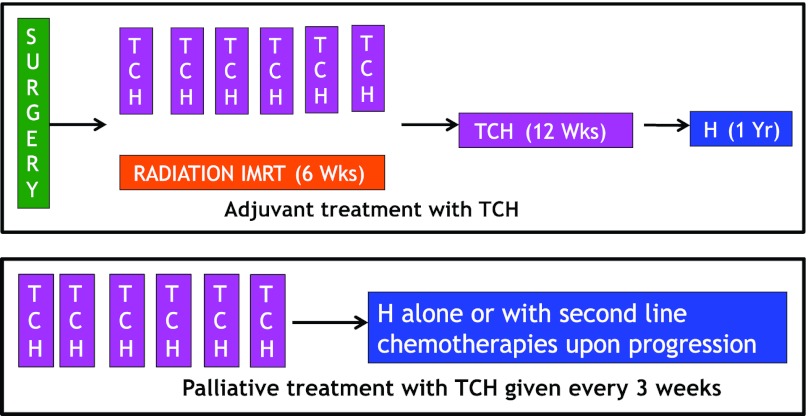
Methods: A total of 13 patients with SDC and HER2/neu expression by immunohistochemistry of 1-3+ were treated with trastuzumab in adjuvant (n = 8) or palliative (n = 5) setting. Adjuvant therapy consisted of concurrent radiation and chemotherapy with weekly paclitaxel, carboplatin, and trastuzumab (TCH) for 6 weeks followed by TCH for 12 weeks and trastuzumab alone for 1 year. Palliative treatment for metastatic disease consisted of TCH every 3 weeks for 6 cycles followed by trastuzumab for variable time periods with or without second-line chemotherapy for progression. All patients had fluorescence in situ hybridization testing for HER2/neu gene amplification.
Results: The median duration of follow-up was 27 months (range: 8-48 months). In all, 62% of adjuvant patients (5/8) had no evidence of disease more than 2 years from completion of therapy. All patients with metastatic disease (5/5 patients) responded to treatment with TCH. One patient achieved a complete response and remains with no evidence of disease 52 months after initiation of TCH. The median duration of response was 18 months (range: 8-52 months).
Conclusion: HER2/neu positivity and treatment with trastuzumab correlated well with long-term survival and response in our patients. Based on this data, we propose that HER2/neu status be examined routinely in all patients with SDCs and the treatment be directed accordingly.
Conflict of interest statement
Disclosures of potential conflicts of interest may be found at the end of this article.
Figures
References
-
- McHugh JB, Visscher DW, Barnes EL. Update on selected salivary gland neoplasms. Arch Pathol Lab Med. 2009;133:1763–1774. - PubMed
-
- Jaehne M, Roeser K, Jaekel T, et al. Clinical and immunohistologic typing of salivary duct carcinoma: A report of 50 cases. Cancer. 2005;103:2526–2533. - PubMed
-
- Barnes L, Rao U, Krause J, et al. Salivary duct carcinoma. Part I. A clinicopathologic evaluation and DNA image analysis of 13 cases with review of the literature. Oral Surg Oral Med Oral Pathol. 1994;78:64–73. - PubMed
-
- Glisson B, Colevas AD, Haddad R, et al. HER2 expression in salivary gland carcinomas: Dependence on histological subtype. Clin Cancer Res. 2004;10:944–946. - PubMed
Publication types
MeSH terms
Substances
LinkOut - more resources
Full Text Sources
Other Literature Sources
Medical
Research Materials
Miscellaneous
