. 2013 Feb 20:4:26.
doi: 10.3389/fpls.2013.00026. eCollection 2013.

Photoperiodic regulation of the sucrose transporter StSUT4 affects the expression of circadian-regulated genes and ethylene production

Affiliations

Photoperiodic regulation of the sucrose transporter StSUT4 affects the expression of circadian-regulated genes and ethylene production

Izabela Chincinska et al. Front Plant Sci. .

Abstract

Several recent publications reported different subcellular localization of the sucrose transporters belonging to the SUT4 subfamily. The physiological function of the SUT4 sucrose transporters requires clarification, because down-regulation of the members of the SUT4 clade had different effects in rice, poplar, and potato. Here, we provide new data for the localization and function of the Solanaceous StSUT4 protein, further elucidating involvement in the onset of flowering, tuberization and in the shade avoidance syndrome of potato plants. Induction of an early flowering and a tuberization in the SUT4-inhibited potato plants correlates with increased sucrose export from leaves and increased sucrose and starch accumulation in terminal sink organs, such as developing tubers. SUT4 affects expression of the enzymes involved in gibberellin and ethylene biosynthesis, as well as the rate of ethylene biosynthesis in potato. In the SUT4-inhibited plants, the ethylene production no longer follows a diurnal rhythm. Thus it was concluded that StSUT4 controls circadian gene expression, potentially by regulating sucrose export from leaves. Furthermore, SUT4 expression affects clock-regulated genes such as StFT, StSOC1, and StCO, which might be also involved in a photoperiod-dependent tuberization. A model is proposed in which StSUT4 controls a phloem-mobile signaling molecule generated in leaves, which together with enhanced sucrose export affects developmental switches in apical meristems. SUT4 seems to link photoreceptor-perceived information about the light quality and day length with phytohormone biosynthesis and the expression of circadian-regulated genes.

Keywords: ethylene; flowering; shade avoidance syndrome; sucrose transport.


Figures
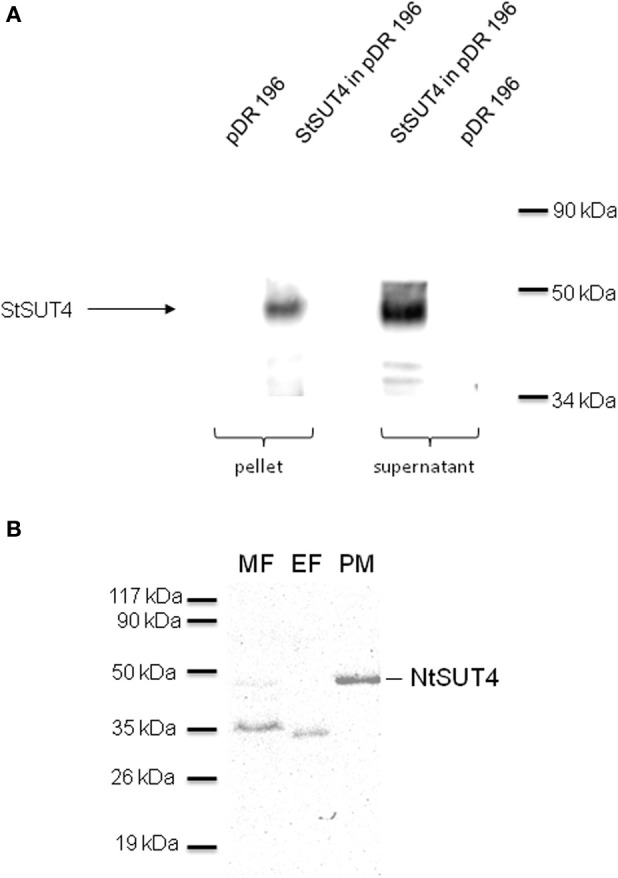
Figure 1
Figure 1
(A) Western Blot analysis of yeast strain SUSY7 expressing StSUT4. The specificity of the StSUT4-specific polyclonal antibody generated in rabbits was tested using microsomal fractions from yeast cells expressing StSUT4 in pDR196 or the empty vector control (pDR196). The corresponding low spin pellet as well as the supernatant was loaded with Laemmli sample buffer and separated by SDS-PAGE. A band of the expected size of 46 kDa is detectable only in yeast extracts expressing StSUT4. (B) Western blot analysis of NtSUT4 in different membrane fractions from tobacco source leaf material. The microsomal fraction (MF) was separated by two-phase partitioning into the endomembranes fraction (EF) and the plasma membrane fraction (PM) by two-phase partitioning as described earlier (Chincinska et al., 2008). 20 μg of protein were loaded per lane on a 12.5% SDS gel. A band with the expected size of 46 kDa was mainly detectable in the plasma membrane fraction.
Figure 2
Figure 2
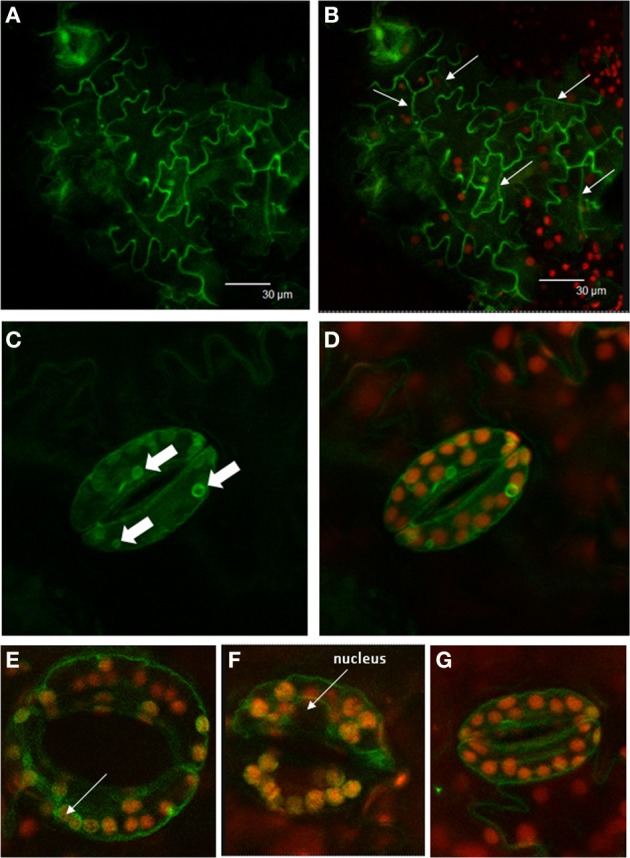
Localization of StSUT4-GFP in stably transformed potato plants. Solanum tuberosum andigena has been transformed with StSUT4-GFP in pCK205 used previously for transient transformation (Chincinska et al., 2008). (A) StSUT4-GFP in young developing sink leaves. (B) Same picture as shown in (A) overlaid with chlorophyll autofluorescence. Arrows mark newly formed cell walls. Epidermis cells undergoing actively cell division. (C) StSUT4-GFP expression in mature source leaves is mainly restricted to guard cells. Arrows mark intracellular fluorescently labeled structures. (D) Same area as shown in (C) overlaid with chlorophyll autofluorescence indicating plastid localization. Note that GFP fluorescence is detectable outside of chloroplasts. (E–G) Guard cells of source leaves showing StSUT4-GFP fluorescence in the periphery of the cells, but sparing the region where the nucleus is localized (arrow) arguing for vacuolar localization.
Figure 3
Figure 3
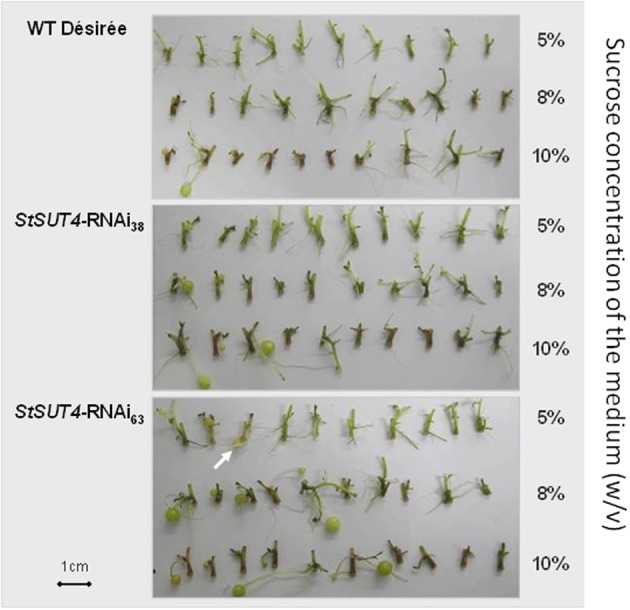
Microtuber production in response to various sucrose concentrations in the dark. Stem cuttings from two independent transgenic lines (StSUT4-RNAi38 and StSUT4-RNAi 63) and WT potato plants from sterile tissue culture were transferred in MS-medium containing 5, 8, or 10% sucrose (w/v). Pictures were taken 10 days after transfer into the dark. The experiment was repeated three times independent experiments and one representative example is given. Note that microtuber production in the transgenic line StSUt4-RNAi #63 is induced by 5% sucrose (arrow). Microtuber induction experiments were performed with Solanum tuberosum ssp. tuberosum plants of the variety Désirée.
Figure 4
Figure 4
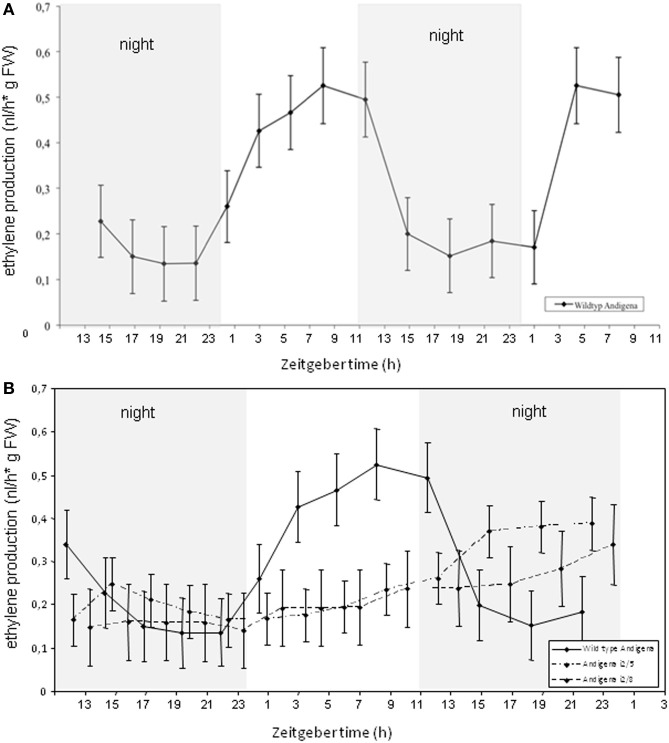
(A) Ethylene production in Solanum tuberosum ssp. andigena plants over a 2 days period show diurnal rhythm with increasing ethylene production during day time and decreasing ethylene production during the night. Plants were grown under day neutral conditions (12 h light/12 h darkness, grey bars indicate dark periods). (B) Ethylene production in StSUT4-RNAi plants # i2/5 and #i2/8 is significantly lower than in potato wild type plants and does not follow diurnal oscillation pattern. Experiments were repeated twice and a representative example is given. The ethylene production is given in nanoliters per hour per gram fresh weight. Error bars indicate the StDev.
Figure 5
Figure 5
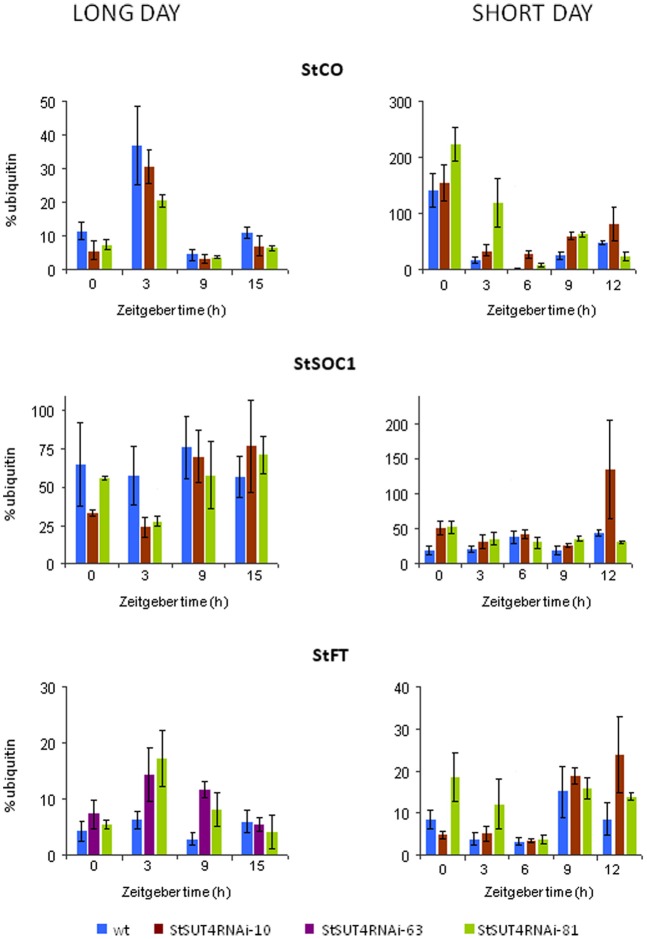
Quantification of the transcript levels of circadian-regulated gene StFT, StSOC1, and StCO via reverse transcription real time PCR in leaves of Solanum tuberosum Désirée plants. Potato plants were grown either under short day (10 h light with a light period from 8 a.m. to 6 p.m.) or long day (16 h light with a light period from 6 a.m. to 10 p.m.) conditions. StCO and StSOC1 mRNA accumulation is reduced in StSUT4-inhibited plants under short day conditions, but increased under long day conditions. StFT transcript levels are increased under both cultivation conditions, short day as well as long day conditions. Relative expression levels are given using ubiquitin mRNA as internal standard. Two technical replicates are performed from two biological replicates in each case. Experiments were repeated at least twice. One representative example is given.
Figure 6
Figure 6
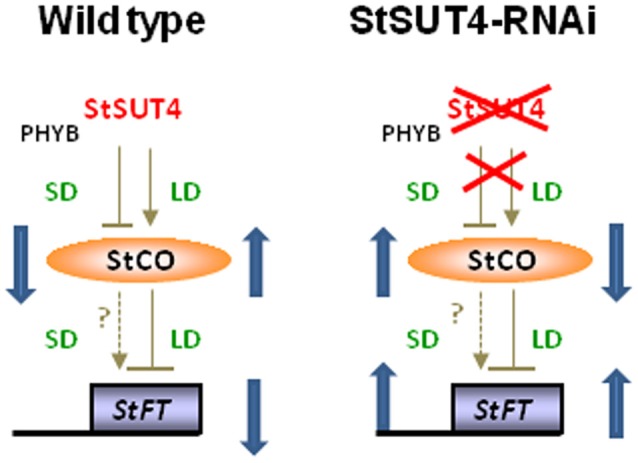
Hypothetical model illustrating the assumed impact of the circadian-regulated gene StSUT4 on the photoperiod-dependent accumulation of StCONSTANS (StCO) and flowering locus T (StFT) transcript levels. Whereas in WT plants StSUT4 inhibits StFT accumulation under long day conditions, this photoperiod-dependent regulation via the StCONSTANS protein is deregulated in StSUT4-inhibited plants leading to increased StFT levels under both, long day and short day conditions leading to early flowering and tuberization even under non-inductive conditions.
Figure A1
Figure A1
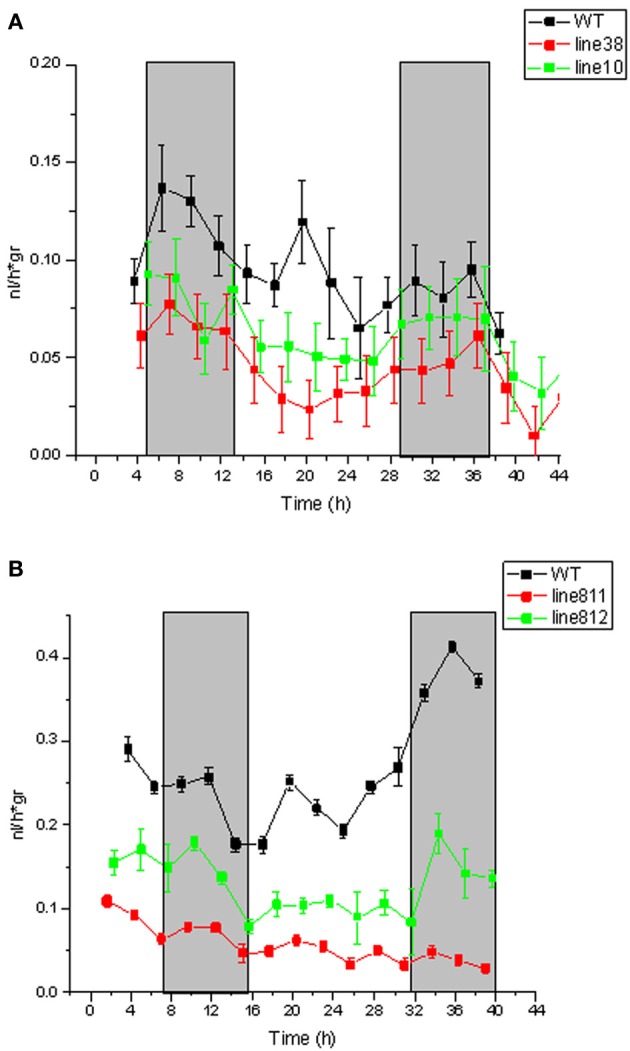
Ethylene production in wild type Désirée and StSUT4-RNAi potato plants. Tissue cultured plants of wild type Solanum tuberosum tuberosum Désirée and corresponding StSUT4-RNAi lines #38, #10 (in A) and two different plants of the transgenic line StSUT4-RNAi #81 (in B) have been analyzed. Time is in h and the grey areas indicate the dark period during the experiment. Plant were grown under long day conditions (16 h light, white light of 270 μmol/m2 × s, grey bars indicate dark periods). Ethylene production is given in nl per h per g fresh weight. Tested plants were kept 3–4 weeks in 2MS medium before ethylene measurement. Fresh weight of plants: A, WT 2.49 g, StSUT4-RNAi #38 1.86 g, StSUT4-RNAi #10 1.84 g. B, WT 3.86 g, StSUT4-RNAi #81.1 5.44 g, StSUT4-RNAi #81.2 4.17 g. StDev is given.

References

    1. Achard P., Baghour M., Chapple A., Hedden P., Van Der Straeten D., Genschik P., et al. (2007). The plant stress hormone ethylene controls floral transition via DELLA-dependent regulation of floral meristem-identity genes. Proc. Natl. Acad. Sci. U.S.A. 104, 6484–6489 10.1073/pnas.0610717104 - DOI - PMC - PubMed
    1. Alders A. W. C. (1987). Marine Refrigeration Manual. Rotterdam: Rotterdam Marine Chartering Agents
    1. Atkins C. A., Smith P. M., Rodriguez-Medina C. (2011). Macromolecules in phloem exudates–a review. Protoplasma 248, 165–172 10.1007/s00709-010-0236-3 - DOI - PubMed
    1. Blazquez M. A., Green R., Nilsson O., Sussman M. R., Weigel D. (1998). Gibberellins promote flowering of arabidopsis by activating the LEAFY promoter. Plant Cell 10, 791–800 10.1105/tpc.10.5.791 - DOI - PMC - PubMed
    1. Chincinska I. A., Liesche J., Krügel U., Michalska J., Geigenberger P., Grimm B., et al. (2008). Sucrose transporter StSUT4 from potato affects flowering, tuberization, and shade avoidance response. Plant Physiol. 146, 515–528 10.1104/pp.107.112334 - DOI - PMC - PubMed

LinkOut - more resources