. 2012:6:65-72.
doi: 10.1007/8904_2011_118. Epub 2012 Jan 31.

Cardiac Pathology in Glycogen Storage Disease Type III

Affiliations

Cardiac Pathology in Glycogen Storage Disease Type III

S L Austin et al. JIMD Rep. 2012.

Abstract

Purpose: To investigate the distribution and clinical impact of glycogen accumulation on heart structure and function in individuals with GSD III.

Methods: We examined cardiac tissue and the clinical records of three individuals with GSD IIIa who died or underwent cardiac transplantation. Of the two patients that died, one was from infection and the other was from sudden cardiac death. The third patient required cardiac transplantation for end-stage heart failure with severe hypertrophic cardiomyopathy.

Results: Macro- and microscopic examination revealed cardiac fibrosis (n = 1), moderate to severe vacuolation of cardiac myocytes (n = 3), mild to severe glycogen accumulation in the atrioventricular (AV) node (n = 3), and glycogen accumulation in smooth muscle cells of intramyocardial arteries associated with smooth muscle hyperplasia and profoundly thickened vascular walls (n = 1).

Conclusion: Our findings document diffuse though variable involvement of cardiac structures in GSD III patients. Furthermore, our results also show a potential for serious arrhythmia and symptomatic heart failure in some GSD III patients, and this should be considered when managing this patient population.


Figures
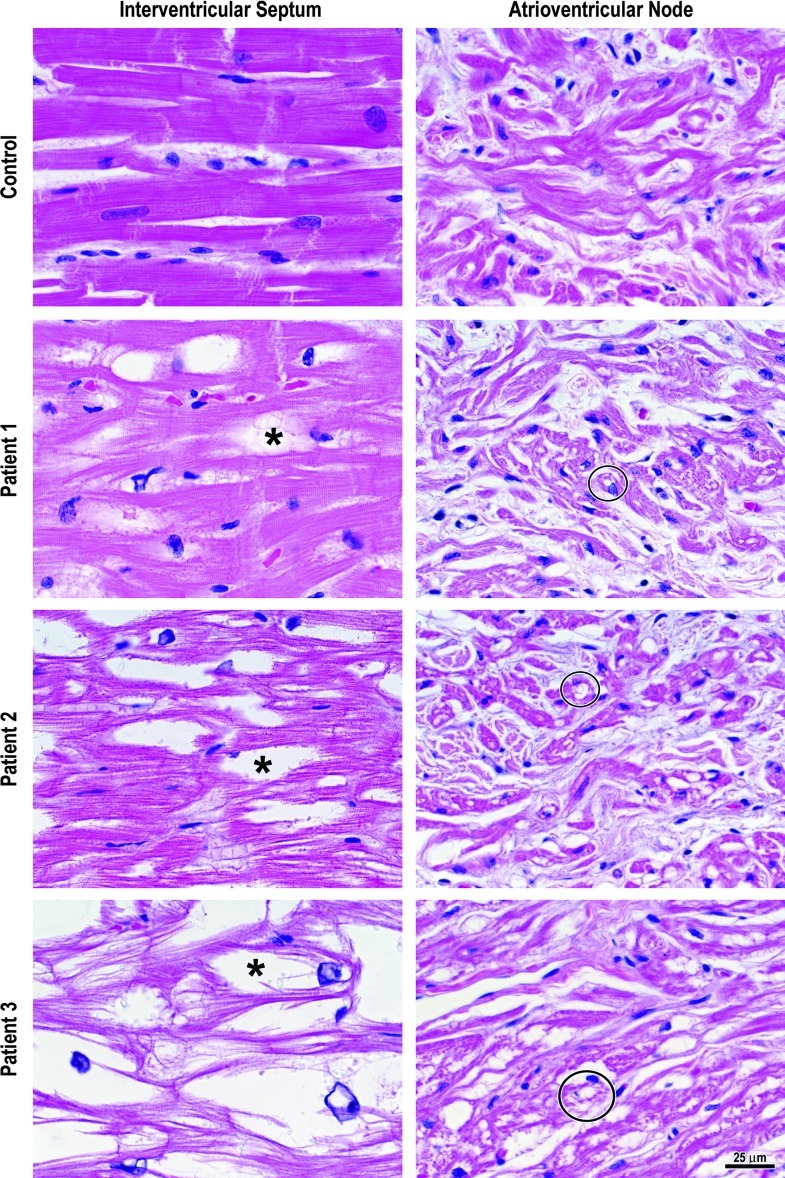
Fig. 1
Fig. 1
Cardiac and AV node myocytes from a 22-year-old man with a normal heart (control) were without vacuolation. All three patients with GSD III exhibited some degree of vacuolation of cardiac myocytes (asterisk) due to glycogen accumulation and glycogen-induced vacuolation of the specialized myocytes of the atrioventricular node (circles)
Fig. 2
Fig. 2
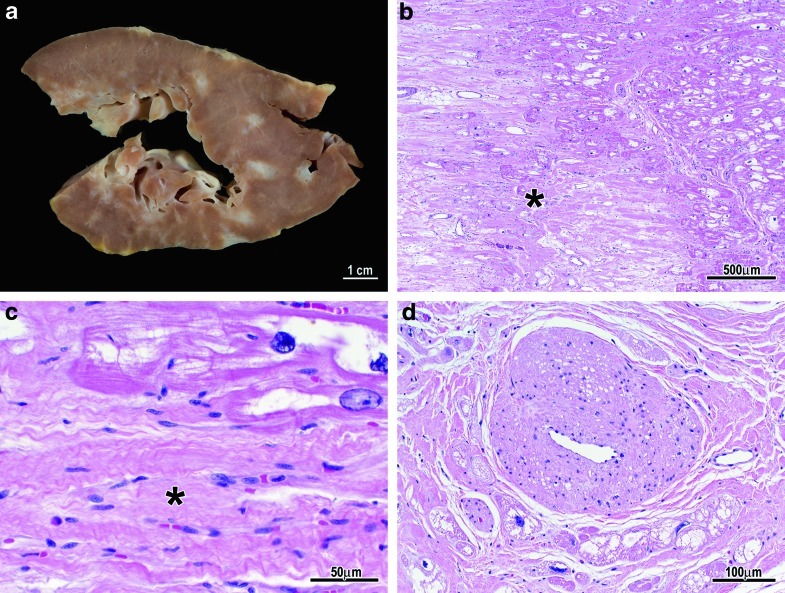
(a) Gross photo of scarring/fibrosis (white areas) in patient 3. (b/c) Photomicrographs showing dense fibrosis replacing myocytes (asterisk). (d) Fibromuscular hyperplasia of a small intramyocardial artery with marked luminal stenosis

References

    1. Akazawa H, Kuroda T, et al. Specific heart muscle disease associated with glycogen storage disease type III: clinical similarity to the dilated phase of hypertrophic cardiomyopathy. Eur Heart J. 1997;18(3):532–533. doi: 10.1093/oxfordjournals.eurheartj.a015283. - DOI - PubMed
    1. Ansong AK, Li JS, et al. Electrocardiographic response to enzyme replacement therapy for Pompe disease. Genet Med. 2006;8(5):297–301. doi: 10.1097/01.gim.0000195896.04069.5f. - DOI - PubMed
    1. Arad M, Benson DW, et al. Constitutively active AMP kinase mutations cause glycogen storage disease mimicking hypertrophic cardiomyopathy. J Clin Invest. 2002;109(3):357–362. - PMC - PubMed
    1. Arad M, Moskowitz IP, et al. Transgenic mice overexpressing mutant PRKAG2 define the cause of Wolff-Parkinson-White syndrome in glycogen storage cardiomyopathy. Circulation. 2003;107(22):2850–2856. doi: 10.1161/01.CIR.0000075270.13497.2B. - DOI - PubMed
    1. Arad M, Maron BJ, et al. Glycogen storage diseases presenting as hypertrophic cardiomyopathy. N Engl J Med. 2005;352(4):362–372. doi: 10.1056/NEJMoa033349. - DOI - PubMed

LinkOut - more resources