. 2013 Mar 5;110(10):3760-4.
doi: 10.1073/pnas.1219591110. Epub 2013 Feb 19.

Worldwide data sets constrain the water vapor uptake coefficient in cloud formation

Affiliations

Worldwide data sets constrain the water vapor uptake coefficient in cloud formation

Tomi Raatikainen et al. Proc Natl Acad Sci U S A. .

Abstract

Cloud droplet formation depends on the condensation of water vapor on ambient aerosols, the rate of which is strongly affected by the kinetics of water uptake as expressed by the condensation (or mass accommodation) coefficient, αc. Estimates of αc for droplet growth from activation of ambient particles vary considerably and represent a critical source of uncertainty in estimates of global cloud droplet distributions and the aerosol indirect forcing of climate. We present an analysis of 10 globally relevant data sets of cloud condensation nuclei to constrain the value of αc for ambient aerosol. We find that rapid activation kinetics (αc > 0.1) is uniformly prevalent. This finding resolves a long-standing issue in cloud physics, as the uncertainty in water vapor accommodation on droplets is considerably less than previously thought.


Conflict of interest statement

The authors declare no conflict of interest.

Figures
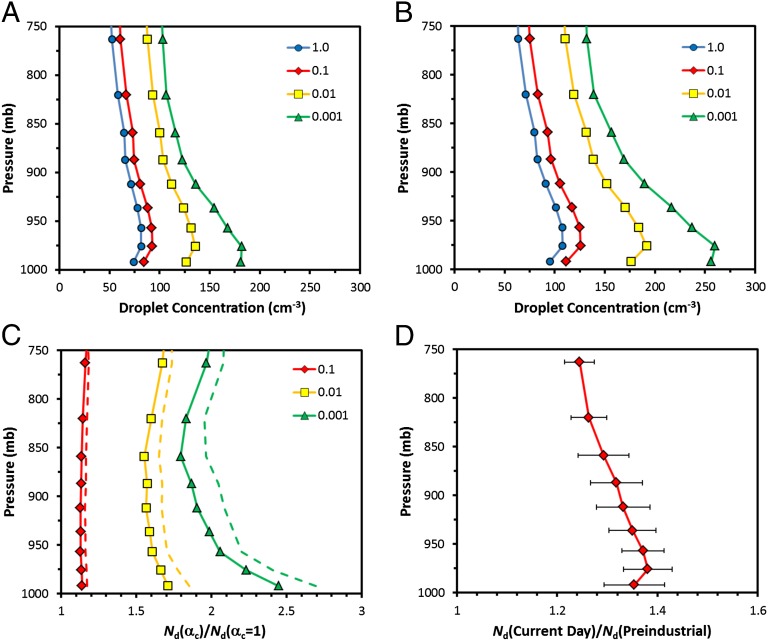
Fig. 1.
Fig. 1.
Global annual average vertical distributions of cloud droplet number concentration (Nd) computed with the NCAR Community Atmosphere Model 5.1 for (A) preindustrial emissions with fixed αc and (B) current-day emissions with fixed αc. (C) Nd for fixed value of α normalized by those computed for αc = 1 for preindustrial (solid line) and current-day (dashed line) emissions. (D) Nd for current-day emissions normalized with those for preindustrial emissions. Curve represents average of all constant αc simulations, whereas error bars reflect the corresponding SD.
Fig. 2.
Fig. 2.
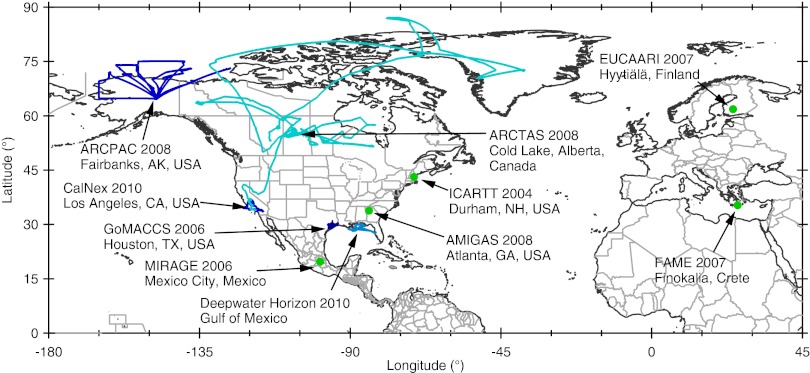
Campaign sites (green markers) and flight tracks (light and dark blue lines) of the globally representative data sets considered in this study. Analysis of the data sets is presented in SI Text and in previous publications (–16).
Fig. 3.
Fig. 3.
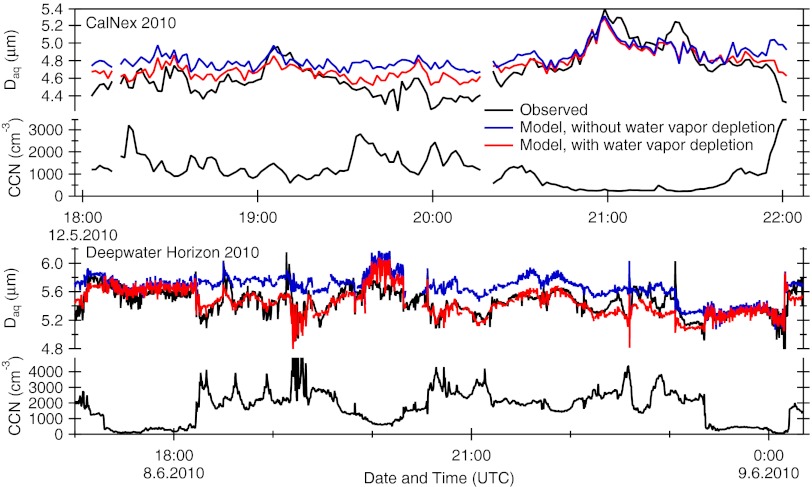
Characteristic observed and predicted time series of number-average droplet diameter for αc = 0.2. Constant 1- and 2.3-μm offsets were added to the observed droplet sizes from the CalNex and Deepwater Horizon campaigns, respectively. The Deepwater Horizon data are from ref. . Neglecting to simulate the supersaturation depression from condensation of water vapor on CCN leads to a larger and considerably less variable predicted mean droplet size than observed. Depletion effects are more prominent for DWH because the presence of coarse mode sea salt leads to larger-size droplets that cause greater total condensation and water vapor depletion for a given particle concentration. In both data sets, applying TDGA would misidentify the presence of slow growth kinetics.
Fig. 4.
Fig. 4.
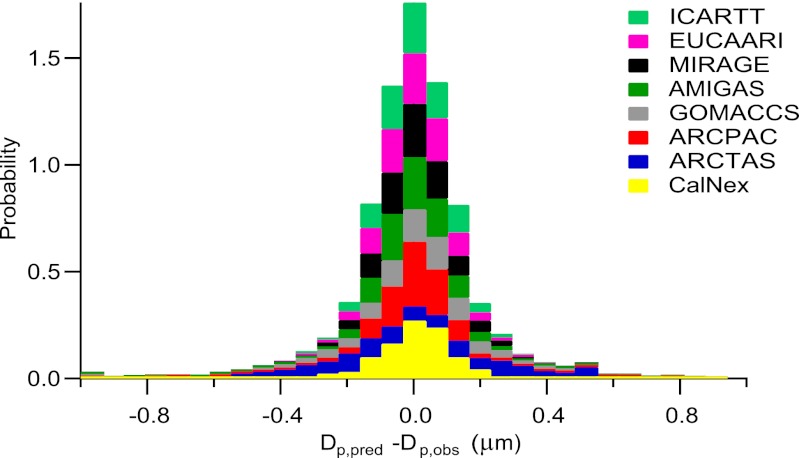
Probability density distributions of the difference between average predicted (αc = 0.2) and observed droplet diameters in the CCN instrument for all the data analyzed in this study. The observed droplet sizes are corrected for a constant bias expressing droplet sizing shifts in the CCN instrument and model prediction uncertainties, as described in SI Text. For all the data shown, predicted droplet size exhibits variability that is within instrument uncertainty, meaning that the effective uptake coefficient is effectively constant for all the data. Combining the results of TDGA on the same data leads to the conclusion that rapid droplet growth kinetics (with αc between 0.1 and 1.0) is globally prevalent.

References

    1. Intergovernmental Panel on Climate Change (IPCC) 2007. Climate Change (The Physical Science Basis. Contribution of Working Group I to the Fourth Assessment Report of the Intergovernmental Panel on Climate Change (Cambridge Univ Press, Cambridge, UK)
    1. Kolb CE, et al. An overview of current issues in the uptake of atmospheric trace gases by aerosols and clouds. Atmos Chem Phys. 2010;10(21):10561–10605.
    1. Mozurkewich M. Aerosol growth and the condensation coefficient for water: A review. Aerosol Sci Technol. 1986;5(2):223–236.
    1. Feingold G, Chuang PY. Analysis of the influence of film-forming compounds on droplet growth: Implications for cloud microphysical processes and climate. J Aerosol Sci. 2002;59(12):2006–2018.
    1. Takahama S, Russell LM. A molecular dynamics study of water mass accommodation on condensed phase water coated by fatty acid monolayers. J Geophys Res. 2011;1116(D2)

Publication types